Showing posts with label Professional Development. Show all posts

Wednesday, February 22, 2017

Silly Songs Boost Memory

Using silly songs can help books your students' memories and improve their test scores. Raki's Rad Resources will be hosting a Facebook Live Video on this topic on February 23, 2017.

Memory tricks, mnemonics, hand movements, dances; every teacher I know has a few tricks up her (or his) sleeve to help their students remember things. For me it's silly songs. Some songs I find online, some songs I've learned from other teachers and some songs I make up (often on the spot in front of my kiddos). Each year I seem to add more songs to my repertoire. Now that I have been teaching over 10 years, I feel like I should have a song for everything, and yet I've added 3 more just this month!

I tell my students that these songs are meant to get stuck in your head like the commercial songs that you sing without really meaning to. My explanation is that on test day I can't give them hints, but they can remember the songs and that will be like me giving them a hint. The songs help them remember specific things, and so we focus on making sure they know what the song MEANS and not just memorizing the words. For this reason, I have found that the simpler the song the more helpful to the students.

Some of my favorite copyrighted songs are the grammar songs by Shurley English. They are catchy and get stuck in your head so bad I am often still singing them while I'm cooking dinner! But the ones the students remember the most are silly things like "A, B, C, 1, 2, 3, that is where you're comma should be!" which I learned from my mentor teacher while I was student teaching. This song is sung to a Jackson 5 tune and used when we are trying to figure out where to put a comma in a number with at least 4 digits.

I can promise you that often when I am singing these songs I feel like an idiot. I really hate when my instructional coach decides to walk in while we're singing. But then on test day I love watching the students sing these silly little songs in their head. I love seeing the "aha!" moment when the song actually helps them. This makes all of the silly embarassing moments completely worth it.

Since it's hard to really share these songs in a blog post, I have decided to try out my first Facebook Live Video. Tomorrow evening (Thursday, February 23, 2017) around 6pm MST/ 8pm EST I will share a video with you of all kinds of silly songs that I use in my classroom. So even though I know I'll feel silly, please tune in at my Facebook Page and see if any of these songs could be a good memory jog for your students. 


Saturday, February 11, 2017

Low Level / Low Income Students Need Projects Too

Why we should use project based learning with our low level students - a research based presentation from a teacher in a low income school - Heidi Raki of Raki's Rad Resources.

In my experience, I have found that low level / low income students often don't get access to the same projects and higher level thinking activities that their higher level / higher income peers do. Mainly this is because teachers feel like there isn't time for those things when students are behind in basic skills. So instead, we spend a lot of time drilling and skilling low level students in hopes that they will remember those basic facts because of the repetition. 

Now I'm a big fan of repetition. I use it in certain ways in my classroom. It's great for building math fact fluency or memorizing site words. It can also be helpful for building classroom routines. But, it's not the end all and be all of education. In fact, it often leads us to the quote "Doing the same thing over and over again, but expecting different results is the definition of insanity."  Understanding content and using critical thinking skills to solve a problem do not come from drill and skill repetition. Those types of understanding come from making connections between what we already know and what we are learning.

Why we should use project based learning with our low level students - a research based presentation from a teacher in a low income school - Heidi Raki of Raki's Rad Resources.

Brain based learning research shows us that students need to be able to connect what they are learning with background knowledge in order to understand and remember what they are reading. One thing that many of our low level students are lacking is background knowledge. So realistically the best thing we can do to help our low level students is to build their background knowledge. Student will more background knowledge learn faster. As teachers we know this to be true because we see it in our classroom all the time. I can personally think of multiple students in my classroom right now who do better not because they have better processing skills but because they have more background knowledge to connect to. 

Projects are a wonderful way for students to build their background knowledge. They are also a wonderful way for students to make connections between different background knowledge that they already have because projects ask them do work with multiple different skills and concepts simultaneously. 

Another thing that brain based learning research shows us is that students (and people in general) remember things better if they are invested in them. The choices that projects allow students make it more likely that they will be invested in these learning experiences. For example, my students who are working on country study projects have chosen their countries for their own personal reason. This gives them buy in and personal investment in their learning, ownership if you will. How many students take ownership for drill and skill worksheet learning?

Why we should use project based learning with our low level students - a research based presentation from a teacher in a low income school - Heidi Raki of Raki's Rad Resources.

Maria Montessori is famous for developing a hands-on curriculum that gets students engaged in learning through real life projects like cooking meals. Few people remember that her first famous schools was in a poor, inner city area of Rome. She saw unprecented growth in students of low income, low background knowledge and low academic levels. Why then are our American Montessori schools private and geared towards middle to high income students? Why are we not using the Montessori methods, or at least project based learning, in our low income/ low level schools with the kids who need these methods most?


I teach in a school like this and I try to incorporate as many projects as I can. Here are a few of the projects I have used this year with my 3rd graders:

Why we should use project based learning with our low level students - a research based presentation from a teacher in a low income school - Heidi Raki of Raki's Rad Resources.


Why we should use project based learning with our low level students - a research based presentation from a teacher in a low income school - Heidi Raki of Raki's Rad Resources.

Why we should use project based learning with our low level students - a research based presentation from a teacher in a low income school - Heidi Raki of Raki's Rad Resources.


Why we should use project based learning with our low level students - a research based presentation from a teacher in a low income school - Heidi Raki of Raki's Rad Resources.

What projects are you going to do with your low level/ low income students?


Thursday, June 16, 2016

Data is Dangerous for Students


Why data is dangerous for students - one teacher's observations about how data affects her students - opinion piece from Raki's Rad Resources

Data, data, data. The world of education is currently ruled by data. Data is a way to show that students are “growing” and prove that we are doing what is right for the students.

I know that data is supposed to be the lifeblood of education, but I have a few specific qualms with data:

1.)   Time lost for instruction and planning – In order for data to be valid you must have multiple data points. This means taking time during class for students to take multiple assessments and then taking planning time to analyze and triangulate data. Often once we are done analyzing and triangulating data, creating graphs and working through the steps to figure out who needs help with what, we come up with a list of students that we could have predicted from basic classroom observations. So while it’s nice to have “proof” that what we’re doing is correct, is all that time spent really necessary to tell us to do what we would have probably done anyways?

2.)   Increased student anxiety – Kids know that these tests they take are being tracked. Even if we take the time to tell them that these are just checkpoints and nothing for them to stress over, (which is often a lie because more and more decisions are being made that affect student and teacher careers based off of assessments that were only ever meant to inform instruction) students worry about how they are doing. Or the flipside happens and students just start to have the idea that they will never hit the milestone or pass the test and so they begin to not even try.

3.)   Students and teachers are being punished for things outside of their control – Teaching in low income schools, I know that the playing field is not level. Many students from low income areas come in without the same background knowledge that their high income peers come in with. This means that their reading comprehension is affected, and that they will not have the same understanding of basic principles of math as other students. This does not mean that they cannot learn, by any means. However, it does mean that they will often score lower on standardized assessments. Because they traditionally score lower, low income students are often subjected to more test prep and boxed curriculum that is “research based”. What they do not receive is what they were lacking in the first place – experiential knowledge. The more assessments we have to prep them for, the less time there is for giving them exposure to quality literature, field trips and science experiments. Holding teachers responsible to student growth on these tests creates an environment of anxiety and resentment and often leads the best teachers to flee the schools that need them the most.


Unfortunately as teachers, even though we know these facts, we have very little control over what is expected of us in regards to data. We do have control over our attitude towards data, especially when dealing with our students. We need to stress to the students that data is not the sum total of who they are. Data is simply a checkpoint to see if we’re on the right track. Students should have access to the data, but it should not be the focus point of their every day. If we as teachers take the focus off of data and put the focus onto learning, the students will follow our lead.

We also need to be advocates for our students, as much as we possibly can. This is becoming more and more difficult because advocating for our students often means putting ourselves and our livelihoods at risk. We give students tests we don't agree with because to refuse to give the test would mean losing our jobs. However, the more outspoken we are about using data collection correctly, the more likely that policy will eventually change to benefit our students. Even if it's just within your classroom or your school, pushing for one less test or one more appropriate reporting method, you can still be an advocate for your students. Push them and society to see that students are more than just a test score!

I recently read the articles What's at Risk When Schools Focus Too Much on Student Data? and How Some School 'Data Walls' Violate US Privacy Laws which have some great additional points on why the focus on data is getting to be dangerous for our students. As you are finishing up this school year, or preparing for next school year, take some time to think about how you are using data and how you are advocating for your students. What do you want to continue doing? What do you want to change? As teachers our focus should always be on how we can help our students as much as possible. Sometimes our own reflections can give us a better understanding of this than all of the data graphs in the world.


Wednesday, January 13, 2016

5 Ways to Use Test Results WITHOUT Adding Them to Your Grade Book


Tests have become such a hot ticket topic in education. In previous blog posts like What’s Wrong with Standardized Testing and Why Projects are Better than Tests, I have discussed my feelings about standardized testing and testing in general. However, tests can serve a vital purpose in the learning process, especially if they aren’t entered into a grade book. Once we write a grade into our grade book, it means that the learning has stopped. However, we can take the results of tests and use them to drive our instruction and be sure that learning is complete. In order to do this properly, we ideally give our test a week or so before we wish to be “done” teaching a certain topic. Or we allot a portion of our instructional time to continue working on skills that have not yet been mastered. Then we take the test results and use them to drive our instruction.  After the additional instruction time, another test can be given, or even better a project, if a grade is needed.


Five ways to use tests without entering them into your grade book - Use your assessments to drive your instruction. Ideas from Heidi Raki of Raki's Rad Resources


Here are five different strategies that you can take your test results and use them to drive your instruction:

1.) Conference with your students – Take time to sit down with each student to review their results. Talk about both strengths and weaknesses and set specific goals for the next step in their growth. We most commonly do this with reading and writing, but the same concept can be used for many subjects. For example, on a Social Studies test, you might discuss with students the topics that they struggled with on their assessment and suggest (or assign) further research into that topic. In Math, you might suggest a problem solving strategy that would better suit them or point out a simple misconception that they have and suggest ways to correct it.

2.) Create small groups – Take your assessment and create a list of skills or topics that were assessed. Then, review your assessments to see which students are still struggling with which skills or topics. Using this information, create temporary small groups based on the needs of individual students. Use these groups to work on that specific need. These groups might each meet with you or they might be given targeted assignments to help guide them through conquering those missing skills.

3.) Allow students to correct their own mistakes – Give students back their tests with the incorrect answers circled, but no clues given as to the correct answer. Ask students to correct each question, allowing them to use notes, books and additional research. Ask students to do their corrections in color or on an additional piece of paper to prevent a confusion of original answers and corrections. During the process, students will reflect on their own learning and recognize the gaps that they need to fill. 

4.) Create need based activities or projects  - If the majority of your students are lacking on a specific skill based on test results, create activities, lessons or projects that will help the students have additional time to work with the concept. For example, one year my students were struggling with long operations – addition, subtraction, multiplication and division. So I sat down and created a project to help them work on these skills in a real life setting. The resulting project was my balanced checkbook project. This project forced them to use the operations in different ways, but they were so excited to figure out their weekly salary and get spending that there were no qualms and they had a much better understanding by the end of the project.

5.) Provide tiered assignments – For single skill assessments, tiered assignments can come in handy. Students all continue to work on that skill after the test, but they work at a different level depending on their test score. If they have mastered the skill, they are given extension activities to push them into higher level thinking skills. If they have not mastered the skill, they are given time to review. If they have grasped the skill, but not mastered it, they are given time to practice.
Tiered math activity - subtraction with regrouping - free download from Raki's Rad Resources.
One way I used to do this was with the prove it, solve it, fix it approach. In this strategy, all of the students are given a paper with a set of problems. ( I usually used this in math, but it could be done in other subjects as well.) The lowest level students are given the set of problems with the answers provided. They are asked to prove that those answers are correct. By having the correct answer already, the pressure to get the right answer is off and the students have a chance to focus on the process, which is more important anyways.
Mid level students are given the same problem set and asked to solve each problem. This gives them a chance to continue practicing the skill. Higher level students or students who seem to have mastered the skill work on the fix it level. They are given the same problem set, but with incorrect answers. The answers preferably have common mistakes that teachers see regularly with that skill. The students at this level then try to figure out how the students got the incorrect answer and then fix it. Students at this level build higher level thinking and continue working on the skill at another level. You can download a subtraction with regrouping prove it, try it, fix it sheet for free from my Teachers Pay Teachers store to check out this strategy further.

How do you use test scores to drive instruction in your classroom?

Tuesday, October 13, 2015

Students Need to Work on the Writing Process Every Day

While some students are born communicators, few are born writers. Writing is an essential skill to be a successful student and to be a successful adult. Learning to write takes time, so we need to give students the opportunity to practice all steps of the writing process multiple times over the course of the school year. In fact, the Institute of Education Sciences advises that students should work on writing for at least an hour each and every day starting in First Grade. This time does not all have to be dedicated to writing for writing sake, it can be included in your content areas or be a response to a book you read. However, the Institute of Education Sciences also says that students need regular practice in the writing process. Students need to take their writing through all of the steps so that they can internalize the process. Students who have internalized the process will be more successful when it comes time to write college essays and professional papers.


How to thelp students work on the writing process - blog post with instructional ideas from Raki's Rad Resources.


In my classroom, the students work through all of these steps within any two week period. It is important that they work through all of these steps: 

Brainstorming – Students need time to think out their ideas before they begin to write. For young students this starts out as simply as a bubble map or a list of ideas. Older students can take it to the next step by adding an additional layer of detail bubbles, or by creating an outline.

 Drafting – Writing, sitting and getting the ideas in order is hard. This step takes a lot of time and energy for children. Putting it all down on paper is often the hardest part. Additionally students often think that once they are done writing, they are done and should not have to work on their story anymore. In reality we know that the drafting stage will often be revisited after revising. Realistically,drafting and revising is very circular. It is important to teach students about this circular process before they begin writing. Give them a heads up that they are not done just because they write “The end.”

 Revising – Both revising and editing happen after drafting, but it is important that students know the difference between revising and editing. Revising is the restructuring of wording and ideas, not the spelling and grammar. Revising works on story flow, sequencing, word choice and focus. When students have finished revising, they will probably need to go back to drafting. It can be a very circular process, but the ideas and words should be done to satisfaction before students begin editing.

 Drafting and revising should happen in a circular pattern - blog post with instructional ideas from Raki's Rad Resources.

 Editing – Editing is the process of fixing spelling and grammatical errors. This is the time to fix sentence structure, capitalization errors, punctuation errors, and spelling mistakes. Editing really should not happen until the revision/drafting cycle is complete. The only exception is in cases where the grammatical errors cause students to be unable to read their own work and are therefore unable to revise their work.

Conferencing – Before students publish any piece of writing, they should conference with peers and/or a teacher. This is a chance for students to get feedback about their work. Students should have already fixed the majority of their errors, but this is a time to help them continue to revise and edit. No matter who students are conferencing with, remarks should be made about both positives and negatives. I usually use the “Two glows and a grow” idea where so that students aren’t overwhelmed with a list of things they need to fix. After conferencing, students should go back to the revising and editing process. In some cases, they may also have to go back to drafting. This is still a working piece and they may conference on it multiple times.

 Publishing – I do not believe in having students publish every piece they write. Not everything that we write needs to be put on a blog or typed and hung in the hallway. Sometimes what we write is simply a way to practice skills or to help us remember something we learned. Instead of publishing each piece, I encourage students to learn from the mistakes they make in one piece when they write the next. Then, at the end of each genre of writing, they choose their “Prize Piece” and we do second round of revising and editing on this piece. We talk about the perfecting of the piece, and then they publish.


When teaching the writing process, it is important to teach students that the writing process is not linear, but circular. Some steps will get used multiple times for a single piece of writing. Building this process into our students helps encourage them to do their own revising, their own editing and their own “perfecting”. These skills are important, especially to students who will go on to write papers in high school and college, let alone at a professional level.

 

students need to practice different genres of writing - blog post with instructional ideas from Raki's Rad Resources.


The Institute of Education Sciences also recommends that students write for a “variety of reasons”. Students need to know how to write in many different ways. This is why I teach students different genres. Writing a friendly letter is very different than writing an informational report which is very different from writing a poem. Students need to learn the techniques that are important in each specific genre. Just like students need to repeat the writing process multiple times, they also need to write multiple pieces in each genre. It is important for students to be able to take what they learned from writing one piece and use it to improve the next piece that they write in that genre. This is why I developed my genre based writing journals.

Each of my journals has nine possible writing prompts dedicated to one genre. Each prompt walks students through the entire writing process, including some form of reflection for conferencing. For primary students, that is a checklist form of rubric. For intermediate students, that is a category form of rubric. When I use these prompts with my students, not every student works on the same prompt at the same time. Instead, I let students choose the prompts that interest them and work at their own pace. Because each students’ drafting/revising circle may not end at the same time, this is a huge benefit to the children who need more time and the children who finish quickly. If a student completes their work work with quality work, they can move on to the next prompt without waiting around for their classmates. If a student needs more time, they can continue to work at their own pace. Some students will complete all nine prompts, but I always make it clear that you are not expected to. Instead I expect them to complete three to six quality writing pieces per genre. This gives students a good balance of structure and freedom.

 If you are interested in using my writing journals in your classroom, you can find both of these year long packets at my Teachers Pay Teachers store. Each journal is also sold separately if you need just one genre:
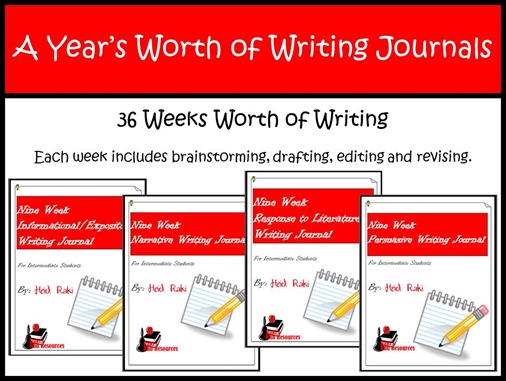
A Year’s Worth of Writing Journals - narrative, informational, persuasive and response to literature writing journals for intermediate grades - 3rd grade, 4th grade, 5th grade

A Year’s Worth of Writing Journals - Primary - fiction, informational, narrative and opinion writing for primary grades - Kindergarten, 1st grade, 2nd grade

I’d love to hear about how you practice the writing process in your classroom. Feel free to leave me a comment! Happy Teaching!

Heidi Raki of Raki's Rad Resources

Friday, October 9, 2015

Give More Feedback and Fewer Grades

What do grades provide to students? Does that number actually help students improve? In reality grades are nothing but a way to tell students where they stack up among other students. This is the reason there is a whole movement going on in education called Teachers Throwing Out Grades. I was first introduced to this group by a Cult of Pedagogy podcast, where the host, Jennifer Gonzalez interviewed Starr Sackstein, one of the teachers leading this movement. I have since joined the Teachers Throwing Out Grades Facebook Group.
Rubrics are Better Than Grades. They give students more information about how to improve instead of giving them a way to compare themselves to others. Opinion from Raki's Rad Resources.
Reading what these teachers have to say made me realize that I was doing a “no grades classroom” without realizing I was doing it. Even before I started working in a school with a standards based report card, I taught using rubrics and conferences and took as few grades as possible in order to give students as much time as possible to learn and grow. Once I started working in a school with standards based report cards, I graded less and conferenced more. Using rubrics instead of number grades allows you to give students real feedback on where they are strong and where they are weak. This information gives the students a roadmap as to what they need to do in order to get better. Rubrics should list out the most important skills that you want to assess. They can be extremely long or extremely short. Here are a few examples of rubrics I use with my students:

Rubrics are Better Than Grades. They give students more information about how to improve instead of giving them a way to compare themselves to others. Opinion from Raki's Rad Resources
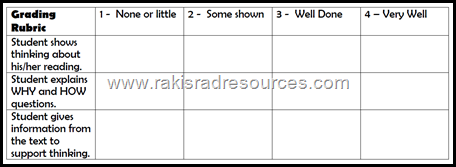
This rubric is from my 36 Week Reading Response Journal where students complete a written response to a student selected book each week of the school year. The students have all week to complete this during their literacy “stations” or as we call it “to do list time”. (For more information, see this blog post about why I don’t do center rotations.) Then for the last hour of Friday’s literacy time, I sit with each student. During this time, we do a fluency check recording (For more information on fluency check recordings, see this blog post about using Evernote to collect data.) and we conference about their reading response. At this time we fill out this rubric together.

Rubrics are Better Than Grades. They give students more information about how to improve instead of giving them a way to compare themselves to others. Opinion from Raki's Rad Resources
This rubric is from my Problem Solving Path Math Journals. For each problem the students and I evaluate their work. We discuss from the beginning of the year that the rubric is specifically weighted so that work is more important than the correct answer because the skills that these journals should enhance is working out word problems.

Rubrics are Better Than Grades. They give students more information about how to improve instead of giving them a way to compare themselves to others. Opinion from Raki's Rad Resources
This rubric is from my Primary Writing Journal. It’s actually two rubrics, one for the student to self reflect on their writing and a second one for the teacher to use during conference. When I taught first grade, these made such a huge difference for my students.

Rubrics are Better Than Grades. They give students more information about how to improve instead of giving them a way to compare themselves to others. Opinion from Raki's Rad Resources
This rubric is from my Desert Research Project where students research one specific desert and create a presentation to teach the rest of the class about their desert. I filled out these rubrics while the students presented their projects and then sat down with each group to review where they were strong and where they were weak so that they could know where to focus on their next presentation.

Rubrics are Better Than Grades. They give students more information about how to improve instead of giving them a way to compare themselves to others. Opinion from Raki's Rad Resources
This detailed rubric is from my Amazing Americans Technology Project. Students are expected to create an informational power point using the information they research about a specific person in American history. The rubric covers all of the pieces of solid writing, giving students a lot of information about their work.
When it is necessary to give a graded test, I sit down afterward with each student and conference about where they are strong and where they are weak. I tell them what we still need to work on. Then, I use the results to form small groups and work on re-teaching. The kids know that these groups are formed based on their needs and that we will work until they have mastered the topic to my satisfaction. This changes our focus from a specific grade to a learning goal with standards that we have to master.
At the end of each school year, my students spend time reflecting on their work. This use these reflections to build an online portfolio. They choose their own writing samples and projects that best reflect their capabilities. These portfolios also include written student reflections. Portfolios give a much clearer picture of where a student is than the numbers that come back from their standardized tests. For more information on how I help my students build their portfolios, you can check out the blog post:   or you can download my Student Created Portfolio Guide.
Rubrics are Better Than Grades. They give students more information about how to improve instead of giving them a way to compare themselves to others. Opinion from Raki's Rad Resources
If it was up to me there would be no grades and no standardized testing. I would replace these things with rubrics and portfolios and discussions about the learning that is happening. Give students more feedback and less grades and see their focus turn towards learning and personal growth and away from competition and complaints. So what about you, do you prefer grades or rubrics? Please feel free to leave your point of view in the comments. Let’s start a discussion about what should be happening in classrooms.
Heidi Raki of Raki's Rad Resources

Sunday, September 6, 2015

Tips to Work Smarter, Not Harder This School Year

Main Graphic LaborlessHello everyone!

ARE YOU REAAADDDY!!!

It is FINALLY here!
 
Today I am linking with Laura from Where the Magic Happens, Krista from Teaching Momster, and Lisa from PAWsitively Teaching! I have joined forces once again with my bloggy friends to bring you the best, most amazing giveaway on this Labor Day weekend!
All of us have been thinking about  good ways in which to treat our readers and followers for Labor Day. We thought hard, and I mean it! Really, really hard… and decided that we can treat you to our best ideas to work smarter rather than harder… at school and home!

I know what it takes to be a great teacher, the stress, the time, the energy… I could go on and on! I also know that we crave time to ourselves and our families and our families crave time with us. So this blog hop will be all about giving you ways to work smarter instead of harder – both at school and at home.

So here we go!

Slide1
One of the smartest things I ever did in my classroom was to STOP grading every single paper. Plan ahead for which assignments will be graded, and focus on those. Everything else can be quickly checked over, graded by students or filed away as a “learning activity”. For me, the big projects, big tests and big essays get my undivided attention. I grade them, leave written feedback and conference with my kids about how they did. However, math textbook pages, vocabulary packets, reading response journals, and other daily tasks fall into one of two categories:


Category #1 – There is an answer key at the answer key station. Take a red pen and check yourself. (No pencils allowed at the answer key station.) If you don’t understand why you got a certain problem wrong, come see me and we’ll conference.Grade Fewer Papers by having an answer key station


Category #2 – Let’s look at this quick check rubric together. Did you meet all of the requirements we talked about? What can you do better next week? This takes about 2 minutes for your average student, can be done during independent work time, gives the kids real time feedback and means that you have less papers to grade later. (For a blog post on how I do independent work time that gives me time to conference with individual students check out this blog post – Why I Don’t Do Center Rotations.)Grade Fewer Papers by using quick rubric checks

Now just because I don’t grade every single paper doesn’t mean I don’t regularly look at my student’s work and make mental notes, or add to my Evernote files on each child. (See this blog post on How to Use Evernote for Your Gradebook.) I know where my kids are without having a huge list of scores for each and every paper. In fact the notes I make help me understand where I can help my students a lot better than a bunch of number scores. And when I go home, I take much less paperwork, which leads me to our next topic -


Slide2
At one time, I was that teacher who brought home a stack of papers every night. I began calling this stack my “guilt stack” because no matter what I did I felt guilty. If I went home and sat down to grade that stack of papers, I felt guilty for not spending more time with my kids. If I went home and never touched the stack of papers I felt guilty for not finishing my work. About the same time I stopped grading every piece of paper I decided not to take home any papers if I could help it. Now report card time sometimes found me bringing home a stack or two, but 90% of the time I left that stack of papers on my desk to be worked on during planning. This actually made me more aware of how I was spending my planning time, and helped lead to my decision to NOT GRADE EVERY PAPER.

Tips to achieving teacher life and home life balance

Now at home without a guilt stack I found myself able to spend quality time with my kids, to make healthier dinners and to exercise. We even started to do fun stuff in the evenings like going for walks and bike rides. Time with your family should not be an afterthought. Teaching is one of those jobs that can encompass every element of your life, unless you make a dedicated decision to have balance. Having balance is hard, but balance is something that we teach our students (and our personal children) by modeling it. And having balance is what keeps us sane so we can continue to be good teachers and good people for a long time. So leave your guilt stack at home at least 75% of the time and spend some time with family and friends.


Slide3
Reading Journal In section one I talked about using quick check rubrics to give your students feedback. Many of my resources have those quick check rubrics built into them. One of the best examples is my favorite is the Weekly Reading Response Journal. This journal gives students a new reading response prompt each week that can be used with pretty much an fiction book at almost any level. At the bottom of the prompt is your quick check rubric that can be used to help students stay on track. I always print and bind the journals at the beginning of the year and have a ready made reading comprehension independent work station for the entire year. Saves time and sanity in so many ways!


Top all these great tips and ideas with these top-notch prizes!

A $100 gift card to Amazon


A $50 gift card to TpT

Slide2

2 $25 gift cards to TpT
Slide1

1 $10 gift card to TpT
Slide3
 
Thank you for reading! And now don't be silly and get your hands all over this awesome giveaway!!


a Rafflecopter giveaway
 

Heidi Raki of Raki's Rad Resources

Thursday, May 28, 2015

Spelling is More Than Just Memorizing


I have been boycotting standard spelling programs for a long time. Memorizing a list of spelling words to regurgitate onto a Friday spelling test is rarely helpful to students. Often students do not remember how to spell the words one week later, and they definitely can’t use those words in their writing. Instead of memorizing a list of words, students need to know how to identify key spelling patterns and word work skills. This way, even if they haven’t memorized how to spell weight, they have a chance of remembering that EIGH can make the long A sound too. This is a skill that will be very important in both reading and writing.


Additionally, when students simply memorize a list of words they rarely understand the meaning of their words, which means they will rarely use those words in their independent writing. The entire purpose behind learning to spell words is to improve reading and writing skills. If students don’t know the meaning of the word, there is no purpose in memorizing how to spell it because they can’t use the word in their writing and it’s not going to help them better understand what they are reading. This is particularly important for ESL students and students from low income homes.  These students often have smaller spoken vocabularies and so they are often asked to memorize lists of words that they don’t understand. This turns into a time wasting exercise and we wonder why their vocabularies are improving so slowly. This is why I have turned my spelling instruction into vocabulary instruction for the past few years. Students learn vocabulary, which I feel is important, but they are also doing “spelling” which many parents and administrators feel is important. Everybody wins!


Even though we teach students spelling patterns, they will still make mistakes in their writing. However, students who have been taught to look at words for possible mistakes will have built up the ability to edit their own writing more proficiently. This is why my spelling assessments are not memorized lists where students write out words that I say – a skill that will rarely be used outside of school, unless your students are planning on becoming secretaries who take dictations. Instead, my students look at typed sentences with misspelled words in them. They then correct the misspelled word. This is a skill that will come in very handy as they edit their own writing, and possibly the writing of a peer.


Two years ago I began to put together some word work/ spelling/ vocabulary packets to help my students work on spelling patterns, vocabulary and editing skills all at the same time. Of course all of my students were not on the same level, so I went ahead and created four differentiated lists for each spelling pattern. This meant that the whole class could practice the same spelling pattern while each student worked at the correct level for them. It has taken time to put together these Differentiated Word Work Packets, but I am excited to say that I have finally completed 30 packets, each with five activities for each level, and put them together into a Year Long Word Work Bundle, which is now available in my Teachers Pay Teachers store.


Whether you choose to use my bundle or another set of resources, please be sure to teach your students spelling patterns, vocabulary meanings and proofreading skills, as all of these are vitally important to applying good spelling to student writing.


Monday, May 11, 2015

What’s Wrong with Standardized Testing?

What's wrong with standardized testing - a teacher's point of view editorial piece written by Heidi Raki of Raki's Rad Resources.

Recently, John Oliver put out a great video about standardized testing and how we use the information gathered from these tests. If you haven’t seen it, you can find it HERE:


In addition, I recently listened to Jennifer Gonzalez’s interview over at Cult of Pedagogy with Anthony Cody about standardized tests in coordination with educational policy, which you can find HERE.


These two resources made me start thinking about standardized testing much deeper. Being out of the classroom this year and having my own children homeschooled, we don’t have to deal with standardized testing much.  I never liked standardized testing when I was in the classroom, and often simply didn’t put much emphasis on it,choosing to do research projects instead of test prep during testing season. However, I’ve also never had my job depend on my students’ test scores.  I didn’t leave teaching or take my kids out because of testing, but now that we are out, I am seeing so many benefits from not having testing as a driving force in our learning environment. If they were to go back into a public school environment, I would definitely be opting them out of the test.

Here are the reasons why I don’t agree with standardized testing:

1.) Tests often occur four to six weeks BEFORE the end of the school year. This means that teachers are required to be done teaching all of their content at least a month before the end of the school year. Not only does this mean that curriculum is rushed through, it also leaves the impression with students and parents that when the test is done, school is done, which means the last six weeks of school can be a major classroom management nightmare. 

2.) Students and teachers NEVER get to see which questions students got right or wrong. Part of the reason for assessing is to know what students haven’t mastered, so that we can cover this material better. In my classroom, all in class assessments are reviewed in detail with students so that they can make corrections to their thinking, or even their test taking strategies. However, standardized tests are never reviewed, so they are there simply to judge students, not to help them.

3.) Standardized tests are often more of an assessment of a students’ background knowledge than of the content or skills that they are learning. This is why low income students traditionally score lower on these tests. They have different background knowledge and approach problems differently. It can also be a problem for kids on the other end of the spectrum. Students who are extremely well read and exposed often over think test questions because they know that things aren’t generally as simple as test questions want them to be.

4.) Current policies put so much pressure on students and teachers, that these tests are now taking center stage when learning should take center stage. I don’t do test prep if it’s not forced on me, but I have never had my job depend on my students’ test scores. I can completely understand how test prep has become a focus of our schools. I don’t think test prep helps students, but I can understand why it is so predominant now.

5.) All children do NOT learn at the same rate or with the same activities. Standardized testing is taking away individual learning. It doesn’t matter if Student A loves to read and learns to read quickly, but lags behind in math skills while Student B enjoys numbers and learns math and exceeds in math, but doesn’t enjoy reading fiction stories. Both students – all students – are expected to be at the same place at the same time, even though we all know that no children, and no adult for that matter, grows and changes at the same rate as other people their own age. Instead of embracing the differences that make us all unique, the testing push tries to stamp us all into the same person.


Portfolios should replace standardized tests - an editorial piece written by Heidi Raki of Raki's Rad Resources.


Portfolios should replace standardized tests - an editorial piece written by Heidi Raki of Raki's Rad Resources.Now I do understand the need for assessment and to show teachers and students that growth has happened over the course of a school year. I think that every students should have a portfolio – paper or online – that travels with them through their school career. This portfolio can be compared against “student norms” to see if students are below, on or above level in different subject areas. It can be used to create an instructional plan for students. It can allow for different students to excel in different areas and to be their own unique selves.

When I was teaching at a private school in Morocco, I started an online portfolio system with my 2nd –5th graders where students created their own portfolios. At the end of each school year, the portfolios were added on to in order to show student growth. The students had certain requirements, including a writing example from each genre and links to completed science and social studies projects. Then the students presented their own portfolios to their teacher and parents. These portfolios showed true growth and understanding over the course of a year, whereas test scores simply gave a snapshot of a single point in time. If you’re interested in using my Online Portfolio Format, you can find templates and instructions on Teachers Pay Teachers.

Heidi Raki of Raki's Rad Resources