Showing posts with label Vocabulary. Show all posts

Thursday, May 28, 2015

Spelling is More Than Just Memorizing


I have been boycotting standard spelling programs for a long time. Memorizing a list of spelling words to regurgitate onto a Friday spelling test is rarely helpful to students. Often students do not remember how to spell the words one week later, and they definitely can’t use those words in their writing. Instead of memorizing a list of words, students need to know how to identify key spelling patterns and word work skills. This way, even if they haven’t memorized how to spell weight, they have a chance of remembering that EIGH can make the long A sound too. This is a skill that will be very important in both reading and writing.


Additionally, when students simply memorize a list of words they rarely understand the meaning of their words, which means they will rarely use those words in their independent writing. The entire purpose behind learning to spell words is to improve reading and writing skills. If students don’t know the meaning of the word, there is no purpose in memorizing how to spell it because they can’t use the word in their writing and it’s not going to help them better understand what they are reading. This is particularly important for ESL students and students from low income homes.  These students often have smaller spoken vocabularies and so they are often asked to memorize lists of words that they don’t understand. This turns into a time wasting exercise and we wonder why their vocabularies are improving so slowly. This is why I have turned my spelling instruction into vocabulary instruction for the past few years. Students learn vocabulary, which I feel is important, but they are also doing “spelling” which many parents and administrators feel is important. Everybody wins!


Even though we teach students spelling patterns, they will still make mistakes in their writing. However, students who have been taught to look at words for possible mistakes will have built up the ability to edit their own writing more proficiently. This is why my spelling assessments are not memorized lists where students write out words that I say – a skill that will rarely be used outside of school, unless your students are planning on becoming secretaries who take dictations. Instead, my students look at typed sentences with misspelled words in them. They then correct the misspelled word. This is a skill that will come in very handy as they edit their own writing, and possibly the writing of a peer.


Two years ago I began to put together some word work/ spelling/ vocabulary packets to help my students work on spelling patterns, vocabulary and editing skills all at the same time. Of course all of my students were not on the same level, so I went ahead and created four differentiated lists for each spelling pattern. This meant that the whole class could practice the same spelling pattern while each student worked at the correct level for them. It has taken time to put together these Differentiated Word Work Packets, but I am excited to say that I have finally completed 30 packets, each with five activities for each level, and put them together into a Year Long Word Work Bundle, which is now available in my Teachers Pay Teachers store.


Whether you choose to use my bundle or another set of resources, please be sure to teach your students spelling patterns, vocabulary meanings and proofreading skills, as all of these are vitally important to applying good spelling to student writing.


Monday, April 27, 2015

ESL Vocabulary Packet Bundles for Your Classroom

In addition to running this blog, my RVing with the Rakis blog and homeschooling full time, I also create and sell resources that teachers can use in their classrooms and home schooling parents can use to help out their children.  To be fair, I am not creating nearly as many resources this year as I did in the past 9 years, for 2 reasons.  Reason #1 – I already have over 500 resources available in my Teachers Pay Teachers store, so much of what I need for my kiddos I have created already.  Reason #2 – I only have 3 students this year, so I have need of less resources.  However, I am going through resources that I made while I was teaching in a classroom full time and “cleaning them up” with clearer teacher directions, better fonts, etc.  I am also finishing out groupings or “series” that I have started and putting them into bundles so that teachers who are interested in buying multiple items from the same category have the opportunity to save some money.  For the next few weeks, I am going to spotlight some of these bundles here on my blog.

English Language Learners need differentiated vocabulary instruction. Build this into your daily routine with my Differentiated English Language Learner Vocabulary Packets. Resources from Raki's Rad Resources

Students who are learning English need to learn vocabulary. It helps them in reading, in writing, even in understanding math word problems. Of course after a year or two ESL students often appear to have a lot of vocabulary but are missing lots of words in comparison to their native English speaking peers. To address this issue, I spent a lot of my time in Morocco developing leveled vocabulary packets for my English Language Learners. By having four different levels, I could meet each of my students where they were instead of having some students lost while others were bored. For each level the students have five different activities where they practice spelling the words, identifying the words, using the words in sentences, and filling the words into blanks in passages using context clues. 


Recently I have gone through my ESL Vocabulary Packets and created bundles that would be appropriate for specific units. I am also working on filling in some missing packets that will eventually create 8 solid units that can be taught over the course of the year. These bundles allow me to provide a discount for my customers, and ensures that I will be fully prepared if and when I return overseas to teach, or even decide to teach in a public school here in the US. I am ESL certified, so I would probably end up teaching ESL students no matter where I end up.


Here are the bundles I currently have available:


All About Me, which covers Body Parts, Emotions, Family, Clothing and Heritage

English Language Learners need differentiated vocabulary instruction. Build this into your daily routine with my Differentiated English Language Learner Vocabulary Packets. Resources from Raki's Rad Resources - All About Me Set


My World, which covers My School, My House, My Bathroom, My Bedroom and My Planet

English Language Learners need differentiated vocabulary instruction. Build this into your daily routine with my Differentiated English Language Learner Vocabulary Packets. Resources from Raki's Rad Resources - My World Set


In the Neighborhood, which covers Careers, Plants, Tools, Transportation and Weather

English Language Learners need differentiated vocabulary instruction. Build this into your daily routine with my Differentiated English Language Learner Vocabulary Packets. Resources from Raki's Rad Resources - In the Neighborhood Set


In the Kitchen, which covers Kitchen Items, Protein Foods, Grain Foods, Dairy Foods and Fruits and Vegetables

English Language Learners need differentiated vocabulary instruction. Build this into your daily routine with my Differentiated English Language Learner Vocabulary Packets. Resources from Raki's Rad Resources - In the Kitchen Set


I hope these packets can help you and your students. Happy teaching and learning!

Heidi Raki of Raki's Rad Resources

Friday, January 9, 2015

Game Press – Use this iPad App to Create Your Own Video Games

Do Your Students Create Their Own  Video Games?  Stop by Raki's Rad Resources to find out why the should be and explore an easy iPad app called Game Press to make it happen in your classroom.


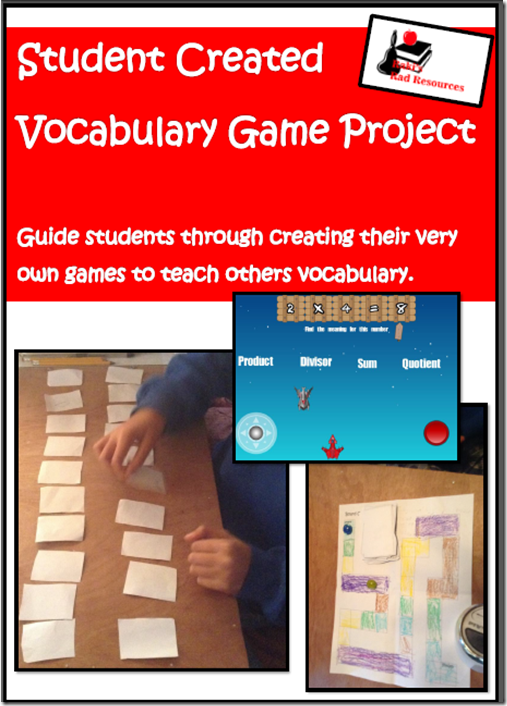
Last trimester, my kiddos created their own vocabulary games with my Vocabulary Game Creation Project to work on key math vocabulary.  My oldest son is a major techie and really wanted to create a video game.  I feel that it is super important for young students to be exposed to the basics of coding, so that they are continually realizing that they are in control of the computer and not the other way around.  Learning the basics of coding teaches students:

- trouble shooting skills (which we call critical thinking when applied to a math problem)

- logical thinking (also a math concept)

- cause and effect (literacy and science concept)

- patience and persistence (life skills)

- application and creativity


So when he asked to play around with creating a video game, we downloaded an app onto our iPad called Game Press, which he used to create his video games.  The app itself is free, but with the free version, you only have three possible levels to your game.  Each level is quite short, so this makes for very short games.  We chose to upgrade for $1.99 and give him access to unlimited levels.

Within the create mode, students design a background and add characters.

Do Your Students Create Their Own  Video Games?  Stop by Raki's Rad Resources to find out why the should be and explore an easy iPad app called Game Press to make it happen in your classroom.

Then, students can assign movements to characters and create simple “if…then” statements in relation to the characters, which will dictate the movement of the characters when someone plays the game.  These “if…then” statements are created by simply drawing lines between two or more behaviors.

Do Your Students Create Their Own  Video Games?  Stop by Raki's Rad Resources to find out why the should be and explore an easy iPad app called Game Press to make it happen in your classroom.

At any moment, students can play their own games, giving them a chance to see how their actions will play out in their game.  This try and check process is key to learning how to use any new piece of technology – and is conveniently an important skill in both math and science. 

Do Your Students Create Their Own  Video Games?  Stop by Raki's Rad Resources to find out why the should be and explore an easy iPad app called Game Press to make it happen in your classroom.

In today’s society, students need to learn not just how to use technology, but how to be in control of programming new technology.  Apps like Game Press help students begin to understand the concepts of coding without having to use a programming language.  This app would make a great addition to an after school coding class or an enrichment program, but it could also be used in a general education classroom.  Here are a few helpful hints if you plan to use it in your general classroom:

1.)  Model the basics for your students.  Project from your iPad if possible, or simply work on the iPad in front of the students.  This will help students know where to get started when they begin.

2.)  Allow students to work in groups.  This helps make the most of limited resources and allows students with more technology experience to become the “experts” who help the group.

3.)  Give early finishers a chance to use “play around” with Game Press and build their expertise.

4.)  Ask students to create a slide by slide plan for their game before they begin creating.

5.)  Set specific guidelines on what MUST be included in a completed game. 

6.)  Make the first game an ongoing project or a quarter or semester long project, so that students won’t feel rushed and will be encouraged to try new things, even if it means failing the first few times.

How could you use Game Press in your classroom?

Heidi Raki of Raki's Rad Resources

Friday, December 12, 2014

Let the Students Teach the Vocabulary Lesson

Teaching kids vocabulary is a critically important skill.  If you understand the vocabulary of any given subject, you will better be able to understand articles or textbook pages on the subject, lessons taught by the teacher, videos watched online and even the tests given on that subject.  There are tons of ways to practice vocabulary – practicing flash cards, playing games, writing sentences, etc.  However, we need to stop and ask ourselves, how much of this vocabulary do we want our students to remember?  In order to truly remember vocabulary words, students have to be doing more than reading the words, copying the definitions, or writing sentences with them.  True, a combination of these different activities will help memory.  This is the reasoning behind my ESL Vocabulary Packets and my Spelling Patterns Vocabulary Packets, giving students the ability to work with words in at least 5 different ways.

However, for key vocabulary words, especially in a content area like Math or Science, the best way for students to truly remember important vocabulary words is to create with them.  Students who create lessons, videos or games with their vocabulary words cement those words and their meanings into their memories because they have had to think about them to such an extent that their brain has carved out a special neurological path for them. 

vocab game

My sons created vocabulary games this trimester for key Math words.  My second grader created board games and memory games using the pieces in my Vocabulary Game project.  My 5th grader, however, got fancy and used an iPad app called GamePress to create three short video games with key vocabulary words in each of his languages.  Each of the kids tried out their games with each other, and with some friends who came over.  This gave them a chance to be the teacher, the expert and the one cementing these words into their memory.

Since my sons are learning Math in three languages – English, French and Arabic – vocabulary is especially important for them to understand what questions are asking of them.  The same can be said of our ESL population in public schools in the US.  Without these key words, students loose meaning in problem solving, on tests and in general lessons.

What vocabulary words could your students benefit from teaching others?

Heidi Raki of Raki's Rad Resources

Tuesday, October 14, 2014

TESOL Teaching Tip #53 - Talk, Talk, Talk, Let Kids Have Discussions

As a teacher at an International School, many of my students were English Language Learners. Even my native English speakers were living in a non-English speaking country. Due to my unique teaching position, I have had some readers ask for tips on teaching English Language Learners. Here is this week’s Tuesday TESOL Teaching Tip:


TESOL Teaching Tip #53 - Let students have and participate in whole class discussions. ESL and ELL students need to use their language well in order to become proficient. Stop by my blog - Raki's Rad Resources - for strategies on how to help your students build their proficiency.

Students learning a new language MUST hear and use that language A LOT in order to become truly proficient.  However, listening to a lecture does not teach students a language.  Neither does having them simply repeat random phrases or verb conjugations.  Instead, students need to be a part of purposeful conversation where they must listen for and use key vocabulary to keep the conversation going.  This is actually quite difficult for teachers because it means – KIDS NEED TO HAVE CONVERSATIONS!  This goes against the common purpose of most teachers – getting kids to be quiet.  Now, I don’t believe kids need to spend the entire day talking, but studies show that kids who engage in conversations regularly, build their vocabulary and usage rules much quicker than kids that don’t.
So, the million dollar question is:  How do you get your students to have conversation, and still maintain decorum in your classroom?

1.)  Have clear expectations - First and foremost, you have to be sure to set up procedures in your classroom which promote positive behavior during discussion times.  Give students the expectations before hand and take time to practice having discussions from the first day of school.

Let students have discussions to build listening and speaking vocabulary - ESL Tip from Raki's Rad Resources 2.)  Begin with a set schedule -  When you are first introducing the idea of discussions to your class, have a set time that this will occur each day.  I used to start with the 15 minutes following Read Aloud.  My students would have a guiding question, which they would answer in their Read Aloud Journal while they were listening to the story. (Focused listening is great for ESL Students – find more details in this Read Aloud blog post.)  After the read aloud was complete, they would have to share their information with 3 classmates in the form of three 5 minute discussions.  Then, we would share out our answers, but students had to tell me what one of their partners had answered, or a conclusion that two students had formed during a discussion – NOT what they had written on their paper.  By doing Read Aloud Discussions every day, at the same time, in the same way, students got comfortable with the idea of discussions within a month and then I could turn around and use discussions in other subjects, at other times, and in other ways.

3.)  Choose groups wisely – With very few exceptions, I NEVER let kids choose their own partner(s) for discussions.  Children tend to choose students who are at close to the same language level as their own, which does not provide students with a chance to grow as an English speaker.  Additionally, students will choose their friends and often get off task or cause any number of management issue.  This is true no matter what age you teach – I have even found it true when teaching PD courses to teachers. :)  Instead, I try to choose partners by pairing up native speakers and fluent speakers with beginning speakers.  I also try to change partners regularly.  In my Read Aloud Discussion example above, I would give each student three partners that they would keep for the week, and then change the partner groups each Monday.  Sometimes I would change all three partners, but more often I would change out one at a time, so that students had a balance of consistency and change.

4.)  Be a part of the discussion – Make yourself a possible discussion partner.  Remember, you are your students’ best role model.  They need time to talk to you and hear you speak just to them.  This practice also gives you a chance to clearly model your expectations to your students, and do quick informal assessments of where their listening and speaking skills are developing and where they are in need of more assistance.  (Anecdotal note time!)

Let students have discussions to build listening and speaking vocabulary - ESL Tip from Raki's Rad ResourcesNow, the second question I often hear from teachers is:  When in my lesson should I let students discuss?  There is no right answer to this.  Whenever and wherever it feels right to your class is when it should be a part of your lesson.  However, here are some examples of where I find it easy to fit in discussions:
1.)  Book talks – read aloud, guided reading, novel studies, etc.

2.)  To answer guiding or essential questions – for a unit, a lesson, or for the school year

3.)  To clarify a new idea or concept in math (or science, or history, or whatever subject you’re introducing new content in.)

4.)  After doing research – in a jigsaw technique, students can share the information they learned with others

5.)  When brainstorming answers to a problem – great for justifying the answer to a problem

6.)  During current events conversations in Social Studies – great for building on Point of View

7.)  While peer editing essays and stories – give and get feedback, quick and painlessly

8.)  When compiling lists of current background knowledge on a given topic – think the K in the KWL chart

9.)  To clarify the meaning of a video or lecture watched in class
10.)  During peer tutoring sessions – have students help each other to find the correct answer, but they must explain the correct way to find the answer, not do the work from them.

One of the best things about have student discussions is that you will find that students will begin initiating meaningful, English conversations on their own.
Heidi Raki of Raki's Rad Resources

Monday, August 11, 2014

The Purpose Behind Bulletin Boards

Despite the thousands of cutsie bulletin boards floating all over Pinterest, the true purpose behind bulletin boards is not to have the cutest room in the school.  The true purpose behind bulletin boards – as I see it – is to increase the learning opportunities for our students. Decorations for the sake of decorations do not help learning and often provide a distraction to students with ADD or other disabilities.

Bulletin boards should be educational, not decoration.  Stop by Raki's Rad Resources for ideas on how to make your bulletin boards more educational.

Bulletin boards:

1.  Should provide students with information that they can reference during lessons or centers.  Bulletin boards should be a part of the learning experience, not a decoration.

2.  Should be built with the students OR have an element that the students can interact with.  Either of these opportunities allow students to feel ownership for the board and encourages them to use the board rather than just be distracted by it.

3.  Don’t have to be changed every week or month.  Bulletin boards can be built slowly over the course of the school year, helping students to connect new knowledge to knowledge gained earlier in the school year.


Just because bulletin boards aren’t decorations, doesn’t mean they can’t be visually attractive.  In fact, good graphic design elements make bulletin boards easier for children to read and thereby more access to the information on them.  Here are a few examples of meaningful bulletin boards for your classroom:


Bulletin boards should be educational, not decoration.  Stop by Raki's Rad Resources for ideas on how to make your bulletin boards more educational.  Word Family word wall, with graphics to help out ESL students.

Word Family Word Wall – These Alphabet Labels, Sight Word Cards and Word Family Word Wall Cards help your students to sound out and recognize the meanings of common words.  Students refer back to this word wall during literacy centers, like read the room and journal writing.


Bulletin boards should be educational, not decoration.  Stop by Raki's Rad Resources for ideas on how to make your bulletin boards more educational.  Math Word Wall with definitions and graphics to help students understand key math vocabulary.

Math Word Wall – Math Word Walls should do more than simply list the important vocabulary words.  Definition cards, like those in my Math Vocabulary Packets (Addition & Subtraction, Multiplication & Division, Fractions, Geometry 1 and Geometry 2) give students the definition to refer to when they are stumped by those vocabulary words at math centers or independent problem solving


Bulletin boards should be educational, not decoration.  Stop by Raki's Rad Resources for ideas on how to make your bulletin boards more educational.  After students answer the questions in their Problem Solving Path math journals, they can check their answers using the QR codes on these posters.

Problem Solving Path – This interactive bulletin board displays the monthly word problems from the Problem Solving Path Journals, as well as giving students QR Codes to help them check their answers.


Bulletin boards should be educational, not decoration.  Stop by Raki's Rad Resources for ideas on how to make your bulletin boards more educational.  Build concept maps with key vocabulary, like the defintions of technology vocabulary.

Technology Word Wall – Word walls don’t have to be listed in alphabetical order.  For topics like technology, it’s better to group Vocabulary Word Wall Cards into connected words or concepts.  Add connecting words or ideas to help students make those connections when they are using the word wall later.


Bulletin boards should be educational, not decoration.  Stop by Raki's Rad Resources for ideas on how to make your bulletin boards more educational.  Use bulletin boards to create pictographs with data on student achievement - like success on mastering math facts.

Math Fact Reward Board – Students can track their own progress on math fact quizzes, and stay motivated to practice during math centers by having a math fact reward board with a fast fact reward system.


How do you keep your bulletin boards meaningful?

Heidi Raki of Raki's Rad Resources

Sunday, March 30, 2014

Introducing Greek Roots – Free Packet

On Monday, I had hernia surgery.  Since this was my second hernia surgery this school year, my husband has about strapped me to the bed so that I will recover fully and not push it too hard.  With all this time in bed, I have set out to try and finish making the vocabulary packets my students will need for the rest of the year.  I have completed two new ESL Vocabulary packets: Plants and Spring Holidays.  Over the course of the year, my ESL students have done 20 different vocabulary packets, including the topics: All About Me, In the Kitchen and Careers.

Free greek root word spelling and vocabulary packet to help elementary students analyze, understand and utilize words with the greek roots phon photo and graph - from Raki's Rad Resources.

Next, I set out to revamp my template for my Word Work Packets in order to begin introducing my students to Greek Roots.  Since September, my students have completed 20 different word work packets on long vowels, consonant patterns, vowel patterns and beginning/ending patterns (like prefixes and suffixes).  Now that we have covered all of the big word work topics, I would like my students to start looking at the roots that make up our words.  For my nonnative speakers, this will be a great time for them to look for cognates with common roots!  So for the next 10 weeks, my students will be looking at Greek and Latin roots that show up in our words.  We are starting out with the Greek roots: phon (sound), photo (light) and graph (write). 

I have switched up the packet a bit to allow students a day to “Analyze” their words by looking at the roots and predicting the meaning based on those roots.

Free greek root word spelling and vocabulary packet to help elementary students analyze, understand and utilize words with the greek roots phon photo and graph - from Raki's Rad Resources.

Then, on the second day, the students actually “Learn” about their words and this is the day we will use pictures, definitions, videos and real world examples to increase their understanding of the words.

Free greek root word spelling and vocabulary packet to help elementary students analyze, understand and utilize words with the greek roots phon photo and graph - from Raki's Rad Resources.

I have kept the third day the same – giving students a chance to sort their words based on the root.  From my experience, I have seen how important of a skill sorting words can be in helping students really recognize what is going on phonetically in a word.

Free greek root word spelling and vocabulary packet to help elementary students analyze, understand and utilize words with the greek roots phon photo and graph - from Raki's Rad Resources.

The fourth day is the students’ chance to write sentences with their words.  This is the same as the second day in my Word Work packets and the third day in my ESL Vocabulary packets.

Free greek root word spelling and vocabulary packet to help elementary students analyze, understand and utilize words with the greek roots phon photo and graph - from Raki's Rad Resources.

Finally, I have kept the fifth day the same as my Word Work packets, giving students a chance to view and fix misspellings of their words.  This is a very important editing skills for students to practice, as well as a preparation for many standardized tests that ask students to find the misspelled word.

Free greek root word spelling and vocabulary packet to help elementary students analyze, understand and utilize words with the greek roots phon photo and graph - from Raki's Rad Resources.

Like my ESL Vocabulary packets and my Word Work packets, each of my Root Word packets has 4 levels with each level increasing in difficulty, however the Root Word packets now have 12 words per level instead of 10.  For my multiage classroom, these 4 levels allow me to provide complete differentiation so that each child receives exactly what they need, while keeping us all pretty much on the same topic or word pattern.

Since the Greek Roots 1: Phon, Photo & Graph packet is the first in the series, it is completely free, so please feel free to download it.  If you’ve never used my vocabulary packets before, I have at least 2 free packets per series.  For ESL students, you can download School Supplies and Fruits and Vegetables completely free.  For Word Work packets (which focus on spelling patterns, but are geared for both ESL and general student populations), you can download Long I and L Endings completely free.

My vocabulary packets have made a world of difference for my students in reading and writing!  I am psyched to see how the root words affect their work.

Heidi Raki of Raki's Rad Resources

Tuesday, March 4, 2014

TESOL Teaching Tip #49 - ESL Students Need Real Life Experiences to Learn Vocabulary

As a teacher at an International School, many of my students are English Language Learners. Even my native English speakers are living in a non-English speaking country. Due to my unique teaching position, I have had some readers ask for tips on teaching English Language Learners. Here is this week’s Tuesday TESOL Teaching Tip:

 
TESOL Teaching Tip #49 - Use regalia and videos to help your esl or ell students understand vocabulary. Find specific tips on how to do this at my blog post - Raki's Rad Resources

ELL Teaching Tip of the Week: Use Regalia and Videos
I have had lots of teachers tell me that their English Language Learners don’t “get” the vocabulary they teach.  The first thing I ask them is “How many senses have your students used to understand their words?”  This generally gets me a puzzled stare as often teachers only “explain” the meaning of a word, meaning that students have used their sense of hearing only.  Additionally, they have heard probably 10 – 12 words, or which they truly understand 5 or 6.  This does not lead to good understanding of a vocabulary word.
Let’s use the example of the word wrench.  A student who doesn’t speak English well doesn’t know what a wrench is.  So you explain to them. “It’s a metal tool used to tighten nuts and bolts when you are building or fixing things.”  The underlined words indicate the words they probably DON’T understand if they don’t understand the word wrench.
ESL tip:  Students need to use all of their senses to learn new vocabulary words Hmmmm…… So what is a more effective way of teaching students what a wrench is.  In all of my ESL Vocabulary Packets, I include a suggested daily routine for teaching vocabulary.  On Monday, it includes introducing students to the words with as many REAL WORLD examples as possible.  So, when we are working on the Tools Vocabulary Packet – Monday is the day to bring the toolbox to school and pull out the real wrench.  Don’t have a real wrench?  What about a video showing how a wrench works?

 ESL tip:  Students need to use all of their senses to learn new vocabulary words Using either of these two methods, students have now touched, seen, heard about and maybe smelled a wrench.  Additionally, they have hopefully connected the word wrench to the corresponding word in their home language and noted it down on their vocabulary sheet for further reference.  The possibility that they will remember this word has gone up exponentially.
While it is more prep work to ensure our ESL students have these real world examples, you will find that the more real life examples they have, the more understanding increases, allowing them to connect what they know with knew knowledge and increasing the spiral of learning.


Successful Strategies for English Language Learners by Heidi Raki of Raki's Rad ResourcesDo you enjoy the weekly TESOL Teaching Tips? Would you like to view an hour long presentation on this topic? I recently presented on Strategies for Teaching English Language Learners at the Everything’s Intermediate Expo. Now you can grab the presentation for just $3.95 from Teacher’s Notebook.


esl Find more TESOL Teaching Tips here, and come back every Tuesday for a new tip!

Heidi-Raki-of-Rakis-Rad-Resources322[1]

Tuesday, March 5, 2013

Uneven Background Knowledge

As a teacher at an International School, many of my students are English Language Learners. Even my native English speakers are living in a non-English speaking country. Due to my unique teaching position, I have had some readers ask for tips on teaching English Language Learners. Here is this week’s Tuesday TESOL Teaching Tip:


ELL Teaching Tip of the Week: Remember that Background Knowledge is Variable

Each week, my students work on a vocabulary packet to help build up their English vocabulary.  I have 4 different levels in each packet, and for awhile, I was keeping every student in their set level.  Students who were Level 1 one week were Level 1 the next, and the same with Levels 2, 3, and 4.  However, I have found that many of my English Language Learners have a very uneven set background knowledge. 

Some of my students have a high vocabulary level in school related topics, like parts of the earth and Teach ESL students vocabulary that is not commonly taught in order to help them build vocabulary and increase reading comprehension.shapes, but have a very low vocabulary level in topics that aren’t normally taught in school, like food and household items.  This was especially true this past week as my class learned about tools.  This is very common for English Language Learners, especially for those who have been learning English since Kindergarten.  These students often learn the English they need to do well at school, but often have large wholes in their vocabulary, as they never learn basic vocabulary like the names of furniture found in a house.  While on face value it does not seem that this vocabulary is very important for students at school, these words come up in stories, word problems, and textbooks regularly.  If students do not know the meaning of these words, it can be particularly difficulty for them to completely comprehend what they are reading.

For my students, I focus on this “missing” vocabulary, by having a weekly vocabulary packet that students work through – one activity each day.  However, I have also learned to pre-test my students.  Before setting students on a level, I sit down with them and see which words they already know.  One week a student may be on Level 1 and the next week, they may be on Level 3.  Flexibility is a key to building vocabulary for English Language Learners.

Teach ESL students vocabulary that is not commonly taught in order to help them build vocabulary and increase reading comprehension.If you’d like to try out my vocabulary packets, I have 3 available for FREE at my Teachers Pay Teachers store – School Supplies, Nationalities and Winter Holidays.


Successful Strategies for English Language Learners - Webinar by Heidi Raki of Raki's Rad ResourcesDo you enjoy the weekly TESOL Teaching Tips? Would you like to view an hour long presentation on this topic? I recently presented on Strategies for Teaching English Language Learners at the Everything’s Intermediate Expo. Now you can grab the presentation for just $3.95 from Teacher’s Notebook.


Find more TESOL Teaching Tips here, and come back every Tuesday for a new tip!
Heidi-Raki-of-Rakis-Rad-Resources322

Tuesday, May 22, 2012

TESOL Teaching Tip #26 - That Word Sounds Like….

My class consists of 20 students, of which only 1 speaks English only in his household, and even he began his life in a bilingual environment. The other 18 speak at least one, if not two other languages in their homes, and go to school in English, although they don’t live in an English speaking country. Due to my unique teaching position, I have had some readers ask for tips on teaching English Language Learners. Here’s this week’s Tuesday TESOL Teaching Tip:

TESOL Teaching Tip #26 - Teach cognates. Looking at words in English that are similar to home languages help students learn English. Find more information on this topic at my blog - Raki's Rad Resources.


ELL Teaching Tip #26: Help Your Students Explore Cognate
All languages are related, and there are words called cognates that help language learners to “guess” the meaning of new words.  Cognates sound and/or look the same in two or more languages.  For example:
Night in English is nuit in French, noche in Spanish, nicht in Scots Cognates for the Word Starand nat in Danish.
Star in English is etoile in French, ster in Dutch, sterk in Kurdish and estrella in Spanish.
Active in English is actif in French, activo in Spanish, ativo in Portugese and attivo in Italian.
Family in English is famille in French, familia in Spanish, familie in Dutch and pamilya in Fillipino.

Sometimes we have what is called “false cognates”, where words give us meaning clues, although they may not be exactly the same.  For example:
Snake in English is serpent in French.
Glacer is a large piece of ice in English, glace means ice in French.
Molest in English means to abuse, molestar in Spanish means to bother.

When we are learning, or teaching, a new language, these cognates help us to learn and remember new vocabulary.  Help your students learn these cognates by being aware of some yourself.  Here is a website with a list of common Spanish cognates.  Here is a website with a list of common French cognates.  A Google Search will reveal cognate lists for other languages as well.
Also, when introducing new vocabulary, encourage your students to tell you if they can find a cognate in their home language.  Have students write these cognates in a “Words I Know” or “My Own Dictionary” type of book, to help them spark their memories.

Everythings-Intermediate-Expo722Do you enjoy the weekly TESOL Teaching Tips? Would you like to view an hour long presentation on this topic? I recently presented on Strategies for Teaching English Language Learners at the Everything’s Intermediate Expo. Now you can grab the presentation for just $4.95 from Teacher’s Notebook.


Find more TESOL Teaching Tips here, and come back every Tuesday for a new tip!

Heidi Raki of Raki's Rad Resources