Showing posts with label Math. Show all posts

Sunday, April 24, 2016

Life Sized Number Lines

During our last few weeks of school, we are working on reviewing math concepts and building up an understanding of numbers using number lines. We started out practicing skip counting in various ways, including ways that are not skip counting starting at 0, giving students a chance to look at counting by 5's and 10's in different ways. Next we started putting these skip counting patterns onto a number line as increments. Now we are using number lines to explore operations. We have reviewed addition and subtraction on a number line and now we will make the connection to an introduction to multiplication.

Creating life sized number lines with index cards - math ideas from Raki's Rad Resources


One of my students' favorite projects was putting together life sized number lines. For this project I had every student come up with their own number and write these numbers on white index cards. We lined up the numbers in order from least to greatest. Then, split the students in half. Each group used their numbers to create their own number line with increments. 

We first brainstormed these number lines on scrap paper and then once I conferenced with each group, the students wrote out their increments on colored index cards. These colored index cards were glued onto butcher paper to create life sized number lines. Once the number lines were made, the students placed their number cards onto the number lines. When their number lines were complete, I gave each group a few extra number cards and asked them to add these numbers to their number line as well. 

Creating life sized number lines with index cards - math ideas from Raki's Rad Resources


The students loved working on these group projects and the lifesized number lines have been a great teaching tool. We have used these life sized number lines to compare numbers and to work on operations. From my observations on this project, I was able to create three differentiated groups for my Prove it, Solve it, Fix it Tiered Activities for Number Lines.

What math activities are you working on during these final months of the year?


Sunday, April 10, 2016

2nd Grade Lesson Plans - Week of April 11th

When I was teaching in a multiage classroom overseas in Morocco, I often posted my lesson plans here on my blog. Now that I am back in the classroom, I have had some requests from readers for the sneak peek into my classroom that sharing my lesson plans allowed others. So here is what my class is up to this week:


2nd Grade Lesson plans for reading, phonics, writing and math - from Heidi Raki of Raki's Rad Resources

In the morning, we start out with Phonics/Writing Centers. This week we are focusing on the Long E spelling patterns. My students work independently on their Long E Spelling and Vocabulary Packet

Also during our morning block we work on writing. One of the great weaknesses for my class as a whole is writing conventions (capitals, punctuation and application of the spelling patterns we have learned), so every week we work on writing to a writing prompt. This week, my students will work on my Freddy Fish Writing Prompt (which you can download for free from my old blog post - 10 Free Writing Prompts). This writing prompt is graded strictly on conventions and gives me a great piece to conference with each child on using good conventions in their writing. 
After I have conferenced with each child on the conventions from last week's writing prompt, I will pull small groups and we will work on our persuasive writing. Right now we are working on the first prompt from my Opinion Writing Journal, which asks the students to write about the best book they have ever read. Most of my groups have finished brainstorming and are well into drafting. This week we will finish drafting and begin the process of editing and revising.


2nd Grade Lesson plans for reading, phonics, writing and math - from Heidi Raki of Raki's Rad Resources

Our second block of the day is reading. We start out the reading section working on reading fluency. First we review our weekly nursery rhyme. The students are working on their Nursery Rhyme Response Sheets for homework, but we review the rhyme each day in class to help build fluency. Students also do one minute partner fluency checks using their weekly passages, which I have pulled from Read Works. (You can find the link for Read Works and other places to pull reading passages at this old blog post: Preparing for Reading Comprehension Standardized Tests.) 

Once we have finished our fluency checks, we will work on building a chart with the characteristics of different types of poetry. We have already read quite a few Shel Silverstein poems and classic nursery rhymes, but this week we will read a bunch of traditional rhyming poems and them to our chart.
Finally, we will move into guided reading. While I pull guided reading groups, my students work on a variety of reading comprehension activities using their weekly passage. After they have finished that day's comprehension activity, they have time to read independently. 
This class has many new readers who have never built up the stamina for silent reading. So I am promoting reading books from cover to cover by tracking the number of on level books each student reads. My students are also completing Book Review Bookmarks on some of the books they read, which we are displaying in our class library in order to encourage other students to read books their classmates have enjoyed.


2nd Grade Lesson plans for reading, phonics, writing and math - from Heidi Raki of Raki's Rad Resources

After lunch, we move into Math. First we start with our daily routine of Calendar Books and Fast Facts Quizzes, which my kiddos call number sprints. The Calendar Books allow us to review multiple number concepts every day, including adding and subtraction 1, 5 and 10 and creating a number using base ten blocks and coins. The Fast Fact Quizzes help us to build number fluency. We are currently working on Subtraction Fast Facts, but by the end of the week I am sure that at least a few of my students will move onto the Addition/Subtraction Mixed Facts.

During these last six weeks of the school year, we are reviewing key concepts that students are still struggling with. Before Spring Break, the students took an assessment covering all of the standards covered this year. Last week we worked on skip counting with my Tiered Skip Counting Math Activity. This week we are working on number lines using my Tiered Number Lines Math Activity
I have split my students into three groups, using their data from this end of the year assessment. The prove it group will work with me to prove that the answers of three comparing numbers problems are correct by labeling and using number lines. The solve it grup will answer three comparing numbers problems, using number lines. The fix it group will "fix" number lines that have been mislabeled by common student mistakes. 
Once students finish their tiered activity, we move into math centers. Most of the students will be working on Moby Max and finishing up the creation of their fraction books. But my "fix it group" from last week's skip counting tiered activity will also spend time finishing the videos that they planned last week using my Video Planning Sheets. Their videos will teach others about skip counting and I am very impressed a their ideas. One group is trying to replicate an Odd Squad type of episode. Another group is teaching skip counting by subtracting life points when playing Yu-Gi-Oh. All of the groups are definitely extending their understanding by creating these videos.

So that's what my class is doing this week. What's your class doing?


Friday, February 19, 2016

Jumping Back into Action with Geometry

After a year and a half of homeschooling, I have handed the homeschool reigns over to my husband and headed back into the classroom. On Tuesday, I started working with an amazing second grade teacher at a charter school here in Albuquerque. I get the joy of learning from her while she prepares to have her baby in late March. Then once she has the baby, I will stay on and supply teach for her. While the first few days back were tiring - I forgot how physical teaching a class is! - they were also amazing. She has a class of eighteen students with a wide range of abilities who are mainly English language learners, my specialty! 

It was wonderful to jump into guided reading and word work with the kids, but the most fun has been math. The class is working on geometry, 2D and 3D shapes, sides, vertices, all that good second grade stuff.  This week we focused on 2D shapes. 

First we walked around the school and found real life shapes, then the students created art with their shapes:

Teaching geometry to second graders - shape art, interactive notebook pages, videos and songs. All suggestions from Raki's Rad Resources.


Next we listened to The Shape Song:


And The Greedy Triangle: (This Youtube version is obviously read by a teacher. There are great think alouds and reading comprehension questions built into the video.)

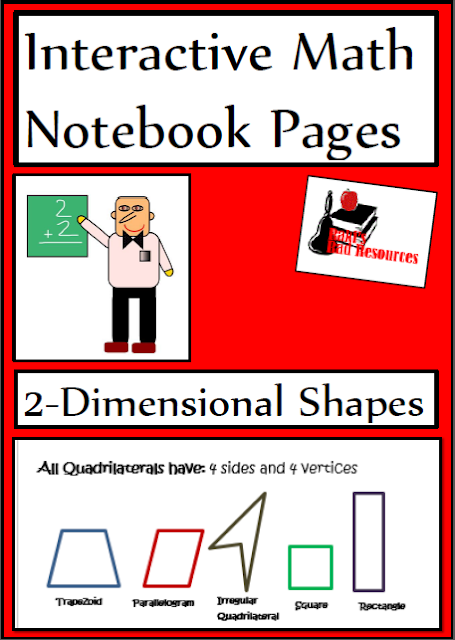
Finally, we reflected on our learning with my 2D Shapes Interactive Notebook Pages.

Teaching geometry to second graders - shape art, interactive notebook pages, videos and songs. All suggestions from Raki's Rad Resources.


2-dimensional shapes interactive notebook pages - includes reference page and reflection options. Geometry resource from Raki's Rad Resources


What a great way to start my journey back into the classroom! I am so excited by this new opprtunity.


Saturday, November 21, 2015

Do You Use Khan Academy for ELL Students?

Khan Academy has been an inspiration for me in so many ways. Their videos gave me a jumping off point when I began using the flipped classroom approach. (Read more about that in this old blog post – Have you flipped your classroom?) Watching their videos encouraged me to make some of my own, which you can now find on my YouTube Channel. But more recently, these videos have given me a chance to immerse my children in French and Arabic.

If you aren’t aware, I am currently a homeschooling mom. (You can learn more about our homeschooling adventure at my RV blog – RVing with the Rakis.) I left the classroom after 9 years in the classroom to stay home and homeschool my children when we left Morocco. I did this mainly so that my sons could continue to learn French and Arabic as they had been in Morocco. So we do reading, writing, grammar and math in French and Arabic every single week. What they have been lacking is immersion. They aren’t in a classroom with a bunch of other kids listening to the teacher speak in their target language all day. So recently we started looking around for videos to use as immersion. One place we especially struggle is Math vocabulary. My kids know how to do all of the work because we have covered the skills in English. However, reading the directions and word problems is much more challenging because Math can have such specific vocabulary. So off to the internet I went to find French and Arabic Math videos. Lo and behold I learned that Khan Academy has their videos translated into many, many different languages including French, Arabic, Spanish and Russian. You can use this link to find links all of the languages offered by Khan Academy

Using Khan Academy to Help Your ELL Students to better understand Math

Now I know that my situation is unique, but these links could easily be used to help our English Language Learning students with their Math and Science. Here are a few ways:

1.) ELL Center or ELL Homework - Give these videos to your students so that they can learn the material in their home language, while learning the vocabulary with you in class. This way they get the best of both worlds and can improve much faster.

2.) Share with your students’ parents. Khan Academy videos show the “American” way of doing Math, no matter what language they are in. So for example my sons learned a different way of subtracting and dividing when they were in Morocco. (I explain these differences in this old blog post – How do you divide?) So they were surprised when they started watching videos in Arabic showing strategies that they are used to seeing in their English materials. This could provide a great way for you to connect with the parents of your ELL students, as it could show them how you are teaching in a format that they can easily understand.

3.) Give your non-ELL students an “immersion” experience. Native English speakers can be rather rough on their ELL counterparts because they don’t understand how difficult it is to learn a new language. Help students understand by playing one of those videos in Russian or Arabic or Spanish to the whole class. Take time to talk about the things students did and didn’t understand and how they felt while watching the video.

For more blog posts about teaching ESL or ELL students, check out a series I used to run called Tips for Teaching ELL Students.

Heidi Raki of Raki's Rad Resources

Monday, March 23, 2015

Calendar Isn’t Just for Kindergarten!!!

Daily calendar math is very common in preschool and primary grades.  However, it is often deemed to be a waste of time with older students.  In my experience, it is anything but a waste of time. 

How to Use Calendar with Upper Elementary and Middle School Students - Ideas and Resources from Raki's Rad Resources

Calendar time can help older students:

- understand how a calendar really works.  I know it seems like common sense, but many older students don’t automatically understand that each month doesn’t begin on a Monday.  Tell a student that March will end on a Thursday and ask them what day April will begin on and many will pause for an extended time.  Working with calendars every day and having time to discuss trends in how we use calendar can be very beneficial for students.  For additional learning, try exposing students to the idea that calendars are not the same in every country on Earth.  In my Calendar Lesson for Interactive Math Notebooks, the reference sheet reminds students that calendars start on Sunday in the North America, but on Monday in most other continents.  This is something that can be referenced easily during calendar math as well.  

How to Use Calendar with Upper Elementary and Middle School Students - Ideas and Resources from Raki's Rad Resources

  - build vocabulary.  Factors, prime, composite, equation.  These vocabulary words were never a problem in my classroom, because we covered them every single day in our Calendar Math Books.  By completing these books, posting answers on our Calendar Math Posters, and reviewing as a class, my students had those math vocabulary words – and many others – down pat and never missed them on assessments. How to Use Calendar with Upper Elementary and Middle School Students - Ideas and Resources from Raki's Rad Resources

- gain mastery of basic skills.  Calendar Math is done every single day.  So if students don’t understand how to find factors of the number of the day at the beginning of the year, by the time they have done it 180 times, they are very likely to have mastered the concept.  Repetition helps us remember.  Calendar Math should cover the concepts that need to be completely mastered.  By repeating these concepts over and over, students build automaticity and confidence with these concepts.

- explore numbers.  Work on the same concepts, use different numbers.  This is how you truly explore how numbers and number properties work.  My students used the number of days they had been in school as their “number of the day” for their Calendar Math Books.  By working sequentially, students could see lots of number patterns, including the odd/even pattern, the growth of factors as numbers get larger and the fact that prime numbers are more common in smaller numbers than larger numbers.  These are all concepts my students explained to me as they completed their Calendar Math Books each morning.How to Use Calendar with Upper Elementary and Middle School Students - Ideas and Resources from Raki's Rad ResourcesHow to Use Calendar with Upper Elementary and Middle School Students - Ideas and Resources from Raki's Rad Resources

One of the most important ways to make Calendar Math meaningful is to be sure that students are completely engaged.  For my classroom, this meant that students completed Calendar Math Books before we reviewed the concepts as a class.  Students completed their books during their independent work time (I don’t do centers – to find out why check out this blog post.).  In the beginning of the year, I stood in front of the room and reviewed each concept with my students, using our Calendar Math Posters.  However, by the sixth week of school, I could turn the reviewing process over to one of my students, whose weekly classroom job it was to lead Calendar.  The other students followed along with their Calendar Math Books open, checking their work, and the work of their leader.  Meanwhile, I could float around and spot check Calendar Math Books, taking anecdotal notes of who was struggling with which concepts.  The review process took an average of 15 minutes each day, with review time being longer in the beginning of the year and shortening down to about 10 minutes during the last trimester when everyone had mastered the concepts.  Those 15 minutes are completely worth the learning that happens during Calendar Math time!

Heidi Raki of Raki's Rad Resources


Wednesday, February 18, 2015

What is Everyone Saying About Math Tiling Puzzles

When I was in the classroom, tiling puzzles were my absolutely FAVORITE math activity.  I started out each trimester giving each student a stapled packet of 10 tiling puzzles, which they worked on whenever they finished work early.  If they finished the entire packet before the trimester was done, there was a no-homework pass available as a prize.  Not only did this keep the kiddos focused and prevent management issues, but the tiling puzzles forced students to work on math facts, math concepts and critical thinking all at the same time.  Plus, because I had puzzles for each operation, I could easily differentiate by simply giving different students different puzzle packs.

Math tiling puzzles allow students to work on math facts, math concepts and critical thinking all at the same time. Stop by Raki's Rad Resources to find more information about these fabulous puzzles.    Math tiling puzzles allow students to work on math facts, math concepts and critical thinking all at the same time. Stop by Raki's Rad Resources to find more information about these fabulous puzzles.

I am not the only one who loves these packets.  Here are some comments that I pulled from the various packets I have available:

“I absolutely love these! The students have to look at multiplication in many different ways to solve the problems. Sometimes they have to reverse the process. Sometimes they must think of possible multiples and eliminate the ones that won't work. Excellent for encouraging them to think "outside the box". Taught them to eliminate as many choices first with reasoning skills and using guess & check with the final possibilities. Thanks for an excellent resource:)”

Math tiling puzzles allow students to work on math facts, math concepts and critical thinking all at the same time. Stop by Raki's Rad Resources to find more information about these fabulous puzzles.“Great for students who finish early!”

“High praise from students... I tried your freebee and was impressed with how it kept my more skilled mathematicians engaged. One of them just saw me printing this packet and said, "Oh I love those!"

“I downloaded the sample version and I love it! I have 6th grade students who are having difficulty with multiplication so this is a great tool to have them self-check!”

“This is great! Just challenging enough to work as a math center yet not too challenging that they will give up. What a creative idea! Thank you for providing.”

“This will be a great bell activity and refresher after the long weekend. Thanks”

 “This is genius! I love how critical thinking is needed to only use each tile one time - along with the addition practice! Thank you for a great product.”


At my Teachers Pay Teacher store, I have 50 Addition & Subtraction puzzles and 50 Multiplication & Division puzzles, but I also have 10 different puzzles available completely FREE, so feel free to grab some free puzzles and see if your kids love them as much as mine did.


Heidi Raki of Raki's Rad Resources

Monday, November 24, 2014

Math Projects For Your Classroom

In addition to running this blog, my RVing with the Rakis blog and homeschooling full time, I also create and sell resources that teachers can use in their classrooms and home schooling parents can use to help out their children.  To be fair, I am not creating nearly as many resources this year as I did in the past 9 years, for 2 reasons.  Reason #1 – I already have over 500 resources available in my Teachers Pay Teachers store, so much of what I need for my kiddos I have created already.  Reason #2 – I only have 3 students this year, so I have need of less resources.  However, I am going through resources that I made while I was teaching in a classroom full time and “cleaning them up” with clearer teacher directions, better fonts, etc.  I am also finishing out groupings or “series” that I have started and putting them into bundles so that teachers who are interested in buying multiple items from the same category have the opportunity to save some money.  For the next few weeks, I am going to spotlight some of these bundles here on my blog.

math project bundle

Math is best learned and practiced in relation to real life situations.  For this reason, my students have always worked on at least two different math projects during the course of a school year – often more if time allowed for it.  For the past two years, I kept the same students in a multiage classroom, so I wanted to make sure that they were doing new math projects that helped them work on different skill sets.  A few of my math projects – like the Balanced Checkbook project and the Holiday Shopping Project – can be done by the same student multiple times, but most should only be done once.  Because of this, I created new and different projects, and have now bundled them together into a set of 7 math projects, which is available for less than purchasing each project individually.  The seven math projects available in the set are:


Holiday Shopping (works on addition, subtraction and rounding while building a holiday shopping list)

Holiday Shopping Project

Ice Cream Shop (works on multiplication, division, subtraction and rounding while students split the bill at an ice cream shop)

Ice Cream Shop Project

Be an Architect (works on area and perimeter while students design their dream school)

Be an Architect Project

Balanced Checkbook (works on all 4 operations and rounding while students plan a monthly budget with salary and bill cards)

Balanced Checkbook Project

Party Planning Project (works on doubling, halving, tripling and quartering, as well as all 4 operations and rounding, while students plan recipes and a budget for a party)

Party Planner Project

Field Trip Project (works on elapsed time and all 4 operations while students create a plan for a field trip they would like to take)

Field Trip Math Project

Holiday Recipe Project (works on elapsed time, addition, subtraction and rounding while students create a plan to follow a holiday recipe)

Holiday Recipe Project

I hope one of these projects, or the entire bundle will help your students to practice their math skills with a real life application.  Happy teaching!

Heidi Raki of Raki's Rad Resources

Monday, November 17, 2014

Memorizing Math Facts is as Important as Knowing Letter Sounds

Memorizing math facts is as important as memorizing letter sounds.  Students cannot build a mathematical understanding without memorizing math facts.  Raki's Rad Resources

Imagine if a child never memorized their letter sounds, but instead had to reference a chart or use a memorization device for each sound of reading a word.  If you have ever read with a beginning reader, you know how slow the process is.  In fact, for most new readers, you spend so much time focused on sounding out those basic words, you never get to reading comprehension.  Similarly, if students never memorize their basic math facts, when they get to complex concepts like percentages, fractions, long division, Algebra and beyond, they never understand the actual concept of what is going on because they have to go back and figure out the basic “letter sounds” of math – math facts.

This is why memorizing and truly understanding math facts is so important.  Without first a good understanding of how numbers come together and second a solid memorization of facts, children will never be able to efficiently work through complex math problems.

Before students memorize facts, they need time to play around with number combinations in manipulative form.  They need to see that 7 green dots and 3 red dots make 10 in enough different ways that they “get” the idea of addition.  They need to see that 4 groups of 5 dots makes 20 in enough different ways that they “get the idea of multiplication.  This manipulation is important, but it should only be the first short step to math facts.  This is the equivalent in reading of learning that all letters make sounds and that sounds can blend together to make words.

Once students have this basic understanding, they need to start the process of memorizing math facts.  Students can memorize math facts through plenty of different types of games, through flash cards, through reciting the facts, through using fact families, or simply by drilling themselves over and over.  There’s no big trick to memorizing.  Each student will learn to memorize in a bit of a different way, but overall the most important part of memorization is practice.  Students need to practice math facts over and over – a minimum of 10 minutes a day, EVERY DAY.  This is something I always stressed to parents and students, if you practice, you memorize – except in cases of specific disabilities.  You know how you use a reading log to track daily reading – consider keeping a math fact log as well, it can be a big help.

One thing that I found as a great way to keep students practicing was to have regular “accountability quizzes” where students could show me – and themselves – that practicing helped.  These fast fact quizzes – which I have in 8 different levels – give students a way to see their growth happen.  If they are practicing, they will move through the levels.  If they are not, they will stay stuck on the same level for weeks at a time.  Eventually, they get sick of seeing their friends move on and they will begin to practice.  Once they do, they start moving through the levels too and are proud of their achievements.  I always have rewards for those who are moving up levels, generally the chance to add a new symbol to the class bar graph, or a sticker for their reward chart.

You can find these accountability quizzes at my Teachers Pay Teachers store:

Memorizing math facts is as important as memorizing letter sounds.  Students cannot build a mathematical understanding without memorizing math facts.  Raki's Rad Resources    Memorizing math facts is as important as memorizing letter sounds.  Students cannot build a mathematical understanding without memorizing math facts.  Raki's Rad Resources


Memorizing math facts is as important as memorizing letter sounds.  Students cannot build a mathematical understanding without memorizing math facts.  Raki's Rad Resources     Memorizing math facts is as important as memorizing letter sounds.  Students cannot build a mathematical understanding without memorizing math facts.  Raki's Rad Resources


Memorizing math facts is as important as memorizing letter sounds.  Students cannot build a mathematical understanding without memorizing math facts.  Raki's Rad Resources   Memorizing math facts is as important as memorizing letter sounds.  Students cannot build a mathematical understanding without memorizing math facts.  Raki's Rad Resources


Memorizing math facts is as important as memorizing letter sounds.  Students cannot build a mathematical understanding without memorizing math facts.  Raki's Rad Resources     Memorizing math facts is as important as memorizing letter sounds.  Students cannot build a mathematical understanding without memorizing math facts.  Raki's Rad Resources


Heidi Raki of Raki's Rad Resources

Thursday, November 13, 2014

Making Math Tutorial Videos

Student created math tutorial videos help you know if the student truly knows what they think they know.  Blog post from Raki's Rad Resources

One of the best ways to know if a student REALLY understands a math concept is to ask them to teach the concept to someone else.  However, letting each student teach the class can be extremely time consuming.  A good alternative is to let students create math tutorial videos, which can be viewed by students at home or during a math center.  My students create their videos with these steps:

1.  Plan out key vocabulary and phrases that will be needed for the video.

2.  Create the video in your chosen app or website.

3.  Record the video.

4.  Edit the video.

5.  Students evaluate themselves on their own rubric.

6.  Teacher evaluates student with the teacher rubric and conferences with students on their work.

We use my Tutorial Video Planning Sheets in this process:

Video planning sheet from Raki's Rad Resources

This week, my children created these videos about the topics they have been learning about for the past 10 weeks.  They do their home school work in English, French and Arabic, so they created three different videos.

2nd Grade English

Student created math tutorial videos help you know if the student truly knows what they think they know.  Blog post from Raki's Rad Resources

2nd Grade French

Student created math tutorial videos help you know if the student truly knows what they think they know.  Blog post from Raki's Rad Resources

2nd Grade Arabic

 Student created math tutorial videos help you know if the student truly knows what they think they know.  Blog post from Raki's Rad Resources

5th Grade English

Student created math tutorial videos help you know if the student truly knows what they think they know.  Blog post from Raki's Rad Resources

5th Grade French

 Student created math tutorial videos help you know if the student truly knows what they think they know.  Blog post from Raki's Rad Resources

5th Grade Arabic

Student created math tutorial videos help you know if the student truly knows what they think they know.  Blog post from Raki's Rad Resources

Before the kids are allowed to publish their videos, they are required to conference with me, which gives me a great way to handle any misconceptions that might be happening in their mathematical knowledge.  It also teaches students the importance of revising and editing work before publishing – which is a skill that should be done in all subjects NOT ONLY IN WRITING.  These videos may not replace tests entirely, but they give me a very clear picture as to where my students stand in regards to mathematical thinking.

For some ideas on programs and apps to use to make videos, check out these two old blog posts:

Online Video Creation Sites

Making Movies on an iPad


Heidi Raki of Raki's Rad Resources