Showing posts with label math facts. Show all posts

Saturday, February 18, 2017

Math Fact Quiz Updates

So it's that point in the year for me that my supplies are slowly starting to run out, including copy paper. One of the biggest uses of copy paper in my classroom is math fact quizzes. We started out the year taking addition and subtraction mixed quizzes and now we have moved into multiplication quizzes. After years of doing these quizzes, I had "Duh!" moment this week and realized that if I made the quizzes two per page they would still be big enough for the kids, but I would save a bunch of paper. So I've just gone through and revamped all of the fact quizzes in my All Inclusive Math Fact Quiz Bundle so that now all offer 2 quizzes per sheet, as well as the original 1 quiz per sheet.

Math fact quizzes - you have the choice one quiz per sheet or two quizzes per sheet - with a level to meet everyone's needs - math fact all inclusive bundle from Raki's Rad Resources.

On Wednesday, I printed my first set of half sheet quizzes and the kids looked at them and said "Why didn't you do that a long time ago Mrs. Raki?" Good question kids, good question!


Sunday, April 10, 2016

2nd Grade Lesson Plans - Week of April 11th

When I was teaching in a multiage classroom overseas in Morocco, I often posted my lesson plans here on my blog. Now that I am back in the classroom, I have had some requests from readers for the sneak peek into my classroom that sharing my lesson plans allowed others. So here is what my class is up to this week:


2nd Grade Lesson plans for reading, phonics, writing and math - from Heidi Raki of Raki's Rad Resources

In the morning, we start out with Phonics/Writing Centers. This week we are focusing on the Long E spelling patterns. My students work independently on their Long E Spelling and Vocabulary Packet

Also during our morning block we work on writing. One of the great weaknesses for my class as a whole is writing conventions (capitals, punctuation and application of the spelling patterns we have learned), so every week we work on writing to a writing prompt. This week, my students will work on my Freddy Fish Writing Prompt (which you can download for free from my old blog post - 10 Free Writing Prompts). This writing prompt is graded strictly on conventions and gives me a great piece to conference with each child on using good conventions in their writing. 
After I have conferenced with each child on the conventions from last week's writing prompt, I will pull small groups and we will work on our persuasive writing. Right now we are working on the first prompt from my Opinion Writing Journal, which asks the students to write about the best book they have ever read. Most of my groups have finished brainstorming and are well into drafting. This week we will finish drafting and begin the process of editing and revising.


2nd Grade Lesson plans for reading, phonics, writing and math - from Heidi Raki of Raki's Rad Resources

Our second block of the day is reading. We start out the reading section working on reading fluency. First we review our weekly nursery rhyme. The students are working on their Nursery Rhyme Response Sheets for homework, but we review the rhyme each day in class to help build fluency. Students also do one minute partner fluency checks using their weekly passages, which I have pulled from Read Works. (You can find the link for Read Works and other places to pull reading passages at this old blog post: Preparing for Reading Comprehension Standardized Tests.) 

Once we have finished our fluency checks, we will work on building a chart with the characteristics of different types of poetry. We have already read quite a few Shel Silverstein poems and classic nursery rhymes, but this week we will read a bunch of traditional rhyming poems and them to our chart.
Finally, we will move into guided reading. While I pull guided reading groups, my students work on a variety of reading comprehension activities using their weekly passage. After they have finished that day's comprehension activity, they have time to read independently. 
This class has many new readers who have never built up the stamina for silent reading. So I am promoting reading books from cover to cover by tracking the number of on level books each student reads. My students are also completing Book Review Bookmarks on some of the books they read, which we are displaying in our class library in order to encourage other students to read books their classmates have enjoyed.


2nd Grade Lesson plans for reading, phonics, writing and math - from Heidi Raki of Raki's Rad Resources

After lunch, we move into Math. First we start with our daily routine of Calendar Books and Fast Facts Quizzes, which my kiddos call number sprints. The Calendar Books allow us to review multiple number concepts every day, including adding and subtraction 1, 5 and 10 and creating a number using base ten blocks and coins. The Fast Fact Quizzes help us to build number fluency. We are currently working on Subtraction Fast Facts, but by the end of the week I am sure that at least a few of my students will move onto the Addition/Subtraction Mixed Facts.

During these last six weeks of the school year, we are reviewing key concepts that students are still struggling with. Before Spring Break, the students took an assessment covering all of the standards covered this year. Last week we worked on skip counting with my Tiered Skip Counting Math Activity. This week we are working on number lines using my Tiered Number Lines Math Activity
I have split my students into three groups, using their data from this end of the year assessment. The prove it group will work with me to prove that the answers of three comparing numbers problems are correct by labeling and using number lines. The solve it grup will answer three comparing numbers problems, using number lines. The fix it group will "fix" number lines that have been mislabeled by common student mistakes. 
Once students finish their tiered activity, we move into math centers. Most of the students will be working on Moby Max and finishing up the creation of their fraction books. But my "fix it group" from last week's skip counting tiered activity will also spend time finishing the videos that they planned last week using my Video Planning Sheets. Their videos will teach others about skip counting and I am very impressed a their ideas. One group is trying to replicate an Odd Squad type of episode. Another group is teaching skip counting by subtracting life points when playing Yu-Gi-Oh. All of the groups are definitely extending their understanding by creating these videos.

So that's what my class is doing this week. What's your class doing?


Wednesday, February 18, 2015

What is Everyone Saying About Math Tiling Puzzles

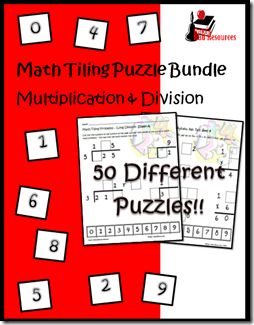
When I was in the classroom, tiling puzzles were my absolutely FAVORITE math activity.  I started out each trimester giving each student a stapled packet of 10 tiling puzzles, which they worked on whenever they finished work early.  If they finished the entire packet before the trimester was done, there was a no-homework pass available as a prize.  Not only did this keep the kiddos focused and prevent management issues, but the tiling puzzles forced students to work on math facts, math concepts and critical thinking all at the same time.  Plus, because I had puzzles for each operation, I could easily differentiate by simply giving different students different puzzle packs.

Math tiling puzzles allow students to work on math facts, math concepts and critical thinking all at the same time. Stop by Raki's Rad Resources to find more information about these fabulous puzzles.    Math tiling puzzles allow students to work on math facts, math concepts and critical thinking all at the same time. Stop by Raki's Rad Resources to find more information about these fabulous puzzles.

I am not the only one who loves these packets.  Here are some comments that I pulled from the various packets I have available:

“I absolutely love these! The students have to look at multiplication in many different ways to solve the problems. Sometimes they have to reverse the process. Sometimes they must think of possible multiples and eliminate the ones that won't work. Excellent for encouraging them to think "outside the box". Taught them to eliminate as many choices first with reasoning skills and using guess & check with the final possibilities. Thanks for an excellent resource:)”

Math tiling puzzles allow students to work on math facts, math concepts and critical thinking all at the same time. Stop by Raki's Rad Resources to find more information about these fabulous puzzles.“Great for students who finish early!”

“High praise from students... I tried your freebee and was impressed with how it kept my more skilled mathematicians engaged. One of them just saw me printing this packet and said, "Oh I love those!"

“I downloaded the sample version and I love it! I have 6th grade students who are having difficulty with multiplication so this is a great tool to have them self-check!”

“This is great! Just challenging enough to work as a math center yet not too challenging that they will give up. What a creative idea! Thank you for providing.”

“This will be a great bell activity and refresher after the long weekend. Thanks”

 “This is genius! I love how critical thinking is needed to only use each tile one time - along with the addition practice! Thank you for a great product.”


At my Teachers Pay Teacher store, I have 50 Addition & Subtraction puzzles and 50 Multiplication & Division puzzles, but I also have 10 different puzzles available completely FREE, so feel free to grab some free puzzles and see if your kids love them as much as mine did.


Heidi Raki of Raki's Rad Resources

Monday, November 17, 2014

Memorizing Math Facts is as Important as Knowing Letter Sounds

Memorizing math facts is as important as memorizing letter sounds.  Students cannot build a mathematical understanding without memorizing math facts.  Raki's Rad Resources

Imagine if a child never memorized their letter sounds, but instead had to reference a chart or use a memorization device for each sound of reading a word.  If you have ever read with a beginning reader, you know how slow the process is.  In fact, for most new readers, you spend so much time focused on sounding out those basic words, you never get to reading comprehension.  Similarly, if students never memorize their basic math facts, when they get to complex concepts like percentages, fractions, long division, Algebra and beyond, they never understand the actual concept of what is going on because they have to go back and figure out the basic “letter sounds” of math – math facts.

This is why memorizing and truly understanding math facts is so important.  Without first a good understanding of how numbers come together and second a solid memorization of facts, children will never be able to efficiently work through complex math problems.

Before students memorize facts, they need time to play around with number combinations in manipulative form.  They need to see that 7 green dots and 3 red dots make 10 in enough different ways that they “get” the idea of addition.  They need to see that 4 groups of 5 dots makes 20 in enough different ways that they “get the idea of multiplication.  This manipulation is important, but it should only be the first short step to math facts.  This is the equivalent in reading of learning that all letters make sounds and that sounds can blend together to make words.

Once students have this basic understanding, they need to start the process of memorizing math facts.  Students can memorize math facts through plenty of different types of games, through flash cards, through reciting the facts, through using fact families, or simply by drilling themselves over and over.  There’s no big trick to memorizing.  Each student will learn to memorize in a bit of a different way, but overall the most important part of memorization is practice.  Students need to practice math facts over and over – a minimum of 10 minutes a day, EVERY DAY.  This is something I always stressed to parents and students, if you practice, you memorize – except in cases of specific disabilities.  You know how you use a reading log to track daily reading – consider keeping a math fact log as well, it can be a big help.

One thing that I found as a great way to keep students practicing was to have regular “accountability quizzes” where students could show me – and themselves – that practicing helped.  These fast fact quizzes – which I have in 8 different levels – give students a way to see their growth happen.  If they are practicing, they will move through the levels.  If they are not, they will stay stuck on the same level for weeks at a time.  Eventually, they get sick of seeing their friends move on and they will begin to practice.  Once they do, they start moving through the levels too and are proud of their achievements.  I always have rewards for those who are moving up levels, generally the chance to add a new symbol to the class bar graph, or a sticker for their reward chart.

You can find these accountability quizzes at my Teachers Pay Teachers store:

Memorizing math facts is as important as memorizing letter sounds.  Students cannot build a mathematical understanding without memorizing math facts.  Raki's Rad Resources    Memorizing math facts is as important as memorizing letter sounds.  Students cannot build a mathematical understanding without memorizing math facts.  Raki's Rad Resources


Memorizing math facts is as important as memorizing letter sounds.  Students cannot build a mathematical understanding without memorizing math facts.  Raki's Rad Resources     Memorizing math facts is as important as memorizing letter sounds.  Students cannot build a mathematical understanding without memorizing math facts.  Raki's Rad Resources


Memorizing math facts is as important as memorizing letter sounds.  Students cannot build a mathematical understanding without memorizing math facts.  Raki's Rad Resources   Memorizing math facts is as important as memorizing letter sounds.  Students cannot build a mathematical understanding without memorizing math facts.  Raki's Rad Resources


Memorizing math facts is as important as memorizing letter sounds.  Students cannot build a mathematical understanding without memorizing math facts.  Raki's Rad Resources     Memorizing math facts is as important as memorizing letter sounds.  Students cannot build a mathematical understanding without memorizing math facts.  Raki's Rad Resources


Heidi Raki of Raki's Rad Resources

Monday, August 11, 2014

The Purpose Behind Bulletin Boards

Despite the thousands of cutsie bulletin boards floating all over Pinterest, the true purpose behind bulletin boards is not to have the cutest room in the school.  The true purpose behind bulletin boards – as I see it – is to increase the learning opportunities for our students. Decorations for the sake of decorations do not help learning and often provide a distraction to students with ADD or other disabilities.

Bulletin boards should be educational, not decoration.  Stop by Raki's Rad Resources for ideas on how to make your bulletin boards more educational.

Bulletin boards:

1.  Should provide students with information that they can reference during lessons or centers.  Bulletin boards should be a part of the learning experience, not a decoration.

2.  Should be built with the students OR have an element that the students can interact with.  Either of these opportunities allow students to feel ownership for the board and encourages them to use the board rather than just be distracted by it.

3.  Don’t have to be changed every week or month.  Bulletin boards can be built slowly over the course of the school year, helping students to connect new knowledge to knowledge gained earlier in the school year.


Just because bulletin boards aren’t decorations, doesn’t mean they can’t be visually attractive.  In fact, good graphic design elements make bulletin boards easier for children to read and thereby more access to the information on them.  Here are a few examples of meaningful bulletin boards for your classroom:


Bulletin boards should be educational, not decoration.  Stop by Raki's Rad Resources for ideas on how to make your bulletin boards more educational.  Word Family word wall, with graphics to help out ESL students.

Word Family Word Wall – These Alphabet Labels, Sight Word Cards and Word Family Word Wall Cards help your students to sound out and recognize the meanings of common words.  Students refer back to this word wall during literacy centers, like read the room and journal writing.


Bulletin boards should be educational, not decoration.  Stop by Raki's Rad Resources for ideas on how to make your bulletin boards more educational.  Math Word Wall with definitions and graphics to help students understand key math vocabulary.

Math Word Wall – Math Word Walls should do more than simply list the important vocabulary words.  Definition cards, like those in my Math Vocabulary Packets (Addition & Subtraction, Multiplication & Division, Fractions, Geometry 1 and Geometry 2) give students the definition to refer to when they are stumped by those vocabulary words at math centers or independent problem solving


Bulletin boards should be educational, not decoration.  Stop by Raki's Rad Resources for ideas on how to make your bulletin boards more educational.  After students answer the questions in their Problem Solving Path math journals, they can check their answers using the QR codes on these posters.

Problem Solving Path – This interactive bulletin board displays the monthly word problems from the Problem Solving Path Journals, as well as giving students QR Codes to help them check their answers.


Bulletin boards should be educational, not decoration.  Stop by Raki's Rad Resources for ideas on how to make your bulletin boards more educational.  Build concept maps with key vocabulary, like the defintions of technology vocabulary.

Technology Word Wall – Word walls don’t have to be listed in alphabetical order.  For topics like technology, it’s better to group Vocabulary Word Wall Cards into connected words or concepts.  Add connecting words or ideas to help students make those connections when they are using the word wall later.


Bulletin boards should be educational, not decoration.  Stop by Raki's Rad Resources for ideas on how to make your bulletin boards more educational.  Use bulletin boards to create pictographs with data on student achievement - like success on mastering math facts.

Math Fact Reward Board – Students can track their own progress on math fact quizzes, and stay motivated to practice during math centers by having a math fact reward board with a fast fact reward system.


How do you keep your bulletin boards meaningful?

Heidi Raki of Raki's Rad Resources