Showing posts with label Language Experience Approach. Show all posts

Monday, February 23, 2015

Using DuoLingo in the Classroom

There are so many benefits to teaching our students a second language.  As they learn a second language, not only are they stimulating new parts of their brain, but they are also building new background knowledge and making connections to vocabulary they already know.  For example, while learning the word for ice in French (glacier), students should make the connection to the English word glacier.  This connection helps them to remember the word longer and be able to retrieve the word quicker – in both languages.

How to easily let your students learn another language during literacy centers.  Ideas on how to use DuoLingo with elementary aged students in this blog post from Raki's Rad Resources.

While we as teachers often understand the growth our students can make by learning a second language, we don’t generally have any control over their access to said language classes.  However, there is a way to use technology to give this possibility to our students.  It’s called DuoLingo and it’s the perfect place to start learning another language.  The program has an app (both for iPad and Android) and a website that provides amazing help with learning a language.  Because DuoLingo can be used on computer, iPad or Android tablet, it is a perfect app for any classroom because it allows us to do more with the technology we have, rather than requiring the purchase of new technology, which is a personal pet peeve of mine – see my post on why we don’t always need to buy new technology for the classroom.

How to easily let your students learn another language during literacy centers.  Ideas on how to use DuoLingo with elementary aged students in this blog post from Raki's Rad Resources.

The DuoLingo program includes all of the elements of learning a language – reading, writing, listening and speaking.  (Unless you are working on a Kindle with no microphone where the speaking part is automatically turned off.)  Unlike other language programs, if you have previous experience with this language, you can take a screening test and move quickly through the more basic levels, which means you start exactly where you’re supposed to. 

How to easily let your students learn another language during literacy centers.  Ideas on how to use DuoLingo with elementary aged students in this blog post from Raki's Rad Resources.

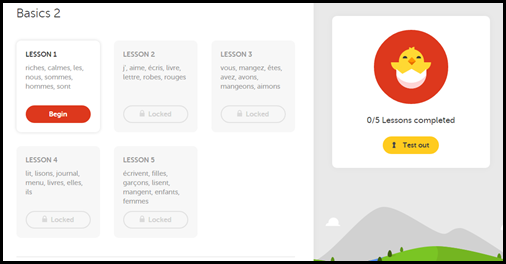
The courses are broken into small sections, each of which includes you listening to, reading, writing and speaking your target language.  Once you have reached mastery of a specific set of skills, you are automatically moved on to the next.  In addition to the activities, within each small section you will find a written “lecture” that explains the topic to you in English, with written examples.  Each “lesson” within DuoLingo takes about 20 minutes, and does not necessarily have to be done every day (although no less than twice a week would be suggested, so students don’t forget what they have learned).  This could easily be fit into your literacy centers, be morning work or become a part of any checklist.  (See my post on using checklists instead of centers.)
How to easily let your students learn another language during literacy centers.  Ideas on how to use DuoLingo with elementary aged students in this blog post from Raki's Rad Resources.

You can choose to have all of your students learn the same language, or let each student choose a language based on their background and interest.  With 18 different languages including Spanish, French, Russian, Italian and Vietnamese, there really is something for everyone on this site.  In addition, this program would be great for English Language Learners.  Instead of learning another language, students can log-in in their home language and practice their English vocabulary and grammar.

How to easily let your students learn another language during literacy centers.  Ideas on how to use DuoLingo with elementary aged students in this blog post from Raki's Rad Resources.

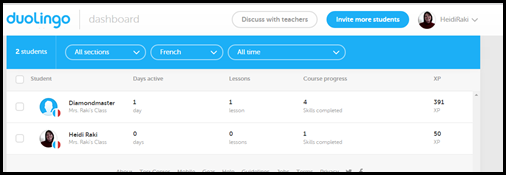
 My sons in grades 2 and 5 use this program to enhance their French vocabulary and grammar and love the interactive pieces that allow them to “power up” as they get correct answers.  I personally use it to review the grammar rules I have forgotten from in class lessons and I find it much easier than many other programs I have used.  Oh, and the best part – this is a FREE program and they even recently added a place where you can sign up as a teacher and monitor the progress of your students!  No money needed to try this out in your classroom and start helping students make connections in new parts of their brain!
How to easily let your students learn another language during literacy centers.  Ideas on how to use DuoLingo with elementary aged students in this blog post from Raki's Rad Resources.

Heidi Raki of Raki's Rad Resources 

Monday, June 25, 2012

Teaching with the Language Experience Approach

Hello everyone, I’d like to introduce you to this week’s guest blogger: Natalie of Teach ESOL. She’s going to explain the Language Experience Approach, which is a great method for English Language Learners, but really works for all learners.  I’ve used it myself in lots of different settings. If you like what she has to say, please take a minute to stop by her website and check her out.signature_thumb1


At the beginning of my first year teaching English learners I was terrified I would never get them to utter a word without just mimicking what I said. I was also baffled as to where I was supposed to access this all-important yet elusive “background knowledge” I kept reading about. I mean they just smiled and nodded or stared at me blankly whenever I asked a question. After much frustration, charades, laughter, self-doubt, and tears I finally landed on something that worked for us! Whether you teach native English speakers or English language learners, you are undoubtedly teaching children language. The way children communicate outside of school is more than likely completely different from the way they are expected to communicate in school. I happen to teach English language learners, but even if you do not, methods that work well for English learners can also work wonders for any student. The Language Experience Approach (LEA) is particularly useful for any student who struggles with academic language. While I advocate for maintaining home languages and dialects, I must concede that there is a standard variety of English that will help students succeed in school and in life. I have found success in helping students produce this “standard English” (just any English at all, in my case) and academic language by using LEA.

I know that at some point in graduate school LEA was at least mentioned and written on a list of terms to know for my teacher certification test. Nevertheless, when one of the essay questions asked how I might incorporate LEA into my teaching all I could think was it was just one more acronym I didn’t know the meaning of. Of course, the first thing I did after the test was to read all about LEA! Now I am thankful that I was stumped on that test because I have enjoyed the process and the results of using LEA. If you are not familiar with this approach to teaching language or reading, here is my take on LEA in a nutshell.

First of all, oral language is the first domain of language to be developed, so before asking students to read unfamiliar stories or even words, it is helpful to engage them in activities where they can listen and speak using the target language. After the students have used the language orally, they then dictate the activity to the teacher. The teacher writes what the student says (verbatim, including errors) and then the student reads what the teacher wrote. By using this approach, students are building a bridge between the spoken and written word. The teacher could also skip the activity part and just write about any personal experience the student wants to talk about. I don’t often do this though, because at the beginning of the year many of my students have little to no English, and later in the year, I want to focus more on academic English, which they are not likely to use when telling personal stories.

One of the easiest and most fun LEA activities this past year was with my K-2 students about the parts of a plant. The very first thing we did (the boring part) was to draw a big flower on chart paper and label the different parts. The students practiced pronouncing the words. We also talked about the things a plant needs to survive and drew and labeled those things. The next day, I gave the students pre-cut pieces of construction paper to make their own flowers. They then used the chart from the day before to help them label their own creations. Their final products looked like this:

Plant Project for English Language Approach

While making the flowers the students had to produce the language when asking the teacher for a stem, some soil, the petals, etc… and follow spoken directions of how to place the parts and draw their own roots. The students then explained to the class how they made and labeled their flowers, using the new vocabulary. Many students wanted to say “stick” for “stem” and “dirt” for “soil”, but by the end of the day they were all using the new words with little difficulty. The next day was the fun part: planting our own flowers. Each student got some seeds and soil to plant in a plastic cup. I poked holes in the bottom of the cup while discussing the importance of letting the water drain, and the students ran their fingers through the soil, while using their previously learned adjectives to describe what they felt. We planted, discussed a good location to put them, and then came back inside to get down to the business of reading and writing. Students first summarized the activity of planting their flowers as a group while I wrote what they said on chart paper. After that we took turns reading what they “wrote” together. Finally, the students used that model to write their own activity summaries. Kindergarteners were able to use the model to copy difficult words, while second graders were expected to elaborate with more adjectives. The final performance was to read what they wrote back to the teacher and their classmates.

As you can tell, when using LEA, students get practice in all four language domains of speaking, listening, reading, and writing. Best of all, the students they are usually happy and excited all the way through the lessons. I know all children have limited attention spans, but combine that with the inability to understand most of what is being said and it’s a monumental struggle to maintain attention and order. While the activities are often a little dirty and loud, it is worth it! I hope other teachers, especially those that have some English learners in their class, will find this method helpful. This example was from the elementary level, but I also teach middle school and find ways to sneak in a little LEA with my English learners. It is often too much like fun for the middle school administration mentality though. If you are interested in discussing middle grades more, please contact me!

Natalie of Teach ESOL

Teach ESOL - a Teaching Blog for Teachers of English Language Learners