Showing posts with label assessments. Show all posts

Wednesday, January 13, 2016

5 Ways to Use Test Results WITHOUT Adding Them to Your Grade Book


Tests have become such a hot ticket topic in education. In previous blog posts like What’s Wrong with Standardized Testing and Why Projects are Better than Tests, I have discussed my feelings about standardized testing and testing in general. However, tests can serve a vital purpose in the learning process, especially if they aren’t entered into a grade book. Once we write a grade into our grade book, it means that the learning has stopped. However, we can take the results of tests and use them to drive our instruction and be sure that learning is complete. In order to do this properly, we ideally give our test a week or so before we wish to be “done” teaching a certain topic. Or we allot a portion of our instructional time to continue working on skills that have not yet been mastered. Then we take the test results and use them to drive our instruction.  After the additional instruction time, another test can be given, or even better a project, if a grade is needed.


Five ways to use tests without entering them into your grade book - Use your assessments to drive your instruction. Ideas from Heidi Raki of Raki's Rad Resources


Here are five different strategies that you can take your test results and use them to drive your instruction:

1.) Conference with your students – Take time to sit down with each student to review their results. Talk about both strengths and weaknesses and set specific goals for the next step in their growth. We most commonly do this with reading and writing, but the same concept can be used for many subjects. For example, on a Social Studies test, you might discuss with students the topics that they struggled with on their assessment and suggest (or assign) further research into that topic. In Math, you might suggest a problem solving strategy that would better suit them or point out a simple misconception that they have and suggest ways to correct it.

2.) Create small groups – Take your assessment and create a list of skills or topics that were assessed. Then, review your assessments to see which students are still struggling with which skills or topics. Using this information, create temporary small groups based on the needs of individual students. Use these groups to work on that specific need. These groups might each meet with you or they might be given targeted assignments to help guide them through conquering those missing skills.

3.) Allow students to correct their own mistakes – Give students back their tests with the incorrect answers circled, but no clues given as to the correct answer. Ask students to correct each question, allowing them to use notes, books and additional research. Ask students to do their corrections in color or on an additional piece of paper to prevent a confusion of original answers and corrections. During the process, students will reflect on their own learning and recognize the gaps that they need to fill. 

4.) Create need based activities or projects  - If the majority of your students are lacking on a specific skill based on test results, create activities, lessons or projects that will help the students have additional time to work with the concept. For example, one year my students were struggling with long operations – addition, subtraction, multiplication and division. So I sat down and created a project to help them work on these skills in a real life setting. The resulting project was my balanced checkbook project. This project forced them to use the operations in different ways, but they were so excited to figure out their weekly salary and get spending that there were no qualms and they had a much better understanding by the end of the project.

5.) Provide tiered assignments – For single skill assessments, tiered assignments can come in handy. Students all continue to work on that skill after the test, but they work at a different level depending on their test score. If they have mastered the skill, they are given extension activities to push them into higher level thinking skills. If they have not mastered the skill, they are given time to review. If they have grasped the skill, but not mastered it, they are given time to practice.
Tiered math activity - subtraction with regrouping - free download from Raki's Rad Resources.
One way I used to do this was with the prove it, solve it, fix it approach. In this strategy, all of the students are given a paper with a set of problems. ( I usually used this in math, but it could be done in other subjects as well.) The lowest level students are given the set of problems with the answers provided. They are asked to prove that those answers are correct. By having the correct answer already, the pressure to get the right answer is off and the students have a chance to focus on the process, which is more important anyways.
Mid level students are given the same problem set and asked to solve each problem. This gives them a chance to continue practicing the skill. Higher level students or students who seem to have mastered the skill work on the fix it level. They are given the same problem set, but with incorrect answers. The answers preferably have common mistakes that teachers see regularly with that skill. The students at this level then try to figure out how the students got the incorrect answer and then fix it. Students at this level build higher level thinking and continue working on the skill at another level. You can download a subtraction with regrouping prove it, try it, fix it sheet for free from my Teachers Pay Teachers store to check out this strategy further.

How do you use test scores to drive instruction in your classroom?

Friday, October 9, 2015

Give More Feedback and Fewer Grades

What do grades provide to students? Does that number actually help students improve? In reality grades are nothing but a way to tell students where they stack up among other students. This is the reason there is a whole movement going on in education called Teachers Throwing Out Grades. I was first introduced to this group by a Cult of Pedagogy podcast, where the host, Jennifer Gonzalez interviewed Starr Sackstein, one of the teachers leading this movement. I have since joined the Teachers Throwing Out Grades Facebook Group.
Rubrics are Better Than Grades. They give students more information about how to improve instead of giving them a way to compare themselves to others. Opinion from Raki's Rad Resources.
Reading what these teachers have to say made me realize that I was doing a “no grades classroom” without realizing I was doing it. Even before I started working in a school with a standards based report card, I taught using rubrics and conferences and took as few grades as possible in order to give students as much time as possible to learn and grow. Once I started working in a school with standards based report cards, I graded less and conferenced more. Using rubrics instead of number grades allows you to give students real feedback on where they are strong and where they are weak. This information gives the students a roadmap as to what they need to do in order to get better. Rubrics should list out the most important skills that you want to assess. They can be extremely long or extremely short. Here are a few examples of rubrics I use with my students:

Rubrics are Better Than Grades. They give students more information about how to improve instead of giving them a way to compare themselves to others. Opinion from Raki's Rad Resources
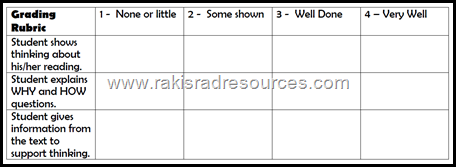
This rubric is from my 36 Week Reading Response Journal where students complete a written response to a student selected book each week of the school year. The students have all week to complete this during their literacy “stations” or as we call it “to do list time”. (For more information, see this blog post about why I don’t do center rotations.) Then for the last hour of Friday’s literacy time, I sit with each student. During this time, we do a fluency check recording (For more information on fluency check recordings, see this blog post about using Evernote to collect data.) and we conference about their reading response. At this time we fill out this rubric together.

Rubrics are Better Than Grades. They give students more information about how to improve instead of giving them a way to compare themselves to others. Opinion from Raki's Rad Resources
This rubric is from my Problem Solving Path Math Journals. For each problem the students and I evaluate their work. We discuss from the beginning of the year that the rubric is specifically weighted so that work is more important than the correct answer because the skills that these journals should enhance is working out word problems.

Rubrics are Better Than Grades. They give students more information about how to improve instead of giving them a way to compare themselves to others. Opinion from Raki's Rad Resources
This rubric is from my Primary Writing Journal. It’s actually two rubrics, one for the student to self reflect on their writing and a second one for the teacher to use during conference. When I taught first grade, these made such a huge difference for my students.

Rubrics are Better Than Grades. They give students more information about how to improve instead of giving them a way to compare themselves to others. Opinion from Raki's Rad Resources
This rubric is from my Desert Research Project where students research one specific desert and create a presentation to teach the rest of the class about their desert. I filled out these rubrics while the students presented their projects and then sat down with each group to review where they were strong and where they were weak so that they could know where to focus on their next presentation.

Rubrics are Better Than Grades. They give students more information about how to improve instead of giving them a way to compare themselves to others. Opinion from Raki's Rad Resources
This detailed rubric is from my Amazing Americans Technology Project. Students are expected to create an informational power point using the information they research about a specific person in American history. The rubric covers all of the pieces of solid writing, giving students a lot of information about their work.
When it is necessary to give a graded test, I sit down afterward with each student and conference about where they are strong and where they are weak. I tell them what we still need to work on. Then, I use the results to form small groups and work on re-teaching. The kids know that these groups are formed based on their needs and that we will work until they have mastered the topic to my satisfaction. This changes our focus from a specific grade to a learning goal with standards that we have to master.
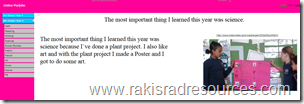
At the end of each school year, my students spend time reflecting on their work. This use these reflections to build an online portfolio. They choose their own writing samples and projects that best reflect their capabilities. These portfolios also include written student reflections. Portfolios give a much clearer picture of where a student is than the numbers that come back from their standardized tests. For more information on how I help my students build their portfolios, you can check out the blog post:   or you can download my Student Created Portfolio Guide.
Rubrics are Better Than Grades. They give students more information about how to improve instead of giving them a way to compare themselves to others. Opinion from Raki's Rad Resources
If it was up to me there would be no grades and no standardized testing. I would replace these things with rubrics and portfolios and discussions about the learning that is happening. Give students more feedback and less grades and see their focus turn towards learning and personal growth and away from competition and complaints. So what about you, do you prefer grades or rubrics? Please feel free to leave your point of view in the comments. Let’s start a discussion about what should be happening in classrooms.
Heidi Raki of Raki's Rad Resources

Saturday, August 16, 2014

How to Keep Kids Engaged in Learning When You are Assessing

It’s the beginning of the school year, time to teach, right?  Wrong!  For many teachers the beginning of the year means sitting down with each student and assessing them to build their base line for those data walls.  While studies show that assessments shouldn’t be done until 3 - 6 weeks into the school year, when students have regained whatever they lost during the “summer slide”, we all know that many administrator want these assessments need to be done by the 10th day of school. 

 10 ways to keep students engaged in thinking and learning while you complete beginning of the year assessments.  Ideas from Heidi Raki of Raki's Rad Resources.

Often we need to start assessing before we have even finished teaching procedures and routines, which means that the students who are not being assessed end up working on busy work in order to keep the class calm and quiet while we are assessing.  So, how do we keep the other student engaged AND have a class that is quiet enough to do a quality assessment?  Here are some ideas:

 10 ways to keep students engaged in thinking and learning while you complete beginning of the year assessments.  Ideas from Heidi Raki of Raki's Rad Resources. 1.  Whole class learning videos with graphic organizers – You know what science and social studies topics are coming up, start building up your students’ back ground knowledge by putting on a learning video about an upcoming topic.  While students are watching, ask them to complete a graphic organizer – to keep them focused and quiet.  You will get the ability to pull students one at a time for assessments, then when you start teaching this topic, students will have some background knowledge on the topic and you can show the video again, stopping to explain where necessary, without kids whining about wanting to see the end.

2.  Autobiographies  - Have students write an illustrated version of their life story.  Tell them that spelling and grammar doesn’t matter – just try their best, but that you are looking to get to know as much as you can about them. This will make a great beginning of the year writing assessment, as well as a piece of writing that you can later use to help students practice revising and editing.  Plus, you will get lots of information about your students that can help you form relationships and build in student led differentiation.

3.  Board Games – You know all those games that you never get to pull out?  Now’s the time to pull them out and teach kids how to play them.  Take a minute to go over the rules of each game before you have kids play them, and then split them into groups to play games like Scrabble, Dominoes, Yahtzee and Battleship.  Students will work on cooperation and problem solving while you get your assessments done.  Extra bonus - later on in the year you can pull out these games for early finishers or to reuse with academic rules.  For ideas on how to reuse board games with academic rules – check out my Friday Game Night blog posts.

10 ways to keep students engaged in thinking and learning while you complete beginning of the year assessments.  Ideas from Heidi Raki of Raki's Rad Resources. 4.  Math Projects to Review last year’s skills – Have students work on real life math projects – like my Ice Cream Shop project or Designing a Dream School.  Choose a project that is just below your instructional level, so that they can do the entire project independently, building confidence and reviewing key math skills, while not boring students so that they get distracted.

5.  Reference book scavenger hunt – Split kids into groups and have students to find information with the reference books in your classroom or library.  Ask students to find the meaning of key vocabulary words using the dictionary, synonyms and antonyms using a thesaurus, bordering countries or states using the atlas and fun facts using the encyclopedia.  The group that finds the most items wins a small prize (like a no homework pass), and the quietest group gets 10 extra points.  This gets kids looking through reference materials they forget about, working with each other and you can pull kids one at a time for assessments.

10 ways to keep students engaged in thinking and learning while you complete beginning of the year assessments.  Ideas from Heidi Raki of Raki's Rad Resources. 6.  Puzzles – Jigsaw and self correcting – Puzzles build critical thinking and problem solving skills.  Having students work on any type of jigsaw or self correcting puzzle will get students using their noggen and staying focused, and hopefully quiet, while you are assessing.

7.  Let the Kids be the experts – Most kids think that they are experts at something.  While you are assessing, tell students that they will be teaching the class about something they are an expert at (can be anything, video games, dinosaurs, making a peanut butter sandwich, whatever!) and this is their time to create their lesson plans.  When all of the assessments are done, take a day or two and let each kid teach the lesson they created.  The kids will get a chance to be the teacher – every students’ dream, you will find out what kids are interested in and what they already know about, and how they are at public speaking.  But best of all, students will be so busy planning their lesson, that they won’t have time to interrupt you while you are assessing their classmates.  Download some guidelines for this in my own blog post – Give Students a Chance to Teach.

10 ways to keep students engaged in thinking and learning while you complete beginning of the year assessments.  Ideas from Heidi Raki of Raki's Rad Resources. 8.  Read & Review Classroom Library Books – Give students time to read several books from the class or school library.  After students have read a book, let them rate and critique the books with my Book Review Bookmarks.  Hang the bookmarks around the library so that students can make an “informed decision” the next time they choose a book.

9.  Explore apps or websites to be used during the school year – All year long, we are in a rush for students to use this technology or that one for a specific project, but students rarely get a chance to just “fiddle around” with apps and websites.  However, children (and adults for that matter) often find that they learn more about how to properly use an app or website by “fiddling with it”, so take this time to let students play around with apps and websites you’ll use later in the year.  Students will be excited to “play on the computer” while you know they are really building background knowledge that will be used in future assignments.  For more information on what apps or websites to use – check out my blog post – Technology Accounts to Create for Your Classroom.

10 ways to keep students engaged in thinking and learning while you complete beginning of the year assessments.  Ideas from Heidi Raki of Raki's Rad Resources. 10.  Fast fact practice – Two months off means most students have forgotten their math facts – well not forgotten, but they certainly aren’t as fast as they were in May.  Use this time to let students practice their math facts with dice and card games, or laminate math fact quizzes and let them use a dry erase marker to race each other or a timer.


How do you keep the other students engaged while you complete your assessments?

Heidi Raki of Raki's Rad Resources

Tuesday, August 5, 2014

TESOL Teaching Tip #51 - Summer for ESL Students = Very Limited English Exposure

As a teacher at an International School, many of my students were English Language Learners. Even my native English speakers were living in a non-English speaking country. Due to my unique teaching position, I have had some readers ask for tips on teaching English Language Learners. Here is this week’s Tuesday TESOL Teaching Tip:

TESOL Teaching Tip #51 - Give esl and ell students a chance to get back into their school routine before doing beginning of the year assessments. Students have limited English exposure over the summer and need a few weeks of English to reacclimate. Find more information on this topic at my blog - Raki's Rad Resources.


TESOL Teaching Tip #51 - Delay back to school assessments
I don’t understand why he’s so quiet, he spoke English so well last year!  I often hear this from teachers of ESL students in their 2nd and 3rd year of English.  At the beginning of the year, we have to remember that most of our ESL students come from households and neighborhoods where they do NOT speak or hear English.  This means that all that we teach them all school year long rarely gets practiced during the summer.  Just like any other skill, speaking English is something that needs to be practiced.  ESL students do not LOSE their English over the summer, but they often return to school out of practice, and need a few weeks to return to their previous level of English.  For this reason, it is important to try and delay assessments on ESL students until the second or third week of school, when they have had a chance to get back into the swing of the language. 
Give students plenty of time to use spoken English and work with partners during those first few weeks of school.  Additionally, assigning language based homework (that will be checked, but not graded) like watching and summarizing videos or creating mock dialogues can help students get in the swing of thinking in English outside of the school house.
Last week, we talked about how to help lower level ESL students adjust to an English only environment.  How do you help your higher level ESL students make the same adjustment?  For more help with higher level ESL students, check out last year’s blog post about Helping Second Year ESL Students.
Heidi Raki of Raki's Rad Resources

Sunday, June 8, 2014

Testing vs. Portfolios = Photograph vs. Video Collection

 Which would be a better indication of a child’s ability to read, a photograph of them holding a book or a video of them reading the book aloud?  No contest right, the video provides much more proof.  Even better, would be a collection of videos that show progress over the course of the year. 

The past two weeks, my students have been working on a variety of assessments.  Some of these assessments – specifically the UK National Tests (SATs) and our comprehensive trimester tests - are photographs – snapshots of how they are performing on a particular day at a particular time.  Online portfolios help students see how they have grown from year to year.  They are a video collection, rather than a photograph of one time and one place.  Raki's Rad ResourcesOthers  - the MAP test that students take multiple times during the year, and the running records that students are assessed with three times a year, are videos, showing their ability with clear details about what they know and how they’ve grown.  However, the best assessment we have worked on are our online portfoliosonline portfolios, which are truly a collection of videos, projects and self reflection which show growth and progress over the course of the year.

An additional benefit of the online portfolios is that the students who have been at the school for two years, can go back and look for themselves at where they were last year at this time and truly understand the growth that occurs as the years pass.  This empowers the students to reflect on what truly matters.  It’s not the number that they get at the end of the MAP test, it is the growth that occurs slowly, over the course of time. 

Online portfolios help students see how they have grown from year to year.  They are a video collection, rather than a photograph of one time and one place.  Raki's Rad Resources

This is especially apparent for ESL students.

Online portfolios help students see how they have grown from year to year.  They are a video collection, rather than a photograph of one time and one place.  Raki's Rad Resources


Online Portfolios are one of the best things I have ever done in my classroom!

Heidi Raki of Raki's Rad Resources