This school year my “class” consisted of only three students – my own sons aged 4, 7 and 11. This year I stopped teaching in a classroom in exchange for an “alternative lifestyle”. My family bought an RV and we are traveling around the United States and homeschooling our boys in the process. You can learn more about what we’re up to at our family blog – RVing with the Rakis.
Even though I haven’t had a full class, I have had my hands full! However, seeing what my kids learned this year has been worth every minute. We have been working on a “year round schedule”, taking five weeks off at Christmas, three weeks off at Easter and so we have just this week finished for the year. Now we will be taking seven weeks off to relax and enjoy our summer.
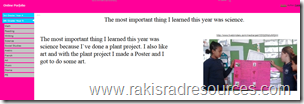
During the last few weeks, the older two boys worked on building online portfolios of their growth and learning for this school year. Here are the results of their weeks of work:
No matter the size of your class or the age of your students, giving your students the chance to reflect on their own learning and growth each year is beneficial to them as students and to you as a teacher.
Recently, John Oliver put out a great video about standardized testing and how we use the information gathered from these tests. If you haven’t seen it, you can find it HERE:
In addition, I recently listened to Jennifer Gonzalez’s interview over at Cult of Pedagogy with Anthony Cody about standardized tests in coordination with educational policy, which you can find HERE.
These two resources made me start thinking about standardized testing much deeper. Being out of the classroom this year and having my own children homeschooled, we don’t have to deal with standardized testing much. I never liked standardized testing when I was in the classroom, and often simply didn’t put much emphasis on it,choosing to do research projects instead of test prep during testing season. However, I’ve also never had my job depend on my students’ test scores. I didn’t leave teaching or take my kids out because of testing, but now that we are out, I am seeing so many benefits from not having testing as a driving force in our learning environment. If they were to go back into a public school environment, I would definitely be opting them out of the test.
Here are the reasons why I don’t agree with standardized testing:
1.) Tests often occur four to six weeks BEFORE the end of the school year. This means that teachers are required to be done teaching all of their content at least a month before the end of the school year. Not only does this mean that curriculum is rushed through, it also leaves the impression with students and parents that when the test is done, school is done, which means the last six weeks of school can be a major classroom management nightmare.
2.) Students and teachers NEVER get to see which questions students got right or wrong. Part of the reason for assessing is to know what students haven’t mastered, so that we can cover this material better. In my classroom, all in class assessments are reviewed in detail with students so that they can make corrections to their thinking, or even their test taking strategies. However, standardized tests are never reviewed, so they are there simply to judge students, not to help them.
3.) Standardized tests are often more of an assessment of a students’ background knowledge than of the content or skills that they are learning. This is why low income students traditionally score lower on these tests. They have different background knowledge and approach problems differently. It can also be a problem for kids on the other end of the spectrum. Students who are extremely well read and exposed often over think test questions because they know that things aren’t generally as simple as test questions want them to be.
4.) Current policies put so much pressure on students and teachers, that these tests are now taking center stage when learning should take center stage. I don’t do test prep if it’s not forced on me, but I have never had my job depend on my students’ test scores. I can completely understand how test prep has become a focus of our schools. I don’t think test prep helps students, but I can understand why it is so predominant now.
5.) All children do NOT learn at the same rate or with the same activities. Standardized testing is taking away individual learning. It doesn’t matter if Student A loves to read and learns to read quickly, but lags behind in math skills while Student B enjoys numbers and learns math and exceeds in math, but doesn’t enjoy reading fiction stories. Both students – all students – are expected to be at the same place at the same time, even though we all know that no children, and no adult for that matter, grows and changes at the same rate as other people their own age. Instead of embracing the differences that make us all unique, the testing push tries to stamp us all into the same person.
Now I do understand the need for assessment and to show teachers and students that growth has happened over the course of a school year. I think that every students should have a portfolio – paper or online – that travels with them through their school career. This portfolio can be compared against “student norms” to see if students are below, on or above level in different subject areas. It can be used to create an instructional plan for students. It can allow for different students to excel in different areas and to be their own unique selves.
When I was teaching at a private school in Morocco, I started an online portfolio system with my 2nd –5th graders where students created their own portfolios. At the end of each school year, the portfolios were added on to in order to show student growth. The students had certain requirements, including a writing example from each genre and links to completed science and social studies projects. Then the students presented their own portfolios to their teacher and parents. These portfolios showed true growth and understanding over the course of a year, whereas test scores simply gave a snapshot of a single point in time. If you’re interested in using my Online Portfolio Format, you can find templates and instructions on Teachers Pay Teachers.
The new year has come and gone. Many people are getting ready to celebrate the 100th day of school. Some may even be using my 100th Day Centers to celebrate! Before we know it, the end of the year will be upon us and we’ll be saying to ourselves – “Oh wait, weren’t we supposed to create portfolios this year?” Now is the time to sit down and create a plan so that you are able to create those portfolios before it’s too late.
Here are the steps I used when creating my online portfolios with my students:
1.) Plan out what information will need to be included in each portfolio. For example, my students always included on writing piece from each genre of writing (narrative, informational, persuasive, responsive to literature and poetry). The writing pieces could be blog posts, storybird books, journal entries or essays we wrote in class.
2.) Share this information with your students as early in the year as you can, so that they can start thinking about which pieces and projects will be included in their portfolio. Stress to them that portfolios showcase the best of their work. Since they want many pieces to choose from, they should try to complete each project to the best of their ability.
3.) 5 to 7 weeks BEFORE you want portfolios published, let students begin reflecting on the year’s learning. I had my students reflect on each subject and write out what they had learned and what their favorite part had been of each subject they reflected on. This writing was the basis of their online portfolio, but it also provided time to truly reflect on the learning and activities that had happened that year.
4.) 3 to 5 weeks BEFORE you want portfolios published, let students begin choosing projects and pieces that they want to include in their portfolio. Give students any specific guidelines for the pieces they want to include. Encourage students to decide at this time HOW they will include these pieces and projects in their portfolios. In the case of an online portfolio, my students uploaded photographs and videos of tangible projects – like dioramas and presentations. They also included links to online projects – online posters, videos, blog posts, etc.
5.) 2 to 3 weeks BEFORE you want portfolios published, begin conferencing and editing with students. Talk to students about what you think about their portfolios, what they might add or take away, help them to make this a true presentation of themselves.
6.) Once students are ready to publish, invite parents in – either in small groups, or as a whole – perhaps in a computer lab if you aren’t in a one to one situation – and allow students to present their portfolios to their parents. If you are using a student-led conference model, this provides you with a great format for presentation.
Available in my Online Portfolio Starter Kit is: three different levels of planning sheets, step by step technology tutorials for students and step by step directions for teachers.
What type of portfolios are being done in your school?
Which would be a better indication of a child’s ability to read, a photograph of them holding a book or a video of them reading the book aloud? No contest right, the video provides much more proof. Even better, would be a collection of videos that show progress over the course of the year.
The past two weeks, my students have been working on a variety of assessments. Some of these assessments – specifically the UK National Tests (SATs) and our comprehensive trimester tests - are photographs – snapshots of how they are performing on a particular day at a particular time. Others - the MAP test that students take multiple times during the year, and the running records that students are assessed with three times a year, are videos, showing their ability with clear details about what they know and how they’ve grown. However, the best assessment we have worked on are our online portfoliosonline portfolios, which are truly a collection of videos, projects and self reflection which show growth and progress over the course of the year.
An additional benefit of the online portfolios is that the students who have been at the school for two years, can go back and look for themselves at where they were last year at this time and truly understand the growth that occurs as the years pass. This empowers the students to reflect on what truly matters. It’s not the number that they get at the end of the MAP test, it is the growth that occurs slowly, over the course of time.
This is especially apparent for ESL students.
Online Portfolios are one of the best things I have ever done in my classroom!
This year I am the luckiest teacher in the world. I get to teach at the best school ever – International School of Morocco, with some of the best, most creative, teachers ever. Each time I walk into someone else’s classroom, I get inspired and we just seem to spiral great teaching ideas off of each other. It’s a wonderful place to teach, and since we are all collaborating, it’s a wonderful place for our kids to learn – a teacher’s dream, right? I have tried and tried to convince the other teachers to create blogs of their own to spotlight and share some of their amazing ideas, but everyone is super busy. Instead, they have each agreed to let me spotlight some of their ideas right here on Raki’s Rad Resources. So, each Friday night, I will be posting an ISM Spotlight.
This week marks the start of the third and final trimester of the school year. In most schools, this is the time people start to think and worry about portfolios. However, at the International School of Morocco, we have been talking about portfolios since the beginning of the year, both for students and for teachers. Portfolios show learning as what it really is, a long process that develops slowly over the course of time, rather than being a snapshot of a single moment of understanding on a single day, as tests are. Portfolios can and should be used all all learning levels – child and adult. In addition to being a place to showcase learning, they are a place and time for the learner and educator to reflect on the growth that has happened.
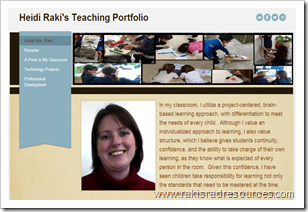
Each teacher at ISM has been slowly building their own teacher portfolios using Weebly, the website we also use to update our parents on school and class announcements. I have completed my portfolio this week and am ready to e-mail it in to be used as part of my teacher evaluation. The process of going back through pictures and projects I have done with my students was wonderful for me. I was able to reflect and see how I have grown as a teacher over these past few years.
During the process of building my portfolio in Weebly, I realized that this program would be just as good as LiveBinders for creating student portfolios as well. So, I created a student tutorial sheet to add to my Online Student Portfolios Packet.
Since many of the Year 3 – Year 6 students have already begun their portfolios in LiveBinders, we will be using LiveBinders again this year. The students who already began their portfolios will add a new tab and subtabs, and the students who are new to the school will start from scratch. (To see how last year’s portfolios turned out, check out this post from last year.) Although we will wait about 2 more weeks before we begin the official brainstorming process, we have been discussing with students all year long which projects they would like to include in their portfolios. Most students want to add their Heat Inquiry Videos and have created multiple Math Tutorial Videos that they are excited to add. I am most excited for the students who began their portfolios last year to open up their portfolios and see how much their work has grown since last year’s entries.
The teacher for Year 1 and Year 2, Courtney Nassar, has been building her portfolios all year long by taking dated pictures of her student’s work on her iPad. She labels each picture with her student’s name and at the end of the year is able to sort the students’ work by their name and create a virtual portfolio to share with the parents.
In Nursery and Reception, the teachers have been saving key pieces of artwork, self portraits and handwriting all years, being sure to date each piece. At the end of the year, they will sort through the pieces with the students to choose which ones belong in the students’ portfolios.
This year I am the luckiest teacher in the world. I get to teach at the best school ever – International School of Morocco, with some of the best, most creative, teachers ever. Each time I walk into someone else’s classroom, I get inspired and we just seem to spiral great teaching ideas off of each other. It’s a wonderful place to teach, and since we are all collaborating, it’s a wonderful place for our kids to learn – a teacher’s dream, right? I have tried and tried to convince the other teachers to create blogs of their own to spotlight and share some of their amazing ideas, but everyone is super busy. Instead, they have each agreed to let me spotlight some of their ideas right here on Raki’s Rad Resources. So, each Friday night, I will be posting an ISM Spotlight.
Each month at ISM, we have a Morning Meeting, to share what we have been learning with the parents. Most of the morning meetings we have shared songs or skits that we have been working on in class. Some of the morning meetings, we have invited parents to come to the classrooms to share projects with them, like our Earth’s Materials Online Posters and our African Folktale Project.
This past Friday, we used our Morning Meeting time to give students time to share their online portfolios with their parents in student led conferences. The Pre-K and Kindergarten students created paper portfolios to share with their parents, while the 1st – 4th graders shared online portfolios in the computer lab.
The student led portfolio conferences are so impactful. They allow students to choose the works that they are most proud of. They also allow students to then present their work and their learning to their parents, which is much more impactful than a teacher presenting the pieces they have chosen to the parents.
Do you do student portfolios or student led conferences? What’s the most powerful part in your class? Mine was seeing one of my “macho boys” sitting on his mom’s lap and guiding her through the math videos he has created this year.






 The teacher for Year 1 and Year 2, Courtney Nassar, has been building her portfolios all year long by taking dated pictures of her student’s work on her iPad. She labels each picture with her student’s name and at the end of the year is able to sort the students’ work by their name and create a virtual portfolio to share with the parents.


