Showing posts with label centers. Show all posts

Tuesday, February 9, 2016

How to Use Video Mini Lessons

Teaching has been my passion for the past 12 years. In order to share my passion with others I've started creating video mini lessons which are available on my YouTube channel for your use. I am currently building two series - Math Mini Lessons and Reading Comprehension Strategies with new videos released regularly.

Of course my videos aren't the only video mini lesson out there. I have always used teaching videos in my classroom in different ways. Some of my favorite videos are created by Khan Academy, Crash Course and TED Ed. In fact I put together a table math videos for my students on Google Docs and you can download that list of videos for free using THIS LINK.


Five ways to use video mini lessons in your classroom - suggestions from Raki's Rad Resources, Flipped Classroom


Video mini lessons can be used in lots of different ways. Here are my five favorite ways to use video mini lessons in the classroom:

1.) Flipped Classroom Homework Assignments - The flipped classroom model allows students to have their "lecture time" at home and learning activities at school. Assign students to watch videos at home instead of doing worksheets. I used this system for two years and it has many benefits including allowing parents to see how the strategies you are teaching, which stops the "But my teacher does it this way." conversations. You can read more about the system I used for the flipped classroom in the blog post: My Flipped Classroom.

2.) Guided Center Activities - Your review center can be replaced by video mini lessons. Instead of having students work on an activity that they aren't sure of, give them a chance to review the concept you have already taught by watching a video mini lesson. In addition to spending extra time on the concept, the students get to see the concept presented in a different way by a different person. 

3.) Substitute Lesson Plans - When I took time off to have my youngest son, I left video mini lessons for the supply teacher to show my students at the beginning of each project. (I was a technology specialist at the time.) Videos can make be a great way for substitute teachers to "teach" just like you would! No more wasted time!

4.) Virtual Co-Teacher - Wouldn't it be lovely to have a co-teacher who could pull small groups and teach them mini lessons based on their needs? Video mini lessons can become that co-teacher for you. Create a Google document or Edmodo note with differentiated videos seperated out by groups. While you are teaching one group, the other groups are being taught by the video mini lesson.

5.) Models for Student Created Videos - Letting your students create their own video mini lessons is taking this completely to the next level. Students get the chance to deepen their understandings and show what they know. After two years of having students create their own videos, I learned that having students watch video mini lessons created by others helps students understand the format and creativity needed. My students planned their videos with this Student Created Tutorial Videos Planning Sheet. 

Do you have another interesting way to use video mini lessons? Leave us a comment so we can learn from you too.

Happy teaching and collaborating!


Tuesday, January 6, 2015

New Year Centers Packet

In addition to running this blog, my RVing with the Rakis blog and homeschooling full time, I also create and sell resources that teachers can use in their classrooms and home schooling parents can use to help out their children.  To be fair, I am not creating nearly as many resources this year as I did in the past 9 years, for 2 reasons.  Reason #1 – I already have over 500 resources available in my Teachers Pay Teachers store, so much of what I need for my kiddos I have created already.  Reason #2 – I only have 3 students this year, so I have need of less resources.  However, I am going through resources that I made while I was teaching in a classroom full time and “cleaning them up” with clearer teacher directions, better fonts, etc.  I am also finishing out groupings or “series” that I have started and putting them into bundles so that teachers who are interested in buying multiple items from the same category have the opportunity to save some money.  For the next few weeks, I am going to spotlight some of the resources I have available in my Teachers Pay Teachers store.

The start of a new year is a great time to encourage students to look backwards and look forward.  I used this New Year’s center packet when I taught 1st grade and again with 2nd graders to help them celebrate the new year. 

New Year's Centers Packet for primary students - three days worth of activities - 15 activities in all - for just $5.00.  Download from my Teachers Pay Teachers store.

The packet contains 15 activities split into three groups.  I have my students complete one group – 5 activities for three days.  This is perfect for a three day week, but can really be done anytime in January.

New Year's Centers Packet for primary students - three days worth of activities - 15 activities in all - for just $5.00.  Download from my Teachers Pay Teachers store.

The first group of activities is focused on “Looking Back” at the year that has just finished.  Reflecting on time past is an important skill.  The activities for this group include: the ACK family time machine, the way back numberline, the best part of last year writing prompt, jumping through time and Nadia’s Great Year reading comprehension.

The second group of activities is focused on “Looking Forward” to the year ahead.  This helps get students used to the idea of a new beginning.  The activities for this group include: past/present/future tense, self portrait – what will you look like next year?, new years resolution writing prompt, yearly math problems and Rania’s resolution reading comprehension.

The third group of activities is focused on “Party Time”.  The traditional celebrations for New Year are as important to learn about as the traditional celebrations for any other holiday. The activities for this group include:  ball drop, party words, celebrate writing prompt, party problem solving and New York City New Years reading comprehension.

New Year's Centers Packet for primary students - three days worth of activities - 15 activities in all - for just $5.00.  Download from my Teachers Pay Teachers store.

To use this in your classroom, stop by my Teachers Pay Teachers and download all 15 activities - the entire three day packet  - for just $5.00.

Heidi Raki of Raki's Rad Resources


Monday, October 27, 2014

Differentiated Center Activities

Centers are not one size fit all!  All instruction should be differentiated to meet the needs of students, including math and literacy centers.  Stop by Raki's Rad Resources for ideas and resources.

Center activities – available in rotations or checklists (Click HERE to see my rant post on why I don’t do center rotations.) - give teachers the perfect opportunity to differentiate and truly meet the needs of our students.  During literacy or math centers, students DO NOT have to be doing exactly the same thing, that is the nature of this time.  However, I often see many teachers who have all students rotate through three IDENTICAL centers and the only time that students are receiving any individualized consideration is when they are at a teacher’s guided reading/ guided math table.  In my opinion, this is a complete waste of what could and should be individualized instructional time. 

Of course, setting up more individualized instructional centers requires a bit more set up. One key to simplifying the process is to have similar, but different, centers available, so that students are working on the same concept, but at different levels.


For example, when I taught 1st grade, my literacy centers most often looked like this:

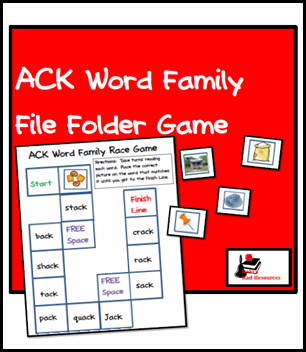
Word Family Station #1 - Playing with Word Families: Students were assigned to either work on self-correcting puzzles (for my lower level students) or file folder games (for my higher level students).   

Centers are not one size fit all!  All instruction should be differentiated to meet the needs of students, including math and literacy centers.  Stop by Raki's Rad Resources for ideas and resources - ACK family self correcting puzzle     Centers are not one size fit all!  All instruction should be differentiated to meet the needs of students, including math and literacy centers.  Stop by Raki's Rad Resources for ideas and resources - ACK family file folder game

Word Family Station #2 - Reading Word Families: Students were assigned to either read word wall cards and match them with other word wall cards that had the same word (for lower level students) or making word centers (for my higher level students).


Centers are not one size fit all!  All instruction should be differentiated to meet the needs of students, including math and literacy centers.  Stop by Raki's Rad Resources for ideas and resources - ACK family word wall cards    Centers are not one size fit all!  All instruction should be differentiated to meet the needs of students, including math and literacy centers.  Stop by Raki's Rad Resources for ideas and resources - ACK family making words center


Independent Reading Station:  Students chose books from leveled boxes and read, and complete their reading journal.

 Centers are not one size fit all!  All instruction should be differentiated to meet the needs of students, including math and literacy centers.  Stop by Raki's Rad Resources for ideas and resources - primary reading journal

Listening Station:  Students listened to self selected stories from a variety of bookmarked story reading websites.  (Find great websites for listening centers in this blog post.)  Then, they shared information about what they learned on a simple listening log.

Centers are not one size fit all!  All instruction should be differentiated to meet the needs of students, including math and literacy centers.  Stop by Raki's Rad Resources for ideas and resources - listening center


In addition to differentiating by general ability, I would often differentiate the word family centers with which word family different students were working on, giving lower level students the chance to re-do the same word family over and over until they achieved success and built fluency and allowing the higher level students to challenge themselves with more difficult word families and harder vocabulary.  Each center started out the year with 41 different word families available and students chose the word families that were assigned to them.

Since I don’t rotate, my students did not move in set groups, so I would have a laminated class list at each center.  At the beginning of the week, I would note word families I would like each student to work on next to their names – using a dry erase marker.  This was a simple way of changing out my centers often without having to do much work. 


This concept can also be used in math.  When I taught 3rd grade, my math centers would most often look like this:


Calendar Books:  Students each received different calendar books, depending on their level.  The covers looked the same and everyone had the same “number of the day”, so it looked like everyone was doing the same thing.  However, my low level students were working on basic number properties like expanded notation and base ten blocks while my higher level students were multiplying and dividing the same number by 10 and 100.

Centers are not one size fit all!  All instruction should be differentiated to meet the needs of students, including math and literacy centers.  Stop by Raki's Rad Resources for ideas and resources - calendar books   Centers are not one size fit all!  All instruction should be differentiated to meet the needs of students, including math and literacy centers.  Stop by Raki's Rad Resources for ideas and resources - calendar books


Fast Fact Practice:  I laminated fast fact quizzes and put them in a center with a kitchen timer.  Students practiced those facts over and over with a dry erase marker and a tissue.  Each quiz was hole punched and organized into a binder by operation. Like with word families, I keep a laminated class list at this center so that students knew which level to work on.


Centers are not one size fit all!  All instruction should be differentiated to meet the needs of students, including math and literacy centers.  Stop by Raki's Rad Resources for ideas and resources - Addition Fact Quizzes    Centers are not one size fit all!  All instruction should be differentiated to meet the needs of students, including math and literacy centers.  Stop by Raki's Rad Resources for ideas and resources - Division Quizzes

Problem Solving Practice:  My students used Problem Solving Path for problem solving practice, which isn’t differentiated, except by grade level.  However, students worked through each monthly journal at their own pace, so some students completed all 10 journals in the course of the year, while others only completed 4.  (I did set a requirement of at least one per trimester, simply to cover required grades.)


Centers are not one size fit all!  All instruction should be differentiated to meet the needs of students, including math and literacy centers.  Stop by Raki's Rad Resources for ideas and resources - Problem Solving Path


Critical Thinking Practice:  Students used tiling puzzles to work build their critical thinking skills.  Students were given their puzzles as a stapled packet of 10 puzzles, differentiated by their level (some starting with addition, others multiplication).  As students completed one packet, they would turn it in for a No-Homework Pass, and the next level of puzzles. 


Centers are not one size fit all!  All instruction should be differentiated to meet the needs of students, including math and literacy centers.  Stop by Raki's Rad Resources for ideas and resources - tiling puzzles     Centers are not one size fit all!  All instruction should be differentiated to meet the needs of students, including math and literacy centers.  Stop by Raki's Rad Resources for ideas and resources - tiling puzzles


Since I did so much differentiation, I now have a TON of resources that are available at different, differentiated levels.  Take advantage of this to save time in your own classroom and download any of the resources I discussed in this blog post at my Teachers Pay Teachers store. 


How do you offer your students a differentiated/ individualized center experience?

Heidi Raki of Raki's Rad Resources

Sunday, February 23, 2014

I Don’t Do Center Rotations – Here’s Why and How I Do It

Center rotations don't work in my classroom.  Stop by Raki's Rad Resources for an alternative to center rotations that provides students with independent work time without all the transitions. For years, I have tried and tired to do “center rotations”.  However, no matter how hard I try, I never seem to be able to make it work.  That’s not to say I don’t do center – type activities, I just don’t do rotations.  Here are my big issues with center rotations:

1.  It means that every group gets exactly the same amount of time for the same activities.  However, my kids NEVER finish the same activity in the same amount of time.  I always have early finishers and kids who require more time.  So, giving each of them exactly 20 minutes to complete the same task is not sensible.

2.  It takes a lot of effort to “watch the clock” and be sure that each group moves when it is supposed to.  Now, I still watch the clock a little in order to be sure I see all of my reading groups at the same time.  However, if I am not nailed to that “20 minute rotation”, then I can spend that 30 minutes with my struggling readers while only taking 10 minutes to check and make sure that my top group is on track with their novel studies. 

3.  When I rotate, I am stuck with finding a set amount of activities that fit into set time blocks, instead of thinking about what my students actually need to be doing. 

4.  Transitions!  I have spent my teaching career trying to get rid of “dead time” transitions.  Getting rid of center rotations got rid of the concept of having all of the students transition at the same time.

Now, don’t think that my students are sitting and listening to me lecture all day, or that they are all working on the same activity with my guidance all day – far from it.  Instead, I spend a lot of time at the beginning of the year training my students on how to use a To Do List. 

I generally write my To Do List on the board, although for younger students I may type the list on a sheet where they can cross off each thing they do and I can check their progress at the end of the day.  My students are trained to start at the top of the list and work down to the last item, which is generally an unending or open ended item, such as working on puzzles or reading a book.  This prevents a teacher’s most dreaded words “I’m done, what do I do now?”

My Math To Do List generally looks like this:Use a to do list instead of a center rotation in order to increase student engagement and decrease transition times.  Find more details at Raki's Rad Resources.

1. Complete your Calendar Book

2.  Complete today’s Daily Math Review

3.  Finish this week’s Reflection in your Interactive Math Notebook

4.  Complete page xxx in your textbook

5.  Work on creating your Math Tutorial Videos

6.  Work on your Tiling Puzzles

7.  Work on Izzi (a critical thinking puzzle)


My Literacy To Do List generally looks like this:Use a to do list instead of a center rotation in order to increase student engagement and decrease transition times.  Find more details at Raki's Rad Resources.

1. Complete today’s poetry reflection

2.  Complete today’s vocabulary

3.  Read for 15 minutes

4.  Work on Reading Response Journals

5.  Work in your Writing Journal

6.  Make “quiz questions” for a book you’ve read recently

7.  Listen to stories on assigned websites

Now, all students do not get to number 5, 6 and 7 every day, but that’s okay.  They have spent time on the things that I feel are most important for that block of time.  I will often set apart separate chunks of time to work on the bottom items of a to-do list, so that students who haven’t reached that point will get extra time to complete their tasks.

St. Patrick's Day Center Packet from Raki's Rad Resources I know at least some of you are going – Wait, Heidi, don’t you sell holiday oriented center packets?  Sure I do, but generally, students don’t rotate through these in my class.  Rather, they will work through each activity at their own pace and make an X over each activity as it is finished.  BTW – St. Patrick’s Day is coming up, and here is a link to my St. Patrick’s Day Center packet.

How do you run independent work time in your classroom?

Heidi Raki of Raki's Rad Resources


Saturday, January 4, 2014

Happy New Year!

It’s officially 2014!  How long do you it will be before we remember to write that down correctly?  As we bring in the Printable New Year's Center Packet with activities about new year's resolutions, self portraits, math problem solving, reading comprehension and verb tenses by Raki's Rad Resourcesnew year, this is a great time to talk with our students about new beginnings, celebrations and resolutions.  I have done all of those things with my New Year’s Center Packet.  It includes looking back at the previous year, looking forward to what will come and of course some time to look at the celebration itself.  The best part is that you don’t have to cut or glue, so if you’re “not quite” ready for the first day pack, you can simply copy and staple this packet and fill a whole day with New Years centered learning.  Download a copy from my Teachers Pay Teachers store.

This year, I teach mainly math, so we will spend some time looking at years and how to compute a person’s age by knowing the year they were born and the current year.  We will also talk about the fact that there are different calendars used around the world, and how the New Year is celebrated in China, India and Islamic countries which do not use the Gregorian Calendar.

What will you do with your students to celebrate the New Year?

Heidi Raki of Raki's Rad Resources