Showing posts with label word families. Show all posts

Monday, October 27, 2014

Differentiated Center Activities

Centers are not one size fit all!  All instruction should be differentiated to meet the needs of students, including math and literacy centers.  Stop by Raki's Rad Resources for ideas and resources.

Center activities – available in rotations or checklists (Click HERE to see my rant post on why I don’t do center rotations.) - give teachers the perfect opportunity to differentiate and truly meet the needs of our students.  During literacy or math centers, students DO NOT have to be doing exactly the same thing, that is the nature of this time.  However, I often see many teachers who have all students rotate through three IDENTICAL centers and the only time that students are receiving any individualized consideration is when they are at a teacher’s guided reading/ guided math table.  In my opinion, this is a complete waste of what could and should be individualized instructional time. 

Of course, setting up more individualized instructional centers requires a bit more set up. One key to simplifying the process is to have similar, but different, centers available, so that students are working on the same concept, but at different levels.


For example, when I taught 1st grade, my literacy centers most often looked like this:

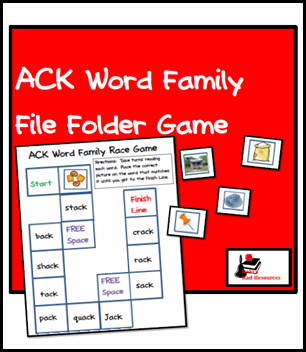
Word Family Station #1 - Playing with Word Families: Students were assigned to either work on self-correcting puzzles (for my lower level students) or file folder games (for my higher level students).   

Centers are not one size fit all!  All instruction should be differentiated to meet the needs of students, including math and literacy centers.  Stop by Raki's Rad Resources for ideas and resources - ACK family self correcting puzzle     Centers are not one size fit all!  All instruction should be differentiated to meet the needs of students, including math and literacy centers.  Stop by Raki's Rad Resources for ideas and resources - ACK family file folder game

Word Family Station #2 - Reading Word Families: Students were assigned to either read word wall cards and match them with other word wall cards that had the same word (for lower level students) or making word centers (for my higher level students).


Centers are not one size fit all!  All instruction should be differentiated to meet the needs of students, including math and literacy centers.  Stop by Raki's Rad Resources for ideas and resources - ACK family word wall cards    Centers are not one size fit all!  All instruction should be differentiated to meet the needs of students, including math and literacy centers.  Stop by Raki's Rad Resources for ideas and resources - ACK family making words center


Independent Reading Station:  Students chose books from leveled boxes and read, and complete their reading journal.

 Centers are not one size fit all!  All instruction should be differentiated to meet the needs of students, including math and literacy centers.  Stop by Raki's Rad Resources for ideas and resources - primary reading journal

Listening Station:  Students listened to self selected stories from a variety of bookmarked story reading websites.  (Find great websites for listening centers in this blog post.)  Then, they shared information about what they learned on a simple listening log.

Centers are not one size fit all!  All instruction should be differentiated to meet the needs of students, including math and literacy centers.  Stop by Raki's Rad Resources for ideas and resources - listening center


In addition to differentiating by general ability, I would often differentiate the word family centers with which word family different students were working on, giving lower level students the chance to re-do the same word family over and over until they achieved success and built fluency and allowing the higher level students to challenge themselves with more difficult word families and harder vocabulary.  Each center started out the year with 41 different word families available and students chose the word families that were assigned to them.

Since I don’t rotate, my students did not move in set groups, so I would have a laminated class list at each center.  At the beginning of the week, I would note word families I would like each student to work on next to their names – using a dry erase marker.  This was a simple way of changing out my centers often without having to do much work. 


This concept can also be used in math.  When I taught 3rd grade, my math centers would most often look like this:


Calendar Books:  Students each received different calendar books, depending on their level.  The covers looked the same and everyone had the same “number of the day”, so it looked like everyone was doing the same thing.  However, my low level students were working on basic number properties like expanded notation and base ten blocks while my higher level students were multiplying and dividing the same number by 10 and 100.

Centers are not one size fit all!  All instruction should be differentiated to meet the needs of students, including math and literacy centers.  Stop by Raki's Rad Resources for ideas and resources - calendar books   Centers are not one size fit all!  All instruction should be differentiated to meet the needs of students, including math and literacy centers.  Stop by Raki's Rad Resources for ideas and resources - calendar books


Fast Fact Practice:  I laminated fast fact quizzes and put them in a center with a kitchen timer.  Students practiced those facts over and over with a dry erase marker and a tissue.  Each quiz was hole punched and organized into a binder by operation. Like with word families, I keep a laminated class list at this center so that students knew which level to work on.


Centers are not one size fit all!  All instruction should be differentiated to meet the needs of students, including math and literacy centers.  Stop by Raki's Rad Resources for ideas and resources - Addition Fact Quizzes    Centers are not one size fit all!  All instruction should be differentiated to meet the needs of students, including math and literacy centers.  Stop by Raki's Rad Resources for ideas and resources - Division Quizzes

Problem Solving Practice:  My students used Problem Solving Path for problem solving practice, which isn’t differentiated, except by grade level.  However, students worked through each monthly journal at their own pace, so some students completed all 10 journals in the course of the year, while others only completed 4.  (I did set a requirement of at least one per trimester, simply to cover required grades.)


Centers are not one size fit all!  All instruction should be differentiated to meet the needs of students, including math and literacy centers.  Stop by Raki's Rad Resources for ideas and resources - Problem Solving Path


Critical Thinking Practice:  Students used tiling puzzles to work build their critical thinking skills.  Students were given their puzzles as a stapled packet of 10 puzzles, differentiated by their level (some starting with addition, others multiplication).  As students completed one packet, they would turn it in for a No-Homework Pass, and the next level of puzzles. 


Centers are not one size fit all!  All instruction should be differentiated to meet the needs of students, including math and literacy centers.  Stop by Raki's Rad Resources for ideas and resources - tiling puzzles     Centers are not one size fit all!  All instruction should be differentiated to meet the needs of students, including math and literacy centers.  Stop by Raki's Rad Resources for ideas and resources - tiling puzzles


Since I did so much differentiation, I now have a TON of resources that are available at different, differentiated levels.  Take advantage of this to save time in your own classroom and download any of the resources I discussed in this blog post at my Teachers Pay Teachers store. 


How do you offer your students a differentiated/ individualized center experience?

Heidi Raki of Raki's Rad Resources

Monday, October 20, 2014

Letter Sticks – A Simple Literacy Manipulative

My youngest son is working on letter recognition and letter sounds, so I made him these easy letter sticks today.

 Craft stick literacy center - write letters on craft stick and then let kids use them to spell words, learn alphabetical order, and more.  Ideas from Raki's Rad Resources

The sticks are super simple – they are just craft sticks that I wrote letters on.  I do uppercase on one side and lowercase on the other, and always write on the front and the back, so there’s no way for kiddos to get confused.  I also make sure that I make at least two for each letter, sometimes more for those Wheel of Fortune letters (R S T L N E).

After I made these, I started thinking of all the ways that these could be used in word work and literacy centers.  So, I thought I’d share a few ideas with you:


1.)  Flash the letter – What’s the name?  What’s the sound?  Just like letter cards, this gives you an easy way to check where students are.  In fact, they can check themselves, and put the ones they know into one cup and the ones they don’t into another.


2.)  Matching uppercase and lowercase – As long as you have at least two of each letter, students can match the uppercase version with the lowercase version easily and increase their understanding of different forms of a letter.

Craft stick literacy center - write letters on craft stick and then let kids use them to spell words, learn alphabetical order, and more.  Ideas from Raki's Rad Resources

3.)  Write out their name – Being able to spell their own name is an important pre-reading skill.  Help kids to spell out their own name by having name cards available to them, and then slowly remove the name cards from the center.


4.)  Spell simple words – First copying words from word wall cards and then creating words of their own, students can use this simple manipulative to build words.  Older kids can use these manipulatives to practice spelling sight words and spelling words.

Craft stick literacy center - write letters on craft stick and then let kids use them to spell words, learn alphabetical order, and more.  Ideas from Raki's Rad Resources

5.)  Quickly change out word family words – Have students create the word family and change out the beginning.  Or have students use these in place of letter cards when playing the Making Words Word Family Centers available at our Teachers Pay Teachers store.


6.)  Work on alphabetical order – Let the kids put the sticks in order from A to Z.  Now can they do it from Z to A?

Craft stick literacy center - write letters on craft stick and then let kids use them to spell words, learn alphabetical order, and more.  Ideas from Raki's Rad Resources

How could you use this simple literacy manipulative?


Heidi Raki of Raki's Rad Resources

Monday, August 11, 2014

The Purpose Behind Bulletin Boards

Despite the thousands of cutsie bulletin boards floating all over Pinterest, the true purpose behind bulletin boards is not to have the cutest room in the school.  The true purpose behind bulletin boards – as I see it – is to increase the learning opportunities for our students. Decorations for the sake of decorations do not help learning and often provide a distraction to students with ADD or other disabilities.

Bulletin boards should be educational, not decoration.  Stop by Raki's Rad Resources for ideas on how to make your bulletin boards more educational.

Bulletin boards:

1.  Should provide students with information that they can reference during lessons or centers.  Bulletin boards should be a part of the learning experience, not a decoration.

2.  Should be built with the students OR have an element that the students can interact with.  Either of these opportunities allow students to feel ownership for the board and encourages them to use the board rather than just be distracted by it.

3.  Don’t have to be changed every week or month.  Bulletin boards can be built slowly over the course of the school year, helping students to connect new knowledge to knowledge gained earlier in the school year.


Just because bulletin boards aren’t decorations, doesn’t mean they can’t be visually attractive.  In fact, good graphic design elements make bulletin boards easier for children to read and thereby more access to the information on them.  Here are a few examples of meaningful bulletin boards for your classroom:


Bulletin boards should be educational, not decoration.  Stop by Raki's Rad Resources for ideas on how to make your bulletin boards more educational.  Word Family word wall, with graphics to help out ESL students.

Word Family Word Wall – These Alphabet Labels, Sight Word Cards and Word Family Word Wall Cards help your students to sound out and recognize the meanings of common words.  Students refer back to this word wall during literacy centers, like read the room and journal writing.


Bulletin boards should be educational, not decoration.  Stop by Raki's Rad Resources for ideas on how to make your bulletin boards more educational.  Math Word Wall with definitions and graphics to help students understand key math vocabulary.

Math Word Wall – Math Word Walls should do more than simply list the important vocabulary words.  Definition cards, like those in my Math Vocabulary Packets (Addition & Subtraction, Multiplication & Division, Fractions, Geometry 1 and Geometry 2) give students the definition to refer to when they are stumped by those vocabulary words at math centers or independent problem solving


Bulletin boards should be educational, not decoration.  Stop by Raki's Rad Resources for ideas on how to make your bulletin boards more educational.  After students answer the questions in their Problem Solving Path math journals, they can check their answers using the QR codes on these posters.

Problem Solving Path – This interactive bulletin board displays the monthly word problems from the Problem Solving Path Journals, as well as giving students QR Codes to help them check their answers.


Bulletin boards should be educational, not decoration.  Stop by Raki's Rad Resources for ideas on how to make your bulletin boards more educational.  Build concept maps with key vocabulary, like the defintions of technology vocabulary.

Technology Word Wall – Word walls don’t have to be listed in alphabetical order.  For topics like technology, it’s better to group Vocabulary Word Wall Cards into connected words or concepts.  Add connecting words or ideas to help students make those connections when they are using the word wall later.


Bulletin boards should be educational, not decoration.  Stop by Raki's Rad Resources for ideas on how to make your bulletin boards more educational.  Use bulletin boards to create pictographs with data on student achievement - like success on mastering math facts.

Math Fact Reward Board – Students can track their own progress on math fact quizzes, and stay motivated to practice during math centers by having a math fact reward board with a fast fact reward system.


How do you keep your bulletin boards meaningful?

Heidi Raki of Raki's Rad Resources