Showing posts with label Guest Bloggers. Show all posts

Monday, March 11, 2013

Six Writing Traits Lessons

Hi guys, we have a guest blogger today.  She’s here to talk about Six Traits Writing – one of my favorite programs.  Her name is  Tama and she’s in my neck of the woods (or at least on my side of the Atlantic ocean), over in Paris.  She also blogs at Across the Pond, so please stop by and check her out.signature


Hi everyone! Salut from Across the Pond Blog in Paris, France. I am guest blogging today here at Heidi Raki's Rad Resources blog. I am super excited to be here and blog with you about something we all know - The Six Writing Traits.  However, there is a fabulous site that I use that shows you how to incorporate literature into the writing process. I love this idea as it makes it more interesting for the students and they also have something to refer back to and, you, as a teacher, have something concrete to model for the students which is always helpful.

Jodie Black and the Northern Nevada Writing Project have an excellent site to engage writers at an early age. How they aim to teach the six writing traits into the early grades is through literature. This gives the children not only a visual to refer to but an idea of something to think about. How many times have you heard, "I don't know what to write about." By intertwining literature into the concepts the students have a better understanding of what is needed to start the writing process.  The Nevada Project has put out a guide of 36 lessons that you can purchase that incorporate the six traits into a literature program. There are also some samples of writing lessons that you can use to get you started.  Yes, you do have to have the books they are referencing in the lessons, but most of them can be found in your pubic library or you can purchase them used from any number of resources or think yard sales!! The Writing Project also has a guide for older primary students as well. Here is the link to some samples for older students.

Another great resource I have found is the Month by Month Trait Based Writing Instruction Book by Maria Walther and Katherine Philips. This guide has proved indispensable for me as not only does it offer wonderful resources for writing, it also ties in your morning message to the writing program so the children can link back to their writings by again having a visual.
 
 
As an example using a writing activity from the Nevada Project, we followed the lesson using the story, All the Places to Love.  After reading the story and modeling the lesson, the children then came up with their own writing about a special place using positional words. Here is a link to the lesson and  a link to what my children wrote for this activity.
 
 
Across the PondBe sure to check out all these great resources to make your writing program even better. See you all around the blogosphere.
Cheers,
Tama


Tuesday, February 5, 2013

Using Movies to Help ESL–Guest Blog Post from Madame Aiello

Recently, I added 6 hours a week of French lessons to my load.  In an effort to free up some time for me to  master this important learning,  I have  asked some amazing bloggers to guest blog for us here on Raki’s Rad Resources. Today our guest blogger is Tammy Aiello from Teaching FSL.  She has agreed to do tonight’s Tuesday TESOL Tip, and she’s more than qualified to do so. After you check out her tip, and grab her freebie be sure to stop by and check out hsignatureer blog – Teaching FSL.


Tuesday TESOL Tip:  Use movies to engage language learners and increase vocabulary.


Hi there! I'm Tammy (aka Madame Aiello) and you can visit my blog at Teaching FSL  I'm honoured to be guest-authoring a blog post at Raki's Rad Resources!  Heidi's ideas are materials absolutely are "Rad" and she's been at this much longer than I have, so I'm thrilled that she's opened her virtual door wide and welcomed me.

I'm a French as a second language teacher in Canada, but I have a secret……….… I'm qualified to teach English as a Second Language as well.  Wanting to try my hand at offering something for English Language Learners as well, I thought it would be wise to draw upon what I know best - things I have used in my own classroom. 

Last year, I showed my French classes the film The Ant Bully, with the French language track turned on, and subtitles as well for portions of the movie. I developed a whole package of activities to explore and discuss the film.  Since I first saw this movie in English with my kids, I thought the inspiration I felt to use it in class would certainly be something for ESL teachers to consider.  There are themes of bullying, identity, and acceptance to explore, and the fact that Lucas is a newcomer in his neighbourhood is sure to make some personal connections with your students. The film also offers a few opportunities to discuss media literacy, and of course a full length movie is rich in vocabulary and sentence structures to explore. Since it's an animated film, it really does capture the kids' attention.


For a synopsis of the movie, I recommend checking Internet Movie Database. I love their parental guidelines, which let you know exactly what objectionable content a movie contains, in clear terms so that you can decide for yourself if you are comfortable exposing your little learners to something. (Warning... there are boogers and butt cracks in this film!)

I've got a little freebie for you imageto try out today related to the movie.  It's a set of
True or False questions that span the entire duration of the film.  Simple enough, but it can lead to some really interesting discussions as well as helping you to check for understanding with your English Language Learners.

Watch for another free sample in the near future as I will be creating a full package equivalent to my FSL material. If you try this, I'd love to hear how your students responded to the activity!
 

Friday, January 18, 2013

Five Things to Consider When Contacting Parents

In the next few months, we will have some awesome guest blog posts for you.  I have added 6 hours a week of French lessons to my load, and so I will be less present than normal in an effort to take the time to master this important learning.  In an effort to help me out, I have had some amazing bloggers agree to guest blog for s here on Raki’s Rad Resources.  Today our guest blogger is Mary Baur from Artistry for Education.  She has some great tips for how to make parent – teacher interaction easier.  After you check out her tips, be sure to stop by and check out hsignatureer blog – Artistry for Education.


Contacting Parents (2)

I’m Mary Bauer from Artistry of Education. I have been teaching for twenty-two years in a diverse community, and I have had my share of conflicts with parents. I want to share a few things I have learned to help these relationships go more smoothly.

Be proactive. I start with a parent information form the first week of school. At the top is this sentence: “I believe that a parent is a child’s first and best teacher.” It sets the tone for the year.

Be positive. All families advocate for their children. They just may not approach us in the way we like at the times we like. All families want their students to be successful. We may define success in different ways. Someone who doesn’t seem to cooperate is probably just afraid.

Be predictable. When I transferred to the school where I teach now, I earned the reputation of working well with parents. “You answer our emails,” one parent shared with me. I make it a personal goal to respond to a parent within twenty-four hours. I make sure I am on time to parent meetings. I want parents to know they can trust me with their children. If I put off contacting the parent, the problem generally grows worse.

Be professional. It’s tempting to gossip in the staff lounge and speculate about family backgrounds. The more parents know they can trust me to keep their concerns private, the more they are willing to share with me information that will help me teach their child.

On the other hand, talking with the student’s previous teacher can give you good information to help you this year. Make sure this conversation is private and based on direct observations of the child and parent conferences.

Be prudent. I have had five or so parents in my career that made me uneasy for one reason or another. It is wise to invite another staff member to attend these conferences. Another person can be a buffer in a potential conflict or a neutral witness to what I share with the parent. If you do this, let the parents know who will be attending the conference so they don’t feel cornered.

The other side of this is inviting the parent to bring in someone he or she feels comfortable with. It is tough to receive difficult information without a support system.

While my career is certainly not conflict-free, I can see how the time I invest in communicating with parents helps everyone involved.


The Artistry of Education

Mary Baur is a third generation public school teacher who has been in education since 1987. She has taught elementary students full time for the last 20 years. She is also a freelance curriculum writer.

Saturday, December 15, 2012

6 Online News Sites Created for Classroom Use

Today we have a special guest blogger joining us.  I’m proud to present Jillian Terry from Teaching Degree.  She has agreed to share some great websites with you.   signature


When I was a freshman in high school, I had a history teacher who made my class read the newspaper at the beginning of every lesson. I didn’t realize it at the time, but that exercise served a higher purpose than just keeping up with current events. It was really a lesson about democracy. My teacher also used it as a way to bring history alive by showing how current world issues often have roots going back hundreds of years.

Because of this, I believe that reading and encouraging an open discussion about world news is a great way to encourage awareness and foster enlightenment. However, since newspapers aren’t as popular as they were when I was in school, here’s a list of some of the best online, kid-friendly news sites on the web today. Use a mixture of local news sources and the following sites for full news coverage.

CNN Student News

If you have access to a digital projector in your classroom, you can watch the daily news segments created by CNN Student News. The videos usually run Some of the best online, kid-friendly news sites to use in the classroom.around ten minutes and contain stories from the U.S. and abroad. Teachers can download transcripts for each segment for reference, and a news quiz is provided to test student understanding. Students can also send their own video news reports and request school shout outs. If accepted, they will be aired on one of the student news segments!

PBS NewsHour Extra

The PBS NewsHour Extra website is packed with high-quality, teen-friendly news and student commentaries. I say “teen-friendly,” because the articles are written to be read by students in grades 7-12. Some of the best online, kid-friendly news sites to use in the classroom.This is another news site that provides teacher lesson plans to encourage full classroom participation. I especially like the Student Voices section which gives students the opportunity to voice their opinions on current events. Daily video clips are also available in the Teacher Center section. These can be used to supplement news stories or other classroom topics.

Nick News

Some of the best online, kid-friendly news sites to use in the classroom.Nick News is a weekly kids’ news show that has been produced for the Nickelodeon network since 1992. Today, the show has its own website where visitors can find news articles and videos from past shows. I’m a big fan of the documentary-like videos which cover how current world issues are affecting the lives of children and teens. For example, this video about local water supply tells the story of how kids in different parts of the world get water to their homes every day.

TIME for Kids

TIME for Kids is a weekly news magaSome of the best online, kid-friendly news sites to use in the classroom.zine published by Time, Inc. Although classrooms must subscribe to the magazine and wait for it to arrive via mail, its digital version is open to the public and can be accessed from any computer. Although the website doesn’t feature as many news stories as the magazine, there are additional features on the site that still make it worth a visit. For example, the Homework Helper section is a good resource for students who need help with English grammar and writing.

CBBC Newsround

Newsround is a weekday kids’ news show produced by the CBBC (the children’s version of the BBC). Even if you don’t live in Great Some of the best online, kid-friendly news sites to use in the classroom.Britain, you can still access the show’s content on its official website. There, you can read a variety of stories, watch video clips, take news quizzes, play games and more. The stories are all very short to accommodate the reading levels of very young students.

Teaching Kids News

This website was started by a Toronto-based freelance journalist and elementary school teacher. The freelance journalist was a parent to one of the elementary school teacher’s students. After asking the journalist to sSome of the best online, kid-friendly news sites to use in the classroom.peak to his class about the news, the teacher came up with a brilliant idea to start a website that produced kid-friendly news articles. TeachingKidsNews.com has been operating now since 2009 and is updated on a daily basis. What makes this site difference from other kid-friendly news sources is that each article is accompanied by a lesson plan to aid reading comprehension, promote discussion, and teach grammar.


Jillian Terry is a freelance education writer and former teacher. As an advocate of homeschooling and online education, her writing often focuses on new methods of education and curriculum reform and has been published on various education websites, including www.TeachingDegree.org. Jillian welcomes your questions and comments below!

Monday, November 19, 2012

A Visit from the Book Jeannie

Today we have a special guest blogger joining us.  I’m proud to present Richard Giso from Room to Read.  He has agreed to share a great class reward that he uses.  After reading, be sure to grab the freebie he is offering.  signature


Here’s a spin on an idea that a fellow first grade teacher shared with me about a “Book Fairy” that visited her children’s literature class when she was a graduate student.

I searched online and found a jeannie lamp. The whole idea is that my class gets a visit from the “Book Jeannie” as a reward. The first time the Book Jeannie comes to my classroom, the lamp appears with a brand new, wrapped book and a letter written on “Book Jeannie Stationary.”

I act all surprised and really jazz this occurrence up! We read the letter and book together. The book becomes a part of my classroom library. I leave the lamp in my library. When the Book Jeannie comes again, it always moves to a new spot. This fun filled idea is a great addition to any classroom. Here are some pictures of me getting ready for a “visit”:


Use the Book Jeannie as a class reward and literacy builder.

I chose the book “Perfect Square” my Michael Hall.


Use the Book Jeannie as a class reward and literacy builder.

I bought some shiny wrapping paper with a glitter bow.


Use the Book Jeannie as a class reward and literacy builder.

I wrote a note on my Jeannie Stationary.


Use the Book Jeannie as a class reward and literacy builder.

I get my jeannie lamp, wrap the book, attach the note and I am ready to place this in my classroom library. Not only does it serve as a reward for good class behavior, but it also promotes a love of literacy.

Please visit my Teachers Pay Teachers store for this freebie.

  - Richard Giso 

Monday, September 17, 2012

Explaining Plagiarism to Elementary Students

Hello everyone, I’d like to introduce you to this week’s guest blogger: Emilia of Plagtracker.com She’s going to explain the importance of teaching young students about plagiarism.  I know this is a topic I have discussed with students as young as 2nd grade, especially when beginning to look at research projects. If you like what she has to say, please take a minute to stop by her website and check out her blog and the services offered.signature_thumb1


Plagiarism has always been a serious problem in education. One may think that children in elementary school have not yet been infected by this debilitating disease that continuously plagues our society in this modern age of technology. Think again.

Perhaps the best way to avoid this is by teaching children as early as elementary aged students the meaning of plagiarism and how to avoid it when doing their homework.

Plagiarism is stealing

Plagiarism is using someone else’s work and passing it off as your own. In simple terms, it is theft in broad daylight. Teachers should explain that plagiarism is stealing; some young students may think that they are just “borrowing” someone’s words or ideas, and therefore it is not wrong. While others may think, everyone is doing it, it must be okay then. No it isn’t. Plagiarism is a serious offence, in some instances, punishable by law. Students who have become serial plagiarists continue to do their wrong-doing simply because they’ve done it so often, it actually feels normal for them to keep doing it and since they haven’t been caught, they somehow feel that they are invincible.

Why We Should Teach Young Students About PlagerismWhy students Plagiarize

When younger students plagiarize, often times it is unintentional and done out of ignorance. They forget to credit their sources, put quotes when needed, or paraphrase correctly. When they are young, these mistakes if not corrected early on may very well stay with them until they reach university, or worse, even into adulthood.

However for older students, it is just plain laziness, especially when they copy paste and directly lift a whole paragraph from the internet, some even forget to change the fonts! As for college or university students who buy essays online or hire someone else to do their school work for them, it’s done because of pure indolence.

End Result

Students should be aware of the serious consequences of plagiarism. However, each schools deal with plagiarism differently. For the younger ones, they can be expelled or given a failing grade with a letter for their parents. For older students though, it is much worse than that. If proven guilty they can lose the chance of earning their degree and graduating, all those years of studying and hard work can be gone in just a flash. For worse case scenarios, legal action can be taken against them.

Keeping your students off the road to plagiarism

1. Keep reminding them that plagiarism is stealing.

2. Explain to your students that even if they “forget” to name a source, even if it’s just an illustration or a drawing, they can still be accused of plagiarism. Keep nagging them to double check if they have absolutely named every single source they’ve used on their report or essays.

3. Use scare tactics: Do a research on people who have been caught plagiarizing other people’s work, especially those who have been slapped with a serious lawsuit, have lost their jobs or suffered extreme humiliation because of their plagiarized work. Search for them online, you’ll find many.

4. After giving your homework to your students, give a short recap on the following: how to use quotation marks when using paragraphs taken from a book, the importance of using citations, and lastly, making a list of every source they’ve used on their homework.

5. Making a check-list guide for your students will also help them avoid the mistake of plagiarism. Ask them questions likes: Did they keep track of where all the information came from in their homework? When they summarized or used ideas in their own words, did they mention where the original source is?

6. Teach them to use anti-plagiarism software found on line. There are many free plagiarism checkers like plagtracker.com to check if their work is plagiarism-free.

7. And lastly, tell your students not to be afraid to approach you and to ask questions if they are still not sure of what they are doing.

While plagiarism is a serious topic, teachers should also be very careful not to put off their students from being creative and using different kinds of sources for their homework and as long as they correctly name their sources, they will never be accused of plagiarism.

Sources:

1. Value Options, https://www.achievesolutions.net/achievesolutions/en/Content.do?contentId=10661

KidsHealth, http://kidshealth.org/kid/feeling/school/plagiarism.html#


- Emilia logo

Monday, August 27, 2012

Spotlight Blogger Pinterest Contest Winners

The results are in!  The Pinterest Spotlight Blogger winners are as follows:


Spotlight Blogger with the most pins – Sally De Cost from Elementary Matters

winner


Commenter chosen by Random.org – Jan from Thinking Out Loud


Both winners have been sent a $10 Amazon Gift Certificate.  Thank you to all who participated!  The number of pins was outstanding! 

In case you missed it, here is a list of the Spotlight Bloggers, their posts, and where they normally post:

Spotlight Blogger #1: Stephanie Moorman from Teaching in Room 6 Making Me Boxes

Spotlight Blogger #2:Michelle Griffo from Apples & ABC’s - Organizing Your Classroom Library

Spotlight Blogger #3:Michelle Lundy from Making it as a Middle School Teacher - Using QR Codes to Teach Vocabulary

Spotlight Blogger #4:Sally DeCost from Elementary Matters - Using Card Games to Teach Fast Facts

Spotlight Blogger #5:Heidi Befort from Globicate - Intentional Writing

Spotlight Blogger #6:Heidi Samuelson from Swamp Frog First Graders - A Bit About Birthdays

Spotlight Blogger #7:Christina Bainbridge from Bunting, Books & Bainbridge - Spelling Ideas

Spotlight Blogger #8:Barbara Gruener from the Corner on Character - Making Friendship Kits

Heidi-Raki-of-Rakis-Rad-Resources_th

Sunday, August 19, 2012

Pin Your Favorite Spotlight Blogger


Riding a Camel in Agadir, MoroccoI am back!!!  My family and I had a relaxing two weeks in the south of Morocco – stop by my personal blog, Journey to Morocco, to see some of the pictures from our trip.  It was a great way to recharge my batteries and prepare for the coming school year. 


imageWhile I was gone, I was lucky enough to have 8 Amazing Spotlight Bloggers write posts for your enjoyment.  In case you don’t know, I am running a Pinterest contest for these amazing bloggers.  The Spotlight Blogger who has the most pins on her post by August 27th will win a $10 Amazon Gift Certificate (One of the bloggers already has over 900 pins on her post). 

In addition, I will be sending out a $10 Amazon Gift Certificate to one of you on the same day.  Here’s how it simple it is to win:

1.  Go through the Spotlight posts, pin your favorite post to one of your boards.

2.  Leave a comment here telling us which post was your favorite and giving me an e-mail address to send your gift certificate to should you win.

That’s it – easy, right?  On the 27th, I’ll send out the Gift Certificates – using Random.org to select the comment winner. 


Here is a list of the Spotlight Bloggers, their posts, and where they normally post:


Spotlight Blogger #1:  Stephanie Moorman from Teaching in Room 6 Making Me Boxes


Spotlight Blogger #2:Michelle Griffo from Apples & ABC’s - Organizing Your Classroom Library


Spotlight Blogger #3:Michelle Lundy from Making it as a Middle School Teacher  - Using QR Codes to Teach Vocabulary


Spotlight Blogger #4:Sally DeCost from Elementary Matters  - Using Card Games to Teach Fast Facts


Spotlight Blogger #5:Heidi Befort from Globicate  - Intentional Writing


Spotlight Blogger #6:Heidi Samuelson from Swamp Frog First Graders  - A Bit About Birthdays


Spotlight Blogger #7:Christina Bainbridge from Bunting, Books & Bainbridge  - Spelling Ideas


Spotlight Blogger #8:Barbara Gruener from the Corner on Character  - Making Friendship Kits


You can also find all of these posts on my Stuff for My Classroom Pinterest board.  Happy Pinning!

Heidi Raki of Raki's Rad Resources

Saturday, August 18, 2012

Making Friends with Spotlight Blogger–Barbara Gruener from The Corner on Character


spotlight bloggerWelcome back to Raki's Rad Resources for our latest Spotlight Blogger.  My family and I are camping right now, and we are taking a break from all screens in an effort to recharge our batteries and get ready for the new school year.  While we are gone, I hope you are enjoying the spotlight bloggers who have agreed to guest blog for me.  Be sure to pin the posts you like, as the spotlight blogger with the most pins on their post will win a special prize!  And then, please stop by their blogs and see all the awesome things they have to offer you.

clip_image001


Greetings from The Corner on Character. Thanks, Heidi, for inviting me to stop by and talk about one of my favorite topics - FRIENDS.


As school inches nearer, I'm excited about another chance to facilitate those budding friendships in the upcoming school year. An important focus as you grow your class families is helping your kids connect with one another and build relationships. To make the abstract concept of friendship a bit more tangible, consider making a Friendship Kit with your little learners. Prior to the lesson, put the items below (and a list of what each represents) into a clear sandwich baggie. Before showing students the items in the Kit, ask them what they might put into a Friendship Kit if they were making one and why. 

After they share their ideas, show them your pre-fab Kit but don't tell them what each item represents yet. Instead, pull out the items one by one and ask how that particular item might represent friendship. Stress that there are no right and wrong answers so that students will feel free to share what comes to mind. I think you'll be pleasantly surprised at the interesting and insightful answers that you get. One third-grade answer amazed me: “Just like a button holds a shirt together and makes it whole, your friend completes you." After you’ve gone through all of the items, share this list and see how closely they came to what the item represents.
 
Friendship Kit - Teaching Kids about Friendship

*A Button: Friends "button up" and keep one another's secrets, unless it's a hurtful secret. This is a great time to talk about the kinds of secrets friends don't keep!
*A Rock: Friends are a strong and rock-solid support.
*A Penny:  Friends are honest like Abe, the President on the coin.
*A Cotton Ball: Friends cushion the rough road.
*A Rubber Band: Friends sometimes stretch us.
*Sweet & Sour Tarts: Friends appreciate the differences in others.
*A Smiley Face Sticker: Friends stick together.
*A Bandage: Friends can help heal hurts.
*A Paper Clip: Friends help keep everything together.
*A Flashlight Keychain: Friends are key and add light to our world.

If you have a budget, you can actually purchase the items in bulk and let the students make a Friendship Kit for themselves. When I did this, it cost about 10 cents per kit.

A book to complement this activity is Our Friendship Rules by Peggy Moss and Dee Dee Tardif.

It's kind of a guidebook for relationships. I've used it in my counseling office when mediating those triangle friendships, when two pair off and one feels left out. As a follow-up exercise, ask students to write a paragraph or talk about these words of wisdom:
 
 
"To have a friend, you've got to be a friend."
 
 
Click {here} for a Friendship Treasure Hunt and {here} for a freebie download about Trustworthiness, our Friendship Pillar. What’s your favorite Friendship book and activity?


Thursday, August 16, 2012

Spelling Ideas–Spotlight Blogger–Christina from Bunting, Books, and Bainbridge

spotlight bloggerWelcome back to Raki's Rad Resources for our latest Spotlight Blogger.  My family and I are camping right now, and we are taking a break from all screens in an effort to recharge our batteries and get ready for the new school year.  While we are gone, I hope you are enjoying the spotlight bloggers who have agreed to guest blog for me.  Be sure to pin the posts you like, as the spotlight blogger with the most pins on their post will win a special prize!  And then, please stop by their blogs and see all the awesome things they have to offer you.

clip_image001


It's me- Christina- from Bunting, Books, and Bainbridge and I'm so excited to be guest blogging over here today while Heidi is off enjoying some vacay! 

If you have seen my blog lately, you know that I'm moving from a 1st/2nd split class to a new position teaching 3rd grade ELA in a new district. It's been an exciting summer for me as I'm setting up my room and thinking about how I'm going to teach reading & language arts to 120 3rd graders all throughout the day.


Our blocks of class time are going to be about 50 minutes long, so I've been thinking about how I'm going to fit it all in... especially spelling.  I didn't do enough with spelling when I had a 100-minute block with my little people... so thinking about quick, meaningful practice that I can only budget a few minutes for is tough!  But I've come up with a few ideas (and some good oldies too!) that I wanted to share with you.


*First up is your generic old "quiz each other". In true old school style, pairs would take turns quizzing each other on their words. This would be fun for them to do every once in a while... but I like things a little more fun and exciting!


*Who doesn't love Play Dough?!  My first and second graders always loved making their words with that gooey stuff! This little guy just spelled "complete" with his Play Dough!

*Do you have desks with shiny surfaces? Did you know that dry erase markers will erase off of them quickly and easily? I thought about putting five minutes on a timer and having my kiddos write their words on their desk tops!  I know they would love it!

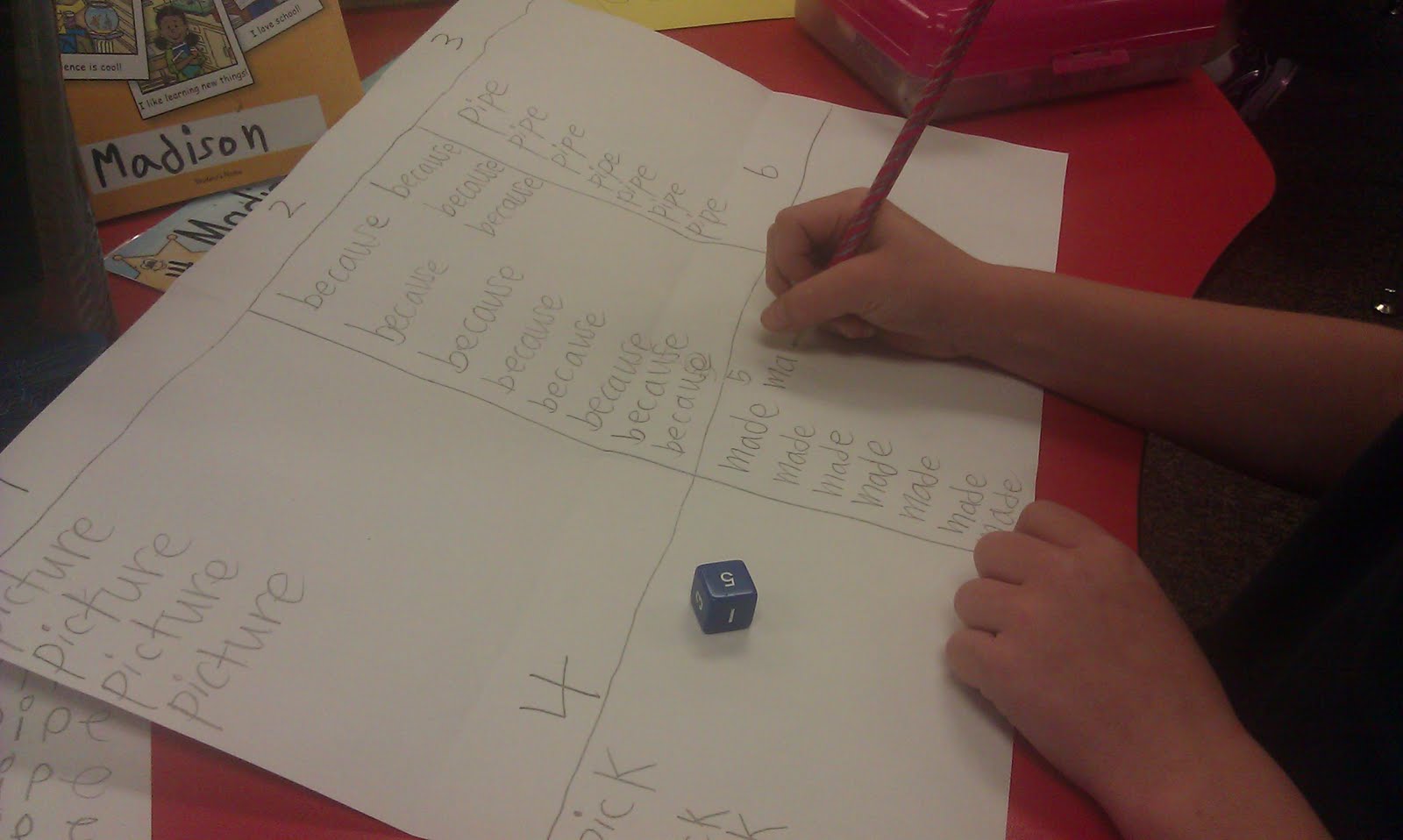
*This one is one of my favorites and my kiddos LOVE LOVE LOVE it! I have my kiddos fold a piece of paper in half and then into thirds so they have six sections.  They number each section and choose one spelling word that is tricky for themselves and write that word once in each section. So, the kiddos get to differentiate this activity for themselves! Give each kiddo a dice and have them roll it.  Whatever number comes up, they'd have to write that word in the "sixth" on their paper.  Do this for about 5 minutes and they LOVE to see which number "wins"!


*One more... this is a whole class spelling game.  I know there are lots of people who play "Sparkle" and lots of ways to play, but this is how I play... the kiddos sit on their desks and you start at one side of the room. Announce a word. The first student gives the first letter, next student gives the second letter, and so on. When the last letter is given, the next student says "Sparkle" and has to sit down- they are out. This is a good game to help students practice paying attention since you have to know what letter was just said and what the word is! It's fun, but does take more than just five minutes.
So, there you have it! A couple quick spelling activities to jazz up your spelling routines!


*Sometimes my kiddos also do a quick independent handwriting practice by choosing 8 of their words and writing each word in their best handwriting, then choosing one or two to use in a sentence.
I'd love to share that freebie with you!  Just click the picture to download it in Google Docs! I included primary lines and something more intermediate!


I'm also going to link my blog button below to all of my spelling posts on my blog... from there you can even snag my monthly "Speller's Choice" packet for free!
Thanks, Heidi, for having me!
:)
Christina

Monday, August 13, 2012

A Bit About Birthdays - Spotlight Blogger: Heidi Samuelson from Swamp Frog First Graders

imageWelcome back to Raki's Rad Resources for our latest Spotlight Blogger.  My family and I are camping right now, and we are taking a break from all screens in an effort to recharge our batteries and get ready for the new school year.  While we are gone, I hope you are enjoying the spotlight bloggers who have agreed to guest blog for me.  Be sure to pin the posts you like, as the spotlight blogger with the most pins on their post will win a special prize!  And then, please stop by their blogs and see all the awesome things they have to offer you.


Hello All,  My name is Heidi Samuelson and I teach First Graders in TN.  I usually write my blog posts at "Swamp Frog First Graders", but am so excited to be guest posting today!

I have a confession to make....birthdays are not my favorite thing to celebrate....there...I feel better!

So when I was in Walmart the other day and came across these treasures in the new school supply area....I thought they might help me make birthdays a little more special for my kiddos and a little more easier on me :)

 
Here's the idea....
~place birthday pencils and erasers inside the adorable (but way too expensive) pencil pouch...
~create "It's My Birthday" tag for lanyard...
 
On child's birthday, they get to choose a (pre-sharpened and ready to go) pencil and eraser from the pencil pouch....then they get to wear the birthday lanyard throughout the day instead of a sticker (that always fell off before lunchtime anyway)!
 

If you're at all familiar with Dr. Jean then you know what a  "spitfire" she is to watch during a conference/workshop !  I've learned about tons of things from her.  My favorite are her classroom cheers
 
However... I was inspired by her YouTube video of some ideas for making birthdays special...
You can check out her blog post about birthday celebrations HERE.
 
 
I've created a "cheat sheet" to post near the 'meeting area' in my room so I remember what the words are to the songs and chants she talks about in her video. 
 
 
You can download a copy for your class by clicking on the picture above.
 
A friend of mine also said she remembered a teacher friend of hers making the day special with a candy bar and a note on the birthday child's desk waiting for them when they come in the room....Uhmmm...not sure I'm ready for THAT...but maybe a roll of smarties for being a year smarter today???  Might have to work on a tag or sticker for that concept...Be sure to hop over to the Swamp and see if I can cook anything up !


Sunday, August 12, 2012

Intentional Writing–Spotlight Blogger by Heidi Befort of Globicate

spotlight bloggerWelcome back to Raki's Rad Resources for our latest Spotlight Blogger.  My family and I are camping right now, and we are taking a break from all screens in an effort to recharge our batteries and get ready for the new school year.  While we are gone, I hope you are enjoying the spotlight bloggers who have agreed to guest blog for me.  Be sure to pin the posts you like, as the spotlight blogger with the most pins on their post will win a special prize!  And then, please stop by their blogs and see all the awesome things they have to offer you.

clip_image001


The beginning of the year clip_image002always seems to be a swirl of ideas and planning and creating for me. I even have a hard time stopping my brain to sleep at times. Most of my thoughts are about my new students, new curriculum, larger class sizes, parent communication, seating , and classroom management. It’s hard to focus on just one thing, and thinking about it makes me exhausted. There is one thing I do love to focus on though and it’s one of the first things I ask my students to do when they arrive on the first day of school…write!

Writing is a great way to get your students back in the groove and engaged in school. Not only do you engage them in writing, but also you get them thinking, creating, planning, conferencing, and sharing right from the start. Best part is it gives you an ideal way to assess skills on many levels and start planning for your first writer’s workshop piece and year.

One of my favorite ways to start each piece is by sharing a story, short novel, or picture book. I know what you’re thinking…my students are too old to be read to, right? Well let me tell you, reading to my 4th and 5th graders last year was one of my favorite things to do and theirs too! Right after lunch, turn down the lights, let the students relax and be enthralled by the book. And then guess what, 10 minutes later, wham, on go the lights, we discuss what we read, highlight what you want them to focus on, and then they scatter to desks and writing areas around the room to write silently for 10 minutes. If you sit down and write with them, they will be totally blown away, and won’t know what to do. Plan on sharing what you’ve written also, it’s wonderful for new writers to see and hear what others have to say and how they say it!

So, as you’re planning for your new school year, amongst the seating charts, bulletin boards, incentive charts, and parent handbooks, think about your writer’s workshop and how you can use it to your advantage right from the first bell. I’ve written several posts about Intentional Writing for your students. These posts cover how to generate ideas, graphic organizers, and conferences, all the way to the author’s chair. Check them out at www.Globicate.com, which also includes some freebies and websites to help you.

Here is the link to all the posts and resources!

http://www.globicate.com/search/label/Writing Resources

clip_image004

clip_image006

Heidi Befort is a National Board Certified Teacher in the area of Middle Childhood Generalist and has a Masters in Elementary Education. She specializes in teaching multiage classrooms, grades 1-5, and as a teacher-leader in Technology and Differentiation. Heidi is the creator of Globicate, a website focused on global learning and education.