Showing posts with label esl. Show all posts

Monday, April 4, 2016

Common Culture Stories vs. Multicultural Stories

Which is more important to teach? Common culture stories or multicultural stories? There are many sides to this discussion. Stop by my teaching blog - Raki's Rad Resources and join in the discussion.

Old Mother Hubbard went to the cubboard to get her poor dog a bone. I'm willing to bet that 99% of you reading this can finish that rhyme. However, many of our students can't, especially if they don't come from upper SES, mainstream culture American or British backgrounds. Many of our students come to us not knowing nursery rhymes, folktales, fables and other common culture stories. However, when they get to those standardized tests, it is assumed that they grew up with these stories and rhymes. That's why every test I've ever administered had at least one or two nursery rhymes or folktales on it. Test makers figure everyone's heard of these so they're great to use for vocabulary questions or compare and contrast questions or even just straight comprehension questions. Plus most are licence free, so they're cost free to use! 

The problem of course is that not all of our kids have heard of them, which sets low SES students and students who come from non mainstream cultures at a disadvantage. This is why I make it a point to teach nursery rhymes and common folktales to every class I work with. In fact my students just started using my Nursery Rhyme Comprehension Sheets (free download at my Teachers Pay Teachers store) to disect one nursery rhyme a week. Students need to know these stories and rhymes not only for standardized tests, but because they are referenced in other stories, in movies, in songs and just in general "common culture" discussions.

Which is more important to teach? Common culture stories or multicultural stories? There are many sides to this discussion. Stop by my teaching blog - Raki's Rad Resources and join in the discussion.Recently, I had a discussion with some other teachers about how these rhymes and tales have historically been used as "educational colonialism". Because we think that students NEED to know these stories, we teach them. But often teaching these "common culture rhymes and stories" means that many other great stories, often with a more multicultural cast of characters, which would connect better with these students, don't get taught. John Henry, for example, didn't make a big impact on my current population of students (85% hispanic), but they loved Dona Flor because it had huge floating tortillas like they ones their moms and grandmas make.

And I can see the point of colonialism argument. Why for example to do we teach students in New Mexico the rhyme about how "April showers bring May flowers" when the majority of rain here occurs in the winter? Ummmmm..... because the majority of our common culture rhymes and stories come from England or the Northeastern United States. 

So what's the answer? How do we find balance? I'm not sure I have a tried and true answer. But in my classroom I try to:

1.) Be aware of the bias - Sometimes just knowing can do so much to change our behavior. We as teachers need to know that our kids need both "common culture" and "multiculture" so that we can always be on the look out for ways to include both in our classroom.

2.) Use as wide a mixture of both "common culture" and "multiculture" as I can find - Because I know this is an important topic, especially with my population of students, I try to expose my kids to both, constantly. We definitely do story, rhyme and book overload in my classroom because I am trying to make sure my students are exposed to EVERYTHING I can put in front of them. 

3.) Explain the concept to the kids - Kids are a lot smarter than we give them credit for. I often explain to my students the concept of common culture. I want them to be aware that there are things that are generally accepted as important for them to know. I also want them to know that there are lots of other cultures out there which are equally important, especially their own! This also makes it easier to explain to kids why things like "April flowers bring May flowers" make sense to some people, even if it doesn't to them.

So what's your take? How do you balance common culture stories with multicultural literature? Does your approach change depending on the make up of your classroom? Let's have a discussion!


Saturday, November 21, 2015

Do You Use Khan Academy for ELL Students?

Khan Academy has been an inspiration for me in so many ways. Their videos gave me a jumping off point when I began using the flipped classroom approach. (Read more about that in this old blog post – Have you flipped your classroom?) Watching their videos encouraged me to make some of my own, which you can now find on my YouTube Channel. But more recently, these videos have given me a chance to immerse my children in French and Arabic.

If you aren’t aware, I am currently a homeschooling mom. (You can learn more about our homeschooling adventure at my RV blog – RVing with the Rakis.) I left the classroom after 9 years in the classroom to stay home and homeschool my children when we left Morocco. I did this mainly so that my sons could continue to learn French and Arabic as they had been in Morocco. So we do reading, writing, grammar and math in French and Arabic every single week. What they have been lacking is immersion. They aren’t in a classroom with a bunch of other kids listening to the teacher speak in their target language all day. So recently we started looking around for videos to use as immersion. One place we especially struggle is Math vocabulary. My kids know how to do all of the work because we have covered the skills in English. However, reading the directions and word problems is much more challenging because Math can have such specific vocabulary. So off to the internet I went to find French and Arabic Math videos. Lo and behold I learned that Khan Academy has their videos translated into many, many different languages including French, Arabic, Spanish and Russian. You can use this link to find links all of the languages offered by Khan Academy

Using Khan Academy to Help Your ELL Students to better understand Math

Now I know that my situation is unique, but these links could easily be used to help our English Language Learning students with their Math and Science. Here are a few ways:

1.) ELL Center or ELL Homework - Give these videos to your students so that they can learn the material in their home language, while learning the vocabulary with you in class. This way they get the best of both worlds and can improve much faster.

2.) Share with your students’ parents. Khan Academy videos show the “American” way of doing Math, no matter what language they are in. So for example my sons learned a different way of subtracting and dividing when they were in Morocco. (I explain these differences in this old blog post – How do you divide?) So they were surprised when they started watching videos in Arabic showing strategies that they are used to seeing in their English materials. This could provide a great way for you to connect with the parents of your ELL students, as it could show them how you are teaching in a format that they can easily understand.

3.) Give your non-ELL students an “immersion” experience. Native English speakers can be rather rough on their ELL counterparts because they don’t understand how difficult it is to learn a new language. Help students understand by playing one of those videos in Russian or Arabic or Spanish to the whole class. Take time to talk about the things students did and didn’t understand and how they felt while watching the video.

For more blog posts about teaching ESL or ELL students, check out a series I used to run called Tips for Teaching ELL Students.

Heidi Raki of Raki's Rad Resources

Tuesday, December 16, 2014

ESL Students Need to Read Over the Holidays

As a teacher at an International School, many of my students were English Language Learners. Even my native English speakers were living in a non-English speaking country. In addition to having Vocabulary Packets designed specifically for ESL students, I also write weekly blog posts with tips on teaching English Language Learners. Here is this week’s Tuesday TESOL Teaching Tip:

Make sure students read regularly over holiday breaks by offering a sweet treat.  ESL Teaching Tip of the Week from Raki's Rad Resources

Two weeks off!!!  The kids are excited.  The teachers are excited.  The holidays are a time for families and fun and children should be encouraged to spend that time with their families.  If your students are going home to families where they are going to receive books as holiday presents and reading stories with their parents in English each night, then you aren’t likely to see much of a regression in two weeks.  However, for students who will not hear a word of English for two weeks or who may never read or be read to on their own, assigning reading homework over holiday breaks is vitally important.  During the winter holiday, send home a reading log – or a variety of them – and ask students to read every day.  I emphasize to my ESL students that they do not have to read in English every day, as this is often a time for students to strengthen their skills in their home language.  Instead, I ask that 50% of the reading be in English and 50% be in their home language.  I send home both fiction and non-fiction reading logs, in order to give students a chance to read whatever they enjoy.

Make sure students read regularly over holiday breaks by offering a sweet treat.  ESL Teaching Tip of the Week from Raki's Rad Resource


Make sure students read regularly over holiday breaks by offering a sweet treat.  ESL Teaching Tip of the Week from Raki's Rad Resource 

Of course, many students forget about reading and homework with the excitement of the holidays.  So I often offer a special treat to each student who returns two completed reading logs.  Then, I stop by Target in the few days after Christmas and pick up some clearance Christmas candies.  Students who bring back their work get a handful of candy that they are allowed to eat during the day when they return their reading logThe benefit of reading in any language and working in English for any amount of time makes the transition back into the classroom in January so much easier.

Heidi Raki of Raki's Rad Resources

Tuesday, December 2, 2014

TESOL Teaching Tip #55 - Rules for Using Translation Applications in the Classroom

As a teacher at an International School, many of my students were English Language Learners. Even my native English speakers were living in a non-English speaking country. In addition to having Vocabulary Packets designed specifically for ESL students, I also write weekly blog posts with tips on teaching English Language Learners.

TESOL Teaching Tip #55 - Create rules for using translation applications in the classroom. Translation apps can be a great assistance to esl or ell students when used in moderation. Find information about how you can help your students at my blog - Raki's Rad Resources.

Technology can be extremely helpful when you are learning or practicing another language.  The translating apps alone are worth their weight in gold when you are stuck one word that you can’t believe you don’t know.  I have always allowed students to use translating apps when they get stuck on a vocabulary word in reading or in a math problem.  I also allow them to look up words they are stuck on when they are writing.  However with students, I always feel that using Google Translate or translating apps like iTranslate is a balancing act.  Too little use and students are left staring at a blank paper getting frustrated by the fact that they can’t formulate their thoughts.  Too much use and students translate entire paragraphs and never build their ability to think in English.  The solution, of course is moderation.  We must teach our language learning students to use translating applications moderately and responsibly.  Here are a list of rules that I use in regards to translating applications. 
rules for using translation applications in the classroom.  Great tool for ESL students, but needs to be used moderately and responsibly.  Rule suggestions from Raki's Rad Resources.
These rules must be discussed with students and enforced.  Teachers should also discuss the weaknesses of translating apps with students.  Many words have multiple meanings.  My 2nd grader tried to translate the sentence “Inventors are cool.” into Arabic the other day and got a sentence that talked about freezing inventions.  Translation devices aren’t always right.  We need to teach students to think critically about their translations.  When my 2nd grader got the mistranslation, he knew it wasn’t correct and we were able to brainstorm other words for “cool” that he could substitute and get a better result.  This type of thinking skill helps students think critically about what they are doing, but it must be taught, modeled and explained to students.
Please feel free to weigh in in the comments.  How often do you let your students use translating applications?
Heidi Raki of Raki's Rad Resources


Tuesday, November 11, 2014

TESOL Teaching Tip #54 - Alternatives to Presenting in Front of the Class

As a teacher at an International School, many of my students were English Language Learners. Even my native English speakers were living in a non-English speaking country. Due to my unique teaching position, I have had some readers ask for tips on teaching English Language Learners. Here is this week’s Tuesday TESOL Teaching Tip:


TESOL Teaching Tip #54 - Give students alternatives to presenting in front of the class. Presenting can make ESL or ELL students nervous and prohibit language ability. Find four alternatives and more at my blog post on Raki's Rad Resources.

TESOL Teaching Tip #54 - Give students alternatives to presenting in front of the class.
Imagine standing in front of a room of people who speak perfect Mandarin Chinese and speaking in the broken Mandarin you had been learning for about a year, giving a speech in Mandarin on which you would be graded.  Your palms sweat, your heart races and all the words you do know in Mandarin go racing out of your head from the adrenalin of the moment.  You open your mouth to speak and the words that do come out, jumble up as you try to hurry up and be done with it. 
This is the experience our ESL or ELL students experience when we ask them to present a project or research paper to the class.  The resulting presentations rarely reflect the students’ true language ability or knowledge on the subject.  However, we tend to give them a grade on the presentation just the same.
As a teacher who has always used as many project-based learning experiences as I can, I believe in presenting the completed project.  By presenting the project, students learn to work for an audience, take more pride in their work and are more motivated to create quality work.  I have included presentations as a part of all of the projects before:
Earth's Material Glog Project - a perfect opportunity to allow students to present information to their peers.  from Raki's Rad Resources    Biography Project - a perfect opportunity to allow students to present information to their peers.  from Raki's Rad Resources

Rock Project - a perfect opportunity to allow students to present information to their peers.  from Raki's Rad Resources     Amazing Americans Technology Project - a perfect opportunity to allow students to present information to their peers.  from Raki's Rad Resources

Virtual Desert Project - a perfect opportunity to allow students to present information to their peers.  from Raki's Rad Resources     African Folktale Connected Glog Project - a perfect opportunity to allow students to present information to their peers.  from Raki's Rad Resources     
However, I don’t think that the only way to present projects is by standing in front of the class shaking while your classmates watch on – often bored and not paying attention.  Instead of standing in front of class presenting, I often use one of these alternative techniques:

Four alternatives to presenting in front of class - great for esl students - ideas from Raki's Rad Resources
Four alternatives to presenting in front of class - great for esl students - ideas from Raki's Rad Resources1.)  Museum Day:  Each student sets up their materials in a display around the room and stays at their display to present.  Invite in another class (or two) and ask them to wander around the materials, with no more than 2 or 3 people stopping at each display at one time.  When they get to a display, the person who created the project will present to the few people who stop.  Museum guests can wander at will, or can change displays at the ring of a bell.  Either way, museum presenters will present their project multiple times, giving students a chance to explain their project and use their language skills multiple times in one lesson, while providing them with a low stress way to present.

Four alternatives to presenting in front of class - great for esl students - ideas from Raki's Rad Resources 2.)  Pair and Share:  Split your class into pairs.  In each pair, students will take turns presenting their project to their partner.  Students get the one on one experience of teaching and learning, including the option of asking detailed questions.  You may choose to have students break into a different set of pairs and repeat the process.  In fact you could do as many pairings as you have time for.


Four alternatives to presenting in front of class - great for esl students - ideas from Raki's Rad Resources 3.)  Parent Presentations:  Set up your room similar to the set up for museum day, but invite adults to come and visit – parents, administrators, teachers with a prep period.  When parents come in, students have a chance to present to their own parent in their home language, and then turn and present to an administrator or teacher in English, giving them even more practice with their language skills.


Four alternatives to presenting in front of class - great for esl students - ideas from Raki's Rad Resources 4.)  Small Group Presentations:  If it is very important that all the kids in your class hear all of the presentations, then try doing small group rotations. Break your class into 4 groups.  Have one group stay stable while the other 3 groups move around and listen to presentations from the group who stable.  Once everyone has seen these presentations, switch and make another group stable.  Continue until all students who listened to all presentations.  Management tip -If you are going to have students listen to all presentations, you may want to have them use a graphic organizer to keep track of what they learned from each presentation and keep them engaged.

If students do need to present to the entire class, I often give them the options to work with a partner or group (strength in numbers!) or to create a video and play the video for the class.  All of these strategies are also helpful to students who have stage fright or anxiety about standing in front of a large group of people.
Heidi Raki of Raki's Rad Resources

Tuesday, July 1, 2014

TESOL Teaching Tip #50 - What did you eat for dinner last night? Little questions lead to big discussions.

As a teacher at an International School for two years, many of my students were English Language Learners. Even my native English speakers were living in a non-English speaking country. Due to my unique teaching position, I have had some readers ask for tips on teaching English Language Learners. Here is this week’s Tuesday TESOL Teaching Tip:


TESOL Teaching Tip #50 - Talk to your ESL or ELL students about their home life. These little conversations turn into big conversations and build up your understanding of your students. Find information about this topic at my blog - Raki's Rad Resources.


TESOL Teaching Tip #50 - Talk to your students about their home life.
One of the things I loved about my last school was that we ate lunch and snack with the kids.  This gives you a chance to talk to your students about different topics that would generally come up during a normal lesson.  One of my favorite questions to ask my students during this time was “What did you eat for dinner last night?” The answers may surprise you – and they will definitely give you some insight into what happens when your students leave you.  For ESL students, this question gives them the chance to use vocabulary that they don’t normally use in a classroom – fruits and vegetables, meats, proteins, etc.  In addition, they practice speaking in past tense and forming complete sentences.  The students who don’t use these correct grammar functions are gently reminded by me to use them when speaking, as well as when writing.  Often that exchange goes like this:

Teacher:  What did you eat last night?
Student: Chicken, potatoes
Teacher: In a sentence please.
Student:  I eat chicken and potatoes.
Teacher: I ate chicken and potatoes last night.  Can you repeat that.
Student: I ate chicken and potatoes last night.

After we talk about what we eat, this often leads to discussions about why we like or don’t like these foods, giving time to work on adjectives, and who we ate with, giving time to work on family members.  All of this regular conversation leads ESL students to use a lot of spoken English conventions in a natural setting.
Other great questions to ask are:

What did you do this weekend?
What do you play after school?
What do you eat for breakfast?
What is your bedtime routine like?

If you don’t eat lunch with your students, these questions are equally effective during transition times, waiting for the bathroom, recess etc.

How do you help your ESL students practice their spoken English?
Heidi Raki of Raki's Rad Resources

Tuesday, April 29, 2014

TESOL Teaching Tip #10 - Different Culture = Different Background Knowledge

As a teacher at an International School, many of my students are English Language Learners. Even my native English speakers are living in a non-English speaking country. Due to my unique teaching position, I have had some readers ask for tips on teaching English Language Learners. Here is this week’s Tuesday TESOL Teaching Tip:

TESOL Teaching Tip #10 - Expect different background knowledge from different students. Since background knowledge affects language learning, students will learn at different rates. Find out more about helping your esl or ell students at my blog - Raki's Rad Resources.

ESL Teaching Tip of the Week:  Expect Diverse Sets of Background Knowledge
 This year, my class is wonderfully diverse.  I have students from many different countries, with a few in their first year of living outside of their own culture mixed with a variety of Moroccan students, some who have traveled out of the Morocco and others who haven’t.  Because of this diversity, we regularly have cross-cultural conversations.  For example, I had two girls have a long debate about how popcorn was made the other day.  The girls were working together to write a persuasive essay to their parents about why they should have popcorn for dinner.  The conversation went something like this:

Expect diverse background knowledge from your ESL students - ways to help diverse learners in the elementary classroom - from Raki's Rad Resources

 At this point, I stepped in and showed both students (and a few others who were on each side of the debate) how popcorn could be made in the microwave OR on the stove by showing them videos from YouTube of popcorn being made each way.  Great “ahhhh” moment for students on both sides of the debate.
While this may seem like a trivial thing for kids to understand, the differences in background knowledge can play a big part in how you understand a topic, and the inferences you make during reading.  Most books and tests are designed with an assumption that students share a certain amount of background knowledge.  If you are teaching students who don’t speak English at home OR whose parents come from another culture than the one you teach in, this assumption can be dangerous for students, as they can be deemed as not understanding a topic simply because they have different background knowledge.  Here are a few real life examples I’ve come across this year alone:
TESOL Teaching Tip #10 - Expect different background knowledge from different students. Since background knowledge affects language learning, students will learn at different rates. Find out more about helping your esl or ell students at my blog - Raki's Rad Resources. 1.  On daily language, we had the analogy: Big Bird:yellow::Oscar the Grouch: _______   Ummmm, yeah only students who have watched Sesame Street regularly growing up would know the answer to this question and the majority of the students in the group with this question had NO idea who Big Bird was.

2.) During our Earth Day read aloud, one of the tips for saving energy was not to run the dryer when only half full.  This led to the question by one of my Moroccan students - “What is a dryer?”  Insert long explanation and video before he believed me that most people in the US use a dryer and very few hang their clothes on the line.

3.)  While reading a Raz-Kids book about going on a picnic, the students couldn’t understand what the carrot stick picture was and kept guessing “French Fries”, since carrot sticks are not regularly eaten here.  The packet of apple slices threw them equally as often.

4.)  One of our running records is based around the topic of Peanut Butter, a common food in the US that is not common in Morocco.  This lack of background knowledge caused so many students to fail the quiz based on this passage that I ended up switching passages because all of the kids could pass the next higher level, but not this particular passage.

TESOL Teaching Tip #10 - Expect different background knowledge from different students. Since background knowledge affects language learning, students will learn at different rates. Find out more about helping your esl or ell students at my blog - Raki's Rad Resources. 5.)  One of my reading groups completely misunderstood a chapter of Mister and Me that happened at a church rally.  All three students are Muslim, so I pre-taught a lot of “church vocabulary words” like pew and altar to help them understand.  However, when they read the chapter that had extreme difficulty visualizing what was happening or understanding why they did things like “pass a basket for money”.

So, background knowledge DOES make a difference, in so many ways.  Names – for people, common restaurants or stores etc. throw students during word problems regularly.  Unfamiliar situations cause misunderstandings in reading.  ESL students, or those with a different background from your “common culture” will be at a disadvantage.  So, how do we help them out?
1.  DON’T IGNORE THE DIFFERENCES.  So many teachers breeze over these cultural misunderstandings in an effort to ‘get on with the lesson’.  Not only does this prevent amazing conversations, where all parties involved (including you!) can learn something, but it allows students to sit in muddled confusion and become frustrated.  If a student doesn’t know who Big Bird is, take the time to pull up a picture or video and show her.  Talk as a class about the cultural differences when they occur.


2.  BRING IT UP.  With some populations, these won’t come up in conversation as much.  When I taught in the US, I often had a population of “Hispanic” and a population of “Non-Hispanic”.  The students who were Hispanic had enough exposure to general US culture to think they understood it all and the students who were Non-Hispanic often had enough Hispanic friends to think they understand Hispanic culture completely.  I often pushed the envelope in these situations, bringing in read alouds and math problems that would purposely put one group or the other at a disadvantage and forcing a discussion.  For example, when we read “Too Many Tamales”, I would point out that many of my Hispanic students had a greater understanding of this topic because they made tamales at home with their family.  Then, I would invite students to share how tamales were made.

3.  MIX IT UP.  Kids learn best from each other.  Giving students time to work with students from a variety of cultures and language abilities allows them to learn from that experience and have discussions like our popcorn discussion above.

4.  STRESS THE SIMILARITIES.  Kids expect that everyone around them has had similar experiences.  Sometimes when they start to “get” that their background experiences are different from those of others, they feel weird, or left out.  Stress to them that everyone has different background knowledge and that it’s okay and wonderful.  Put emphasis on the similarities while you learn about the differences.

5.  GET TO KNOW YOUR STUDENTS.  Differences in background knowledge affect more than just ESL students or students from other countries.  Socio-Economic status and ethnic groups can also effect your background knowledge.  Since students understand the world through the lens of their background knowledge, it is vitally important that we understand our students’ background knowledge.  Talk to your kids about what they ate for dinner last night, what they do on the weekends, where they have traveled to etc.  By knowing what your students’ home life is like, you can be better prepared for cross-cultural situations.


What is your best cross-cultural classroom discussion story?


Successful Strategies for English Language Learners by Heidi Raki of Raki's Rad ResourcesDo you enjoy the weekly TESOL Teaching Tips? Would you like to view an hour long presentation on this topic? I recently presented on Strategies for Teaching English Language Learners at the Everything’s Intermediate Expo. Now you can grab the presentation for just $3.95 from Teacher’s Notebook.


Tips for teaching ESL students - from Raki's Rad Resources Find more TESOL Teaching Tips here, and come back every Tuesday for a new tip!
Heidi Raki of Raki's Rad Resources

Tuesday, November 15, 2011

Show Me The Picture

My class consists of 19 students, of which only 1 speaks English only in his household, and even he began his life in a bilingual environment. The other 18 speak at least one, if not two other languages in their homes. Most of my students speak Arabic, but many also speak French. I have 3 who speak French and not Arabic, 1 who speaks Spanish, and 1 who speaks a Philippine dialect. All of my students speak SOME English, but to varying degrees. My job is to teach them English, while also teaching them everything we normally teach in school (reading, writing, math, science, social studies etc.) Fortunately, I am certified to teach ESL and have some experience with English Language Learners. Due to my unique teaching position, I have had some readers ask for tips on teaching English Language Learners. So, from now on, I will now be doing a Teaching Tip Tuesday geared especially towards teaching English Language Learners. Here’s my TESOL Tuesday Teaching Tip:


TESOL Teaching Tip #1 - Use pictures and graphics to help ell students understand what is being asked of them. ESL tips from Raki's Rad Resources.


TESOL Teaching Tip #1 – Use Pictures
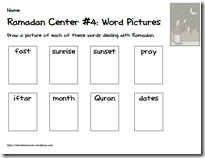
One of the thing teachers are often surprised of with English Language Learners is how they can understand some difficult vocabulary, but then not know what a grape is.  Remember that when English Language Learners are learning, they are not always understanding every word, so often there is basic, or non school TESOL Teaching Tip #1 - Use pictures and graphics to help ell students understand what is being asked of them. ESL tips from Raki's Rad Resources.vocabulary that they are missing.  For example, I recently completed a Muslim Holiday Center Packet with my students.  One of the activities was for them to draw a picture of words that were important to Ramadan.  All of my kids could draw a picture of sunrise and sunset and pray and fast.  The word that stumped them – date (as in the fruit you eat when you break your fast.)  Now, if these students lived somewhere else, I would say maybe they don’t know what a date is, but this is Morocco, dates are a very common snack here.  So, I went and did a google image search, showed my students a picture of a date, and all of a sudden, they understood.
TESOL Teaching Tip #1 - Use pictures and graphics to help ell students understand what is being asked of them. ESL tips from Raki's Rad Resources.This is the reason I say use pictures, use lots and lots of pictures as often as you can.  If you don’t feel comfortable doing a google search, use www.askkids.com or have a ready supply of books, magazines or picture cards ready to explain those words that are often unexplainable.   Showing a picture can get you through some of those simple words and on to more important topics, while allowing your English Language Learners to gain new vocabulary in the process.  Don’t forget to come back for TESOL Teaching Tip #10 – where we will talk about how culture can also affect some of how these pictures are viewed by your students.

signature