Showing posts with label project. Show all posts

Tuesday, December 8, 2015

It’s Project Time!

Projects increase learning while also assessing students better than tests do. ideas and suggestsions from Raki's Rad Resources


We just finished up our trimester and as always the last two weeks consisted of lots of projects! Projects let me get an assessment while the kids are actually further cementing their learning. While they are creating their projects, I watch them discover for themselves what they do and don’t understand. They then have the opportunity and the necessity to go and find the information to that they need to fill in their own gaps.

For example, my 6th grader had a pretty good idea of what a coat of arms was. But when it came time to explain that to others as part of his Symbolism Country Study Project about Germany, he realized that he didn’t really know the purpose behind a coat of arms. A little bit of additional research not only improved his project, it also cemented his understanding of the importance of a coat of arms, and of symbols in general, into his own understanding. Here’s what his project looked like:

 PIC FOR MOM 

Additionally, my 3rd grader could easily recognize equivalent fractions but to explain it to someone else in a Math Tutorial Video was much more challenging. He had to take another look at the images he used and decide how to describe those pictures well enough so that someone else could understand. He wrote out his script using these phrases and in doing so cemented his own understanding of the concept. Here is his video:


 Projects are great assessments of what students already know, but they are also a great opportunity to further understanding and comprehension of topics. What projects have your students done this year?

Heidi Raki of Raki's Rad Resources

Sunday, July 26, 2015

How Much Choice Should Students Have?

How much student choice do students have in your classroom? This blog post will explain how to give students choices while still exposing them to new topics. Opinions by Heidi Raki of Raki's Rad Resources.

Giving students control over what they learn and how they learn means that students are more motivated, more interested and more likely to make connections to what they are learning. In fact this upcoming school year, I am going to be giving my kids an entire day each week to explore any topic that interests them in a 20% Time/Passion Project. My eleven year old wants to research marketing strategies to help him with his jewelry making business a success. My soon to be eight year old wants to learn how to make a campfire. I think these are great things to learn and in the process I know we will work on a variety of ELA topics, including internet research, reading critically, and written expression, as well as some science and social studies and possibly even some math.

Obviously I am a proponent of student choice. However, I feel that when we give students 100% control, such as in the unschooling movement, that we miss out on an opportunity to broaden their horizons. Exposing students to topics and ideas that are new and unique to them pushes kids out of their comfort zone, but it also gives them new ideas and new background knowledge. This in turn allows kids to find new ideas and to have bigger passions to explore in future passion projects. In my dream world (which I try to replicate in my homeschool environment) we would all use a 1/3 1/3 1/3 approach.

One third of what we do in the classroom should be about exposing students to new information without student choice. Just because students aren’t choosing it doesn’t mean it should be boring. This is the time to spark student interest in topics they don’t think they are interested in. I often do this with things like Internet Scavenger Hunts, Virtual Time Machines and Novel Studies.

How much student choice do students have in your classroom? This blog post will explain how to give students choices while still exposing them to new topics. Opinions by Heidi Raki of Raki's Rad Resources. - American Constitution Internet Scavenger Hunt

How much student choice do students have in your classroom? This blog post will explain how to give students choices while still exposing them to new topics. Opinions by Heidi Raki of Raki's Rad Resources. - 1940 Time Machine Power Point Presentation 

How much student choice do students have in your classroom? This blog post will explain how to give students choices while still exposing them to new topics. Opinions by Heidi Raki of Raki's Rad Resources. - Mister and Me Novel Study Packet

One third of what we do in the classroom should give students at least some choice. Students might choose their own topic, their own book or how they want to present the information they are studying.

For example, when my students researched American History, I let each student choose a person who interested them, but they were required to learn things about them that would relate back to our study of American History.

How much student choice do students have in your classroom? This blog post will explain how to give students choices while still exposing them to new topics. Opinions by Heidi Raki of Raki's Rad Resources. - American History technology research project

When we studied rocks, students got to choose a rock or gemstone that interested them, but needed to find out set information.

How much student choice do students have in your classroom? This blog post will explain how to give students choices while still exposing them to new topics. Opinions by Heidi Raki of Raki's Rad Resources. - Rock research project

When we studied deserts, the kids were assigned a desert, but were allowed to choose from a wide range of possibilities to create their “virtual field trips” to their desert.

How much student choice do students have in your classroom? This blog post will explain how to give students choices while still exposing them to new topics. Opinions by Heidi Raki of Raki's Rad Resources. - deserts of the world science unit

If students were interested in a particular book, I allow them to study them using my Generic Novel Study Packet or my Generic NonFiction Book Study packet so that they are getting in all of their reading comprehension strategies, but are working with a book that is important to them.

How much student choice do students have in your classroom? This blog post will explain how to give students choices while still exposing them to new topics. Opinions by Heidi Raki of Raki's Rad Resources. - self selected novel study

One third of what we do in the classroom should be completely student led. Students should get to read the books they enjoy, explore the topics that interest them, write about what is important to them and make connections between what they are learning and their own background knowledge.

This could be done with a 20% time project, obviously. However, I also argue allowing kids time to free read any type of material and to journal or blog could be included in this topic. This could also be done by teaching others about something they know about or enjoy. My kids do this when they create Tutorial Videos or Vocabulary Games on any topic they choose.

How much student choice do students have in your classroom? This blog post will explain how to give students choices while still exposing them to new topics. Opinions by Heidi Raki of Raki's Rad Resources. - create your own tutorial video project

How much student choice do students have in your classroom? This blog post will explain how to give students choices while still exposing them to new topics. Opinions by Heidi Raki of Raki's Rad Resources. - create your own vocabulary game project

What is essential here is giving students a large amount of time to practice being in charge of their own learning, while still allowing teachers and the classroom to be an element that exposes them to new ideas and concepts, thereby expanding their horizons.

Thoughts on this topic? Feel free to leave a comment. Let’s start a discussion on student choice!

Heidi Raki of Raki's Rad Resources


Tuesday, March 10, 2015

Halfway Done With Our Country Study Projects!

Year long country study project for any country in the world - great for homeschoolers or classrooms alike.  Students research any country they choose and cover all of their science and social studies standards, as well as literacy standards like informational reading and writing.  Resource from Raki's Rad Resources. I know that many of the teachers who read this blog are getting close to done with their school year, but we are running a year-round schedule this year, so we are actually just past halfway.  Last week, the kids finished the fifth project in their Year Long Country Study Project.  They created virtual field trips to one of the Ancient Civilizations that existed in their country.  This was the cumulative project from after a month of exploring what life was like in the years before 0 AD.


Each month we have worked on a different type of project – maps, food webs, art projects, virtual museum exhibits.  This month, they created virtual field trips.  They both chose to create their projects by creating recorded Power Point movies. 


Here are their projects:


Ancient China - the Han Dynasty (5th Grade)


Ancient Siberia - the Xiongnu Dynasty (2nd Grade) 


After finishing their projects, the boys write up a reflection and add their work to their comprehensive Live Binders project.  At the end of the year, each of their tabs will have a reflection and their project. 


Year long country study project for any country in the world - great for homeschoolers or classrooms alike.  Students research any country they choose and cover all of their science and social studies standards, as well as literacy standards like informational reading and writing.  Resource from Raki's Rad Resources 


This project has been perfect for my homeschool family, but I really wish I had created it last year when I was in the classroom.  The boys are not only learning about their own country, they also talk to each other, so they have learned a lot about the other child’s country as well.  Imagine a class of 20 each with different countries!  Plus, in addition to learning a wide range of Social Studies and Science skills, the boys work on research, reading comprehension and written expression.  Talk about covering a lot of skills! We’ve even incorporated some math into our history lessons as we figure out how many years happened between certain events and dynasties.  If you would like to use this Year Long Country Study Project with your classroom or homeschool family, feel free to download it at my Teachers Pay Teacher store.

Heidi Raki of Raki's Rad Resources


Sunday, December 28, 2014

Why are Projects Better than Tests?

Projects are better than tests for both teachersand students.  Stop by Raki's Rad Resources to read arguments about why this is true.

Tests, especially multiple choice tests don’t tell me whether students understand a concept.  As inconvenient as it is to notice, students taking a standard multiple choice test have a 20 – 25% chance of passing a multiple choice test if they can’t read any of the questions, just depending on how lucky they are in their guesses.  In fact, I’ve had students do better on a test when they didn’t read the test than when they took the time to try and read the words on a test.  As a teacher, a multiple choice test given to a set of silent third graders tells me:

1.  How good of a reader my student is

2.  How good my student is at making inferences

3.  How much vocabulary my student has

4.  How good my student is at using test taking strategies like process of elimination

5.  How good my student is at sitting still and quiet for long periods of time


And all of this is on a good day.  If students are having a bad day, a multiple choice test may tell me:

1.  Who had a good nights sleep last night

2.  Who ate a nutritious breakfast

3.  Who had a fight with a sibling, parent or friend this morning

4.  Who isn’t feeling well due to a virus or cold

5.  Who is distracted by the class playing outside on the playground, the kids fooling around in the halls, or the clock ticking away


Okay tests aren’t perfect, but they’re convenient and time saving devices, right?  This allows us to take away less instructional time, right?  Not really.  When you figure in:

1.  We spend a lot of time preparing students for a test – teaching them the specific skills, vocabulary and type of questions will be on a test.

2.  We stop all learning to take time out for tests and require students to sit still and be quiet until every child is done.

3.  Because we require students to sit still for so long, we have to take further instructional time to let them “unwind” after a test.

4.  Children who did poorly, or who are anxious that they might have done poorly on a test, may shut out everything done in class after the test until they receive their score.

5.  We still need to spend time grading the tests and reviewing the scores with students.

Tests often give teachers skewed and unclear information.  Stop by Raki's Rad Resources to read arguments about why this is true.


Alright, but the argument goes that students still need to take tests so that they will be prepared for their future.  Think about your every day life.  When was the last time you took a test that WASN’T part of a class?  In Cosmo magazine?  At the doctor’s office?  Probably the last time you took a test that impacted your life was when you took your teacher certification test, which is a whole other can of worms!  However, when was the last time you completed a project?  Wrote an article?  Created a presentation?  Taught others about something you had recently learned?  As a teacher and a business person, I am much more likely to do the projects, the presentations, the teaching the staff about what I learned at a conference than I am to take a test.  The same could be said about 99% of the jobs that our students will hold in their future.  So a good generalization would be to say that 99% of success in life is based on project completion and 1% is based on test results.  Unfortunately, in many classrooms today at least 75% of a child’s grade is based on tests and quizzes while only about 10 – 20% is based on projects.  How exactly is this helping our students?

The solution?  PROJECTS!  And not always close ended, follow the steps to a set conclusion projects.  Students need time for open ended inquiry projects, research projects, present my learning projects and create something completely new projects.  But, projects are time consuming and teachers have so much to get through, so how do you find the time?Projects are better than tests for both teachersand students.  Stop by Raki's Rad Resources to read arguments about why this is true.

1. Integrate!  Cover multiple standards with a single project.  My new Create Your Own Cookie Science Inquiry project covers math, science and literacy standards.  My African Folktales Online Poster Project covers social studies, literacy and technology standards.  Even projects like my Balanced Checkbook Project covers math, social studies, literacy and technology standards.  This means that instead of giving three or four tests, one project can cover all of those standards and actually save you time.


2.  Let students evaluate themselves.  Many of my projects, including the Build Your Own Vocabulary Game project and Math Video Creation project give students a chance to evaluate their own work before you sit down and conference with them.  This means that the conversation is geared up and ready to go. A simple two minute conference is all that is needed to explain to students where they are strong and what they need to work on next time.

  3.  Use a rubric.  Scoring a rubric with 5 – 10 categories often takes less time than grading a 30 question test.  Also, if you go over the rubric with students BEFORE they begin their project, they have a clear idea of what you are looking for and there is so much less of the “I didn’t understand what it was asking of me.” conversation at the end of an assessment.  All of the projects I have available in my Teachers Pay Teachers store come with some sort of a rubric.  However, I also use rubrics in my Reading Response Journals, Math Problem Solving Journals and Writing Journals.  So, by the time we get to a project, my kids are so used to looking at rubrics, they can often grade themselves.  In fact, sometimes I have students grade themselves on the rubric using a green pen and then go through their work and mark my own grades with a red pen, so that they can see how I look at their work versus how they look at their work.  Often you will find that kids are harder on themselves than we are on them.

Rubrics make project expectations clear and simple.  Stop by Raki's Rad Resources to read arguments about why this is true.

  4.  Multitask!  Projects don’t have to be done when the entire class is sitting still in one place, like tests do.  Instead, you can be teaching a mini lesson in one area of your classroom while students work on a project in another area.  In fact, projects can be a regular part of your math or literacy centers, making one less center for you to have to plan each week.

  5.  Get rid of the fluff.  Projects – when done right – are fun for kids.  So, instead of inserting craftivities or other “fluff” to make our lessons more fun, let students work on a project.  They will have fun, learn a lot and give you a good idea of where they are in a variety of different areas.  Kids will agree too.  I have had kids give up recess to build virtual field trips to the desert for my Deserts of the World project and forgo watching a movie to work on designing projects for their Earth’s Materials projects.  Kids like projects, simple and easy.


Finally, according to the constructivist school of thought, kids learn more doing the project than from reading an article, listening to a lecture, watching a video or working on a math problem.  Now, I think that all of those are great ways to build up background knowledge, but students won’t truly understand anything if we ask them to absorb it and spit it back out on a test.  However, if they take that information, use it in a project, process it and then are asked a question on those end of the year tests that unfortunately public schools cannot avoid, they might just remember the information. 

Food for thought.  What do you think about projects?  Do you use them?  How much?  Why or why not?  I’d love to see a conversation about this begin in the comments.

Heidi Raki of Raki's Rad Resources


Monday, November 24, 2014

Math Projects For Your Classroom

In addition to running this blog, my RVing with the Rakis blog and homeschooling full time, I also create and sell resources that teachers can use in their classrooms and home schooling parents can use to help out their children.  To be fair, I am not creating nearly as many resources this year as I did in the past 9 years, for 2 reasons.  Reason #1 – I already have over 500 resources available in my Teachers Pay Teachers store, so much of what I need for my kiddos I have created already.  Reason #2 – I only have 3 students this year, so I have need of less resources.  However, I am going through resources that I made while I was teaching in a classroom full time and “cleaning them up” with clearer teacher directions, better fonts, etc.  I am also finishing out groupings or “series” that I have started and putting them into bundles so that teachers who are interested in buying multiple items from the same category have the opportunity to save some money.  For the next few weeks, I am going to spotlight some of these bundles here on my blog.

math project bundle

Math is best learned and practiced in relation to real life situations.  For this reason, my students have always worked on at least two different math projects during the course of a school year – often more if time allowed for it.  For the past two years, I kept the same students in a multiage classroom, so I wanted to make sure that they were doing new math projects that helped them work on different skill sets.  A few of my math projects – like the Balanced Checkbook project and the Holiday Shopping Project – can be done by the same student multiple times, but most should only be done once.  Because of this, I created new and different projects, and have now bundled them together into a set of 7 math projects, which is available for less than purchasing each project individually.  The seven math projects available in the set are:


Holiday Shopping (works on addition, subtraction and rounding while building a holiday shopping list)

Holiday Shopping Project

Ice Cream Shop (works on multiplication, division, subtraction and rounding while students split the bill at an ice cream shop)

Ice Cream Shop Project

Be an Architect (works on area and perimeter while students design their dream school)

Be an Architect Project

Balanced Checkbook (works on all 4 operations and rounding while students plan a monthly budget with salary and bill cards)

Balanced Checkbook Project

Party Planning Project (works on doubling, halving, tripling and quartering, as well as all 4 operations and rounding, while students plan recipes and a budget for a party)

Party Planner Project

Field Trip Project (works on elapsed time and all 4 operations while students create a plan for a field trip they would like to take)

Field Trip Math Project

Holiday Recipe Project (works on elapsed time, addition, subtraction and rounding while students create a plan to follow a holiday recipe)

Holiday Recipe Project

I hope one of these projects, or the entire bundle will help your students to practice their math skills with a real life application.  Happy teaching!

Heidi Raki of Raki's Rad Resources

Tuesday, November 11, 2014

TESOL Teaching Tip #54 - Alternatives to Presenting in Front of the Class

As a teacher at an International School, many of my students were English Language Learners. Even my native English speakers were living in a non-English speaking country. Due to my unique teaching position, I have had some readers ask for tips on teaching English Language Learners. Here is this week’s Tuesday TESOL Teaching Tip:


TESOL Teaching Tip #54 - Give students alternatives to presenting in front of the class. Presenting can make ESL or ELL students nervous and prohibit language ability. Find four alternatives and more at my blog post on Raki's Rad Resources.

TESOL Teaching Tip #54 - Give students alternatives to presenting in front of the class.
Imagine standing in front of a room of people who speak perfect Mandarin Chinese and speaking in the broken Mandarin you had been learning for about a year, giving a speech in Mandarin on which you would be graded.  Your palms sweat, your heart races and all the words you do know in Mandarin go racing out of your head from the adrenalin of the moment.  You open your mouth to speak and the words that do come out, jumble up as you try to hurry up and be done with it. 
This is the experience our ESL or ELL students experience when we ask them to present a project or research paper to the class.  The resulting presentations rarely reflect the students’ true language ability or knowledge on the subject.  However, we tend to give them a grade on the presentation just the same.
As a teacher who has always used as many project-based learning experiences as I can, I believe in presenting the completed project.  By presenting the project, students learn to work for an audience, take more pride in their work and are more motivated to create quality work.  I have included presentations as a part of all of the projects before:
Earth's Material Glog Project - a perfect opportunity to allow students to present information to their peers.  from Raki's Rad Resources    Biography Project - a perfect opportunity to allow students to present information to their peers.  from Raki's Rad Resources

Rock Project - a perfect opportunity to allow students to present information to their peers.  from Raki's Rad Resources     Amazing Americans Technology Project - a perfect opportunity to allow students to present information to their peers.  from Raki's Rad Resources

Virtual Desert Project - a perfect opportunity to allow students to present information to their peers.  from Raki's Rad Resources     African Folktale Connected Glog Project - a perfect opportunity to allow students to present information to their peers.  from Raki's Rad Resources     
However, I don’t think that the only way to present projects is by standing in front of the class shaking while your classmates watch on – often bored and not paying attention.  Instead of standing in front of class presenting, I often use one of these alternative techniques:

Four alternatives to presenting in front of class - great for esl students - ideas from Raki's Rad Resources
Four alternatives to presenting in front of class - great for esl students - ideas from Raki's Rad Resources1.)  Museum Day:  Each student sets up their materials in a display around the room and stays at their display to present.  Invite in another class (or two) and ask them to wander around the materials, with no more than 2 or 3 people stopping at each display at one time.  When they get to a display, the person who created the project will present to the few people who stop.  Museum guests can wander at will, or can change displays at the ring of a bell.  Either way, museum presenters will present their project multiple times, giving students a chance to explain their project and use their language skills multiple times in one lesson, while providing them with a low stress way to present.

Four alternatives to presenting in front of class - great for esl students - ideas from Raki's Rad Resources 2.)  Pair and Share:  Split your class into pairs.  In each pair, students will take turns presenting their project to their partner.  Students get the one on one experience of teaching and learning, including the option of asking detailed questions.  You may choose to have students break into a different set of pairs and repeat the process.  In fact you could do as many pairings as you have time for.


Four alternatives to presenting in front of class - great for esl students - ideas from Raki's Rad Resources 3.)  Parent Presentations:  Set up your room similar to the set up for museum day, but invite adults to come and visit – parents, administrators, teachers with a prep period.  When parents come in, students have a chance to present to their own parent in their home language, and then turn and present to an administrator or teacher in English, giving them even more practice with their language skills.


Four alternatives to presenting in front of class - great for esl students - ideas from Raki's Rad Resources 4.)  Small Group Presentations:  If it is very important that all the kids in your class hear all of the presentations, then try doing small group rotations. Break your class into 4 groups.  Have one group stay stable while the other 3 groups move around and listen to presentations from the group who stable.  Once everyone has seen these presentations, switch and make another group stable.  Continue until all students who listened to all presentations.  Management tip -If you are going to have students listen to all presentations, you may want to have them use a graphic organizer to keep track of what they learned from each presentation and keep them engaged.

If students do need to present to the entire class, I often give them the options to work with a partner or group (strength in numbers!) or to create a video and play the video for the class.  All of these strategies are also helpful to students who have stage fright or anxiety about standing in front of a large group of people.
Heidi Raki of Raki's Rad Resources

Sunday, September 21, 2014

Salt Maps Solidify Understanding

Hello guys, sorry for my long absence here on the blog – I’ve had a migraine the size of Texas that makes looking at the computer screen a very big challenge.  It’s still there, but lighter, so here’s hoping we’re on the upswing!  Anyways, homeschooling (and teaching) rarely stops for a headache, so I wanted to share with you a project my boys did this week.
Creating salt maps to help students make sense of geography - great project for elementary and high school alike.  Easy to differentiate - Details at Raki's Rad Resources
Instead of completing separate Science and Social Studies units, my kiddos are doing year long Country Study Projects.  Each month, we spend three weeks researching a specific topic in regards to our country – through books, encyclopedias, videos and field trips – and then on week four, the kids take all of what they have “learned” and put it into action with a hands-on or technology based project.  I give the kids some basic expectations for their project, but they have a lot of freedom with how they want to create and deliver project.
For the last three weeks, we have been looking at the geography and climate of our countries (Russia for my 2nd grader and China for my 5th grader), so this week they were tasked with creating a map. 
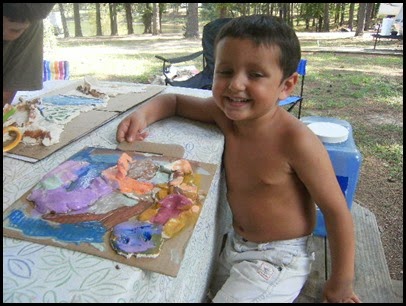
My younger son is much more of a kinesthetic learner, so he chose to create a salt map, giving him a chance to build the Ural Mountains and Bakail Lake with his hands and paint not only the landforms, but the bordering countries and the Arctic Ocean.  We used a recipe I got from another blogger I love – Becky from Kid World Citizen and he had so much fun that he kept telling me “This isn’t work mom, it’s easy!” Here are a few pictures of the process:
Creating salt maps to help students make sense of geography - great project for elementary and high school alike.  Easy to differentiate - Details at Raki's Rad ResourcesFirst, he spread the clay out on the cardboard with the outline his daddy drew for him.
Creating salt maps to help students make sense of geography - great project for elementary and high school alike.  Easy to differentiate - Details at Raki's Rad ResourcesThen, he added in all of the landforms.  This took a few trips back to the map to determine where exactly those rivers and mountains were supposed to be.
Creating salt maps to help students make sense of geography - great project for elementary and high school alike.  Easy to differentiate - Details at Raki's Rad Resources Finally he determined colors for his landforms and countries and had a blast painting his map.
Creating salt maps to help students make sense of geography - great project for elementary and high school alike.  Easy to differentiate - Details at Raki's Rad Resources And here is the final product.
Creating salt maps to help students make sense of geography - great project for elementary and high school alike.  Easy to differentiate - Details at Raki's Rad Resources
Since we were playing with clay, the little one (3 years old) decided he needed to get in on the action too, so he created the first letter of his name – S.


My oldest son is a technology guy and so he took a completely different take on this project.  Using Power Point, he created a layered map, and then recorded himself explaining the map using Camtasia Studio – the same program that I use for my Math Mini Lesson Videos.  Besides showing him how to draw on the map, he created this project completely independently – which was great for a mom with a headache!
Although both of the maps made by the boys came out quite differently, what I noticed was that during the process of making the maps, the kids would say things like “I know the mountains are in the East, but where?” and go back to the map to check again.  They were clarifying and building on to their own knowledge by building this project.  This will keep it in their memory so much longer than if they had memorized the information to study for a test.  Hope your week of teaching and learning was as fabulous as ours was!
Heidi Raki of Raki's Rad Resources