Showing posts with label field trip. Show all posts

Saturday, October 4, 2014

Using Photobucket in the Classroom

Photobucket is a photo saving and photo sharing website that has been around for a long time.  I have used this website for personal uses – saving pictures of my sons to share with family, saving pictures of items I am selling to be able to share easily on forums and Craigslist, etc. etc.  However, it’s only recently that I have started using Photobucket in my classroom.  I started using it as a means of sharing class pictures with parents, but have found that it can be used for so much more than that.  Here are some ways to use Photobucket in the classroom:

5 Ways to use photobucket in the classroom - how to share class photos with parents and class, share anchor charts, document field trips and build an online portfolio - ideas from Raki's Rad Resources.

1.)  Sharing Class Photos – I’ll start with the easy one.  Class photos can be uploaded into password protected photo albums, which allow you to upload pictures with student faces and names, which often can’t be used on class blogs.  Give the parents the password through your newsletter or weekly e-mail and you can upload pictures once a month or so, to give parents (and grandparents) a way to peek into your classroom.  Parents love the protection you are providing their students and the ability to download pictures that they would like to print for scrapbooks and photo albums.

5 Ways to use photobucket in the classroom - how to share class photos with parents and class, share anchor charts, document field trips and build an online portfolio - ideas from Raki's Rad Resources.


2.)  Sharing Anchor Charts – Anchor charts can be amazing teaching tools, but when the lesson or unit is done, where do you put all of these beautiful charts?  Why not take pictures of them and upload them into a photo album on photobucket?  Then, link the album to your class blog or your edmodo account and students can re-visit these anchor charts at home for homework help, while working in a small group with access to a computer or iPad (great for BYOD classrooms), or you can be bring it up and project it for the whole class when you need to refer to it again later – great space saver!

5 Ways to use photobucket in the classroom - how to share class photos with parents and class, share anchor charts, document field trips and build an online portfolio - ideas from Raki's Rad Resources.

3.)  Saving Student Work for Online Portfolios – Online portfolios should include links to virtual projects, but even in our technology based world, all projects shouldn’t be virtual.  Some students do much better with creating hands-on projects out of clay.  There is still a place in our classroom for building posters and dioramas.  We don’t want to leave those projects out of portfolios, but it is quite complicated to sit down with each student and upload pictures into online portfolios.  But, if you take pictures of projects and upload them into an album on photobucket, students can have easy access to them when it is time to put their portfolios together.

5 Ways to use photobucket in the classroom - how to share class photos with parents and class, share anchor charts, document field trips and build an online portfolio - ideas from Raki's Rad Resources.

4.) Keep Student Taken Photos for Projects – My class always spends a lot of time creating virtual projects (Prezis, Live Binders, Glogs) and videos (Check out my blog post on online video creation.)  Often students need pictures to put into their projects.  First of all, this is a great time to talk to students about royalty and royalty – free pictures.  Get students used to the fact that they SHOULD NOT copy and paste images from any old Google search as early as possible.  Part of this lesson for my kids was always, is there a way you can create your own image to go in there?  We talked about taking our own pictures to use in our projects.  (See my blog post on different ways to use an iPad camera.)  For example, one of my students was creating a video to teach others how to tell time and she wanted a picture of a clock.  So, she took a picture of our classroom clock and imported it into her Powtoon video.  These images that are taken by your class, can be stored in a photo album on Photobucket.  By putting the photos into a photo album, they can be shared amongst the students in your class.


5.)  Document Field Trips – When you take a field trip, let students document their trip with individual, or group cameras (or iPads).  After the field trip, upload all of the pictures into a photo album on Photobucket and view the photo album as a whole class.  Pictures show us point of view.  Take time to discuss how some students viewed the trip vs. how others viewed it.  Can students find something in the photo album that they hadn’t even noticed on the trip?  Create a summary of learning that happened on the trip, and use this as a time to connect the trip back to what has been going on in class. (Find more ideas for field trips in this blog post.)

5 Ways to use photobucket in the classroom - how to share class photos with parents and class, share anchor charts, document field trips and build an online portfolio - ideas from Raki's Rad Resources.

What “outside of the box” way do you use Photobucket in your classroom?

Heidi Raki of Raki's Rad Resources

Sunday, August 17, 2014

Get in Touch with History by Walking Around It

During the summer, most teachers I know spend at least some time planning for the next school year.  My favorite “planning” to do during the summer is field trip planning, because it means I get to tour cool places I’d like to take my students to – often with my own kids in tow.  Here are some of my favorite field trip locations, that can be found in most every community, as well as a list of content connections you can make for your students.  Often as teachers we only include field trips in our science and social studies, but there are lots of reading, writing and math connections that can be made in these locations as well.  I am going to share one type of field trip a week and ideas for making curriculum connections with each field trip.

field trips

Historical Sites: Battlefields, lighthouses, colonial homes, ancient ruins, anything of historical importance can be of great insight to students.  Seeing how things once were helps them to better understand how things once were.  My best historical site field trip had to be the Ancient Roman Ruins at Chellah, which you can read about this old blog post.

Reading: Historical fiction stories come to life when you are able to visit the places where these stories take place.  Newspaper articles – new and old – make for great reading in connection to historical sites, as do “first person accounts” of what went on in these places.  This is a great time to talk about the difference between primary and secondary sources, as well as in comparison with historical fiction based off of these events.

clip_image001Writing:  Once students have experienced the historical site, they can have a chance to write from the point of view of a person who lived or worked at this site.  Students may also write informational – newspaper articles – about the current site, OR about the site as it existed during it’s most important time period.  Taking time to write a descriptive essay that makes someone else feel as if they experienced the same field trip is also a great writing activity for historical field trips.

Math:  Using timelines is a great way to teach elapsed time.  Create a timeline of important events that happened at this location.  Have students create their own word problems based off of this timeline.  For example:  How long was it from when the castle was built until when King X moved in?

Science:  Students can explore the questions:  What materials were used to build this site?  How have they lasted as long as they have?  What types of preservation has been done? Were any archeological techniques used?

Social Studies:  Exploring the history of the area is huge, but students could also explore the time periods when this building was in its peak, the geographical and political elements that led to its creation, the elements that led to the downfall or closing of the site.  Creating a map or timeline of the site could also be beneficial.

To make field trips more educational, I often use graphic organizers and other activities to keep my students focused.  Read more about the specifics in this blog post: Field Trips Aren’t Just For Fun.  Be sure to stop by next week for another Field Trip Curriculum Connection.

What is your best field trip idea?

Heidi Raki of Raki's Rad Resources

Sunday, August 10, 2014

The Lawmakers Are In – Time for a Field Trip!

During the summer, most teachers I know spend at least some time planning for the next school year.  My favorite “planning” to do during the summer is field trip planning, because it means I get to tour cool places I’d like to take my students to – often with my own kids in tow.  Here are some of my favorite field trip locations, that can be found in most every community, as well as a list of content connections you can make for your students.  Often as teachers we only include field trips in our science and social studies, but there are lots of reading, writing and math connections that can be made in these locations as well.  I am going to share one type of field trip a week and ideas for making curriculum connections with each field trip.

 Make the most of your next field trip with these curriculum connections from Raki's Rad Resources

Government Buildings  Seeing how government works first hand can be extremely powerful and enlightening for children.  Most city halls and court houses will allow tours, and some might even arrange for children to speak with lawmakers.  Providing students with access to how and where laws are made gives them a sense of empowerment and may be the building of future political leaders.

Reading:  Dr. Seuss has a collection of stories that talk about government – without talking about government: Yertle the Turtle and If I Ran the Zoo are both great for beginning the discussion about government.  Most states these days of their own websites; let students explore the websites, reading for information about what goes on

Make the most of your next field trip with these curriculum connections from Raki's Rad Resources.Writing:  Create a list of questions you would ask if you were going to interview a lawmaker – if you get a chance to speak with one, be sure to ask some of the questions!  If you don’t get a chance to speak with one, do internet research to see if you can come up with the answers and create a “mock interview” with the information you find.  Write an informational essay about the history of the building you go to.  Make a list of information you would like to see added to the government building’s website.

Math:  Look for 2-dimensional and 3-dimensional shapes in the architecture of the building: arcs are semi-circles, domes are half a sphere, columns are tall cylinders.  How long has this building been around?  Create a timeline to explore the elapsed time history of the building.

Science:  While walking around the building, think about these questions:  What type of architecture or engineering went into the design of the building?  What materials were used?  Where did the materials come from?  What repairs need to be done, now or in the future?

Social Studies:  What type of government work goes on in the building?  Explore the connection between this government building, and other government buildings at different levels (ie. the county courthouse vs. the Supreme Courthouse).  If the chance is given, talk to a lawmaker about their job and the laws they have worked with.  Find out where the money comes from to fund this building and the people who work inside it.  Discover the history behind the building.

To make field trips more educational, I often use graphic organizers and other activities to keep my students focused.  Read more about the specifics in this blog post: Field Trips Aren’t Just For Fun.  Be sure to stop by next week for another Field Trip Curriculum Connection.

What is your best field trip idea?

Heidi Raki of Raki's Rad Resources

Monday, August 4, 2014

Beaches and Mountains – What Landforms Do You Live Near?

During the summer, most teachers I know spend at least some time planning for the next school year.  My favorite “planning” to do during the summer is field trip planning, because it means I get to tour cool places I’d like to take my students to – often with my own kids in tow.  Here are some of my favorite field trip locations, that can be found in most every community, as well as a list of content connections you can make for your students.  Often as teachers we only include field trips in our science and social studies, but there are lots of reading, writing and math connections that can be made in these locations as well.  I am going to share one type of field trip a week and ideas for making curriculum connections with each field trip.
  Get the most out of your next field trip with these curriculum connections from Raki's Rad Resources
Natural Landforms: beaches, mountains, lakes, rivers, etc.  Natural formations of the earth give us so much to talk about.  Being there and experiencing these places provides students with more than just a photo opportunity.  Landforms may differ depending on your location.  I have done beach field trips, mountain field trips and desert field trips – all helped my students expand their knowledge base and make curriculum connections like these.
Reading:  Non fiction reading about the creation, use or history of landforms in your area.  Fiction stories about a trip to the beach or climbing a mountain.  Read newspaper articles that talk about current events involving the landform – beach cleanups or wildlife protection acts.
Get the most out of your next field trip with these curriculum connections from Raki's Rad Resources.Writing:  Write the creation story of a landform, from the point of view of a rock sitting near by.  Create a pamphlet convincing people to come and visit this landform.  Write a descriptive essay that would make someone feel as though they were sitting right on or near this landform – be sure to take notes while you are there to help you remember how you felt.
Math:  Count, or estimate:  How many steps to the top of the mountain?  How many tide pools on the beach?  How many fish in the river? How many grains of sand in a bucket?
Science:  Science connections may vary depending on the type of landform, but for all different landforms, you can learn about how it was created, what animals or plants have adapted to live there, how the weather, or other natural forces like tides, affects the landform etc.
Social Studies:  Landforms tend to be a big part of local history.  Was this landform a help or a hindrance to historical populations?  Are there any historical events which happened here?  Are there any laws protecting this landform?  Does this landform attract tourist revenue?
To make field trips more educational, I often use graphic organizers and other activities to keep my students focused.  Read more about the specifics in this blog post: Field Trips Aren’t Just For Fun.  Be sure to stop by next week for another Field Trip Curriculum Connection.
What is your best field trip idea?
Heidi Raki of Raki's Rad Resources


Sunday, July 27, 2014

Stop and Look at the Flowers – Oh and Learn Along the Way

During the summer, most teachers I know spend at least some time planning for the next school year.  My favorite “planning” to do during the summer is field trip planning, because it means I get to tour cool places I’d like to take my students to – often with my own kids in tow.  Here are some of my favorite field trip locations, that can be found in most every community, as well as a list of content connections you can make for your students.  Often as teachers we only include field trips in our science and social studies, but there are lots of reading, writing and math connections that can be made in these locations as well.  I am going to share one type of field trip a week and ideas for making curriculum connections with each field trip.

Make the most out of your next field trip to the botanical gardents with these curriculum connections from Raki's Rad Resources.

Botanical Gardens:  Plants from all different habitats available in one place.  A chance to look at many parts of the life cycles.  Botanical Gardens provide so many different learning possibilities.

Reading:  There are great books out there about plants, including Diary of a Sunflower, the Great Kapok Tree and From Seed to Plant.  Reading the signs and placards at the botanical gardens is a highly overlooked skill – many kids walk right by without gaining that bit of extra information that they can get by looking at the posted signs.

Make the most out of your next field trip to the botanical gardents with these curriculum connections from Raki's Rad Resources.Writing:  Write the life story of one of the plants – from the point of view of the plant.  Look at the scientific names for the plants – see what root words you can find in these names.  Write a letter to the editor about why we should (or shouldn’t) give more money to the Botanical Gardens.

Math:  Create a tally chart to track which types of plants you see – trees, flowers, shrubs, cactus etc.  Measure the height of different plants. 

Science:  Explore the life cycle of a plant.  Note down ways plants are specially adapted to their natural habitat.  Keep track of which plants flower and which plants don’t.  Learn about how plants help out humans.  Choose one plant you see and research further information about it.  Group related plants together and explain how they are similar and how they are different.

Social Studies:  Explore how people have used plants for their benefit – for food, for medicine, for decoration etc.  Explore laws protecting certain types of plants.  Bring world maps and have students label where each type of plant comes from.

To make field trips more educational, I often use graphic organizers and other activities to keep my students focused.  Read more about the specifics in this blog post: Field Trips Aren’t Just For Fun.  Be sure to stop by next week for another Field Trip Curriculum Connection.

What is your best field trip idea?

Heidi Raki of Raki's Rad Resources

Sunday, July 20, 2014

Exploring Nature Field Trip

During the summer, most teachers I know spend at least some time planning for the next school year.  My favorite “planning” to do during the summer is field trip planning, because it means I get to tour cool places I’d like to take my students to – often with my own kids in tow.  Here are some of my favorite field trip locations, that can be found in most every community, as well as a list of content connections you can make for your students.  Often as teachers we only include field trips in our science and social studies, but there are lots of reading, writing and math connections that can be made in these locations as well.  I am going to share one type of field trip a week and ideas for making curriculum connections with each field trip.

field trips - make the most of them with these curriculum connections from Raki's Rad Resources

 Nature Preserve:  Seeing natural animals in their natural habitat – outside of cages – can be highly beneficial for students.  Knowing how animals are helped to stay in their natural habitat can also be completely beneficial.  Plus, there are so many benefits from simple nature hikes.  Find a blog post I wrote about nature hikes here.    

Reading:  Any number of books about animals can be read before and after going to a nature preserve.  Non fiction books about the types of animals you will see.  Fiction stories about animals, like Winnie the Pooh, the Berenstain Bears or Make Way for Ducklings – Talk about the difference between fictional animals and real animals. Read news articles and opinion pieces about nature preserves vs. zoos.

field trips - make the most of them with these curriculum connections from Raki's Rad Resources - trip to a nature preserveWriting:  Write informational essays about the natural habitat of one of the plants or animals that can be found in the nature preserve.  Persuasive writing – which is better nature preserves or zoos?  Write a fiction story from the point of view of one of the animals.

Math:  Measure how wide the trees are; learn about tree rings and calculate the age of a tree stump.  Create a graph of the animals living at the preserve, or of a statistic (like survival rate or release rate).

Science:   Learn about animal habitats, animal life cycles and animal adaptations.  Learn about plant habitats, plant life cycles and plant adaptations.  Discover how to protect the earth.  Explore the interconnectivity of plants, animals and humans.  Look at leaves and try to identify the different types of trees.  Look for “proof” of animal activity – footprints, feathers, droppings.

Social Studies:  Learn about how native people used nature to live.  Research people like Theodore Roosevelt and John Muir, who worked to set aside national parks to preserve nature, and complete a biography projects with the information.  Explore the laws and current trends that affect ecology.  Discuss what happens when gold or oil is found in a place that is protected by law.


To make field trips more educational, I often use graphic organizers and other activities to keep my students focused.  Read more about the specifics in this blog post: Field Trips Aren’t Just For Fun.  Be sure to stop by next week for another Field Trip Curriculum Connection.

What is your best field trip idea?

Heidi Raki of Raki's Rad Resources

Sunday, July 13, 2014

Behind the Scenes Factory Tours Have Learning Benefits for Kids

During the summer, most teachers I know spend at least some time planning for the next school year.  My favorite “planning” to do during the summer is field trip planning, because it means I get to tour cool places I’d like to take my students to – often with my own kids in tow.  Here are some of my favorite field trip locations, that can be found in most every community, as well as a list of content connections you can make for your students.  Often as teachers we only include field trips in our science and social studies, but there are lots of reading, writing and math connections that can be made in these locations as well.  I am going to share one type of field trip a week and ideas for making curriculum connections with each field trip.
field trips
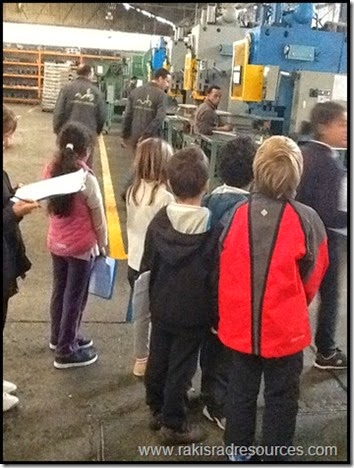
Factories:  Behind the scenes tours of any sort of factory can be extremely educational and can give students a chance to see a world they had no idea existed.  Need help getting into a factory?  Ask around, the families of your students often include someone who works in a factory of some sort, in some capacity, and can put you in contact with the right people.  I have personally done behind the scenes tours of furniture factories, baked goods factories, candy factories and power plants.
Reading:  Read a how-to manual or recipe to create a good similar to those who are created in the factory.  Read advertisements from the factory and determine the persuasive techniques used. 
clip_image001Writing:  Write an essay from the point of view of one of the natural resources that comes into the factory, how it is then changed into a processed good.  Create an advertisement campaign for the factory.  Write an informational essay about how safety procedures are applied in the factory.
Math:  Keep track of the temperatures used in various departments and use that information to create a graph.  Look at the resources that come in to the factory.  How many items are in a package?  How many packages are there?  How many items altogether?
Science:  Search for machines – simple or complex, using my Factory Field Trip sheet.  Find examples of conductors and insulators or magnets or computerized techniques.  Look for safety methods used by factory workers.
Social Studies:  Choose a “good” and research all of the steps it takes to go from the natural resources to the processed good.  Then try to visit a factory that produces that type of goods.  Compare and contrast how goods are made today with how goods were made 200 years ago.  Map out the trip taken by the natural resources that come into a factory and the processed goods that come out of the factory.
 
To make field trips more educational, I often use graphic organizers and other activities to keep my students focused.  Read more about the specifics in this blog post: Field Trips Aren’t Just For Fun.  Be sure to stop by next week for another Field Trip Curriculum Connection.
What is your best field trip idea?

Heidi Raki of Raki's Rad Resources


Sunday, July 6, 2014

Making Museums Magical for Kids

During the summer, most teachers I know spend at least some time planning for the next school year.  My favorite “planning” to do during the summer is field trip planning, because it means I get to tour cool places I’d like to take my students to – often with my own kids in tow.  Here are some of my favorite field trip locations, that can be found in most every community, as well as a list of content connections you can make for your students.  Often as teachers we only include field trips in our science and social studies, but there are lots of reading, writing and math connections that can be made in these locations as well.  I am going to share one type of field trip a week and ideas for making curriculum connections with each field trip.
Educational Benefits of a Field Trip - Benefits of a field trip - curriculum connections for reading, writing, math, science and social studies - from Heidi Raki of Raki's Rad Resources
Museums:  Science museums, natural history museums, art museums, local history museums etc.  Any museum, no matter how small, can provide a great learning experience for children.  Children’s museums gear their exhibits towards the interests and curriculum of children, and if there’s one in your area, you should definitely look it up.  However, don’t be scared to do regular museums.  I have walked through some of the fanciest art museums with a group of small children.  Set the rules ahead of time, let them know that this is a “look, but don’t touch” museum, and take plenty of time to TALK to the kids about what they are looking at.
Reading:  Any Magic School Bus or Magic Tree House book could possibly lead to great museum connections.  We read Vacation Under a Volcano before going to see the Roman coins and figures museum and Dinosaurs Before Dark before going to the local dinosaur exhibit.  Historical fiction stories also provide great connections.  One of my favorite museum memories is going to a local history museum with students right after completing the book Mister and Me and watching my students get enthralled with studying the old Singer sewing machines that had been a large part of the novel.
Educational Benefits of a Trip to the Museum - curriculum connections for reading, writing, math, science and social studies - from Heidi Raki of Raki's Rad ResourcesWriting:  Who hasn’t seen Night at the Museum?  Have kids write about what would happen if the exhibits came to life.  Create a brochure advertising the wonderful exhibits at the museum, or have students write persuasive letters to find more funding for an exhibit they would like to see added.
Math:  Elapsed time is a great activity to work on in museums, as so many exhibits will be marked with a date of creation.  Can students figure out how old each exhibit is?  Children’s museums often have exhibits with a focus on 3-dimensional shapes or building with odd shaped blocks.
Science:  There are so many science museums out there with exhibits on everything from paleontology to meteorology to various forms of technology.  Even art museums can give you a lot to talk about as you look at different substances used to create art and the engineering that goes into sculptures.  I always include a trip to a museum with old cars or trains in my Machines unit!
Social Studies:  Archeological history, local history, country history, ancient history, there is so much history that can be explored in museums.  Additionally, many museums include ancient coins and materials used in economies or daily living.  When I taught my Africa unit, the kids were thrilled to look at coins from all over Africa at a local museum. 
To make field trips more educational, I often use graphic organizers and other activities to keep my students focused.  Read more about the specifics in this blog post: Field Trips Aren’t Just For Fun.  Be sure to stop by next week for another Field Trip Curriculum Connection.
What is your best field trip idea?
Heidi Raki of Raki's Rad Resources


Saturday, June 28, 2014

Educational Benefits of a Trip to the Farm

During the summer, most teachers I know spend at least some time planning for the next school year.  My favorite “planning” to do during the summer is field trip planning, because it means I get to tour cool places I’d like to take my students to – often with my own kids in tow.  Here are some of my favorite field trip locations, that can be found in most every community, as well as a list of content connections you can make for your students.  Often as teachers we only include field trips in our science and social studies, but there are lots of reading, writing and math connections that can be made in these locations as well.  I am going to share one type of field trip a week and ideas for making curriculum connections with each field trip.

field trips

 A Trip to the Farm:  Pumpkin patches, apple or berry picking, milking cows, seeing maple trees tapped for syrup, viewing honey bees or just touring a working farm, there are many variations on the the farm field trip, but all are beneficial to students, especially in our current age where many kids have no idea that food comes from anywhere other than the supermarket.

Reading:  Connect to farm stories like Charlotte’s Web, The Day Jimmy’s Boa Ate the Wash or Maple Syrup Season.  Read informational text about the working of a farm. Completing research about the process of producing the goods produced by the farm.

Benefits of a field trip to the farm - curriculum connections for reading, writing, math, science and social studies - from Heidi Raki of Raki's Rad Resources.Writing:  How to writing about the process of producing the goods produced by the farm.  Fiction stories with the farm as the setting.  Chronological narratives of the trip to the farm.

Math:  Bring money and purchase goods from the stand – figuring out the change they would receive ahead of time.  Figure out the elapsed time that occurs from when a baby animal is born to when it starts helping out the farmer (producing milk, eggs, meat etc.)  Create a graph with data collected at the farm, or ask to look at graphs kept by the farmer – how many eggs are collected each day, how much honey is collected each month, how many visitors come each week, etc.

Science:  Look at the life cycles of the plants and animals that live on the farm.  Create a diet chart to compare and contrast what the different animals on the farm eat.  Interview the farmer about how weather patterns affect the farm.  Look at the chemical reactions that happen in producing goods like bread, jelly, cider and cheese.

Social Studies:  Trace the production of a good produced on the farm – from raw materials to sold product.  Look at the laws and policies that affect farmers.  Research trends in farming – organic vs. chemical based; local vs. shipped etc.  Discuss how farming has changed over the past 200 years.  Have students help produce a product – pick berries, milk cows etc. making them a producers rather than a consumer.


To make field trips more educational, I often use graphic organizers and other activities to keep my students focused.  Read more about the specifics in this blog post: Field Trips Aren’t Just For Fun.  Be sure to stop by next week for another Field Trip Curriculum Connection.

What is your best field trip idea?

Heidi Raki of Raki's Rad Resources

Saturday, March 8, 2014

Field Trips are Not Just for Fun

field trips

Recently, I had a student ask me, “Mrs. Raki, when do we go on a field trip just for fun?”  I giggled at the girl and said “Didn’t you have fun today?” (We had just left a pastry factory.)  “Yeah, but I mean a field trip where we don’t have to work!”  she told me.  “Oh, well that doesn’t happen with Mrs. Raki.” I responded.  “Yeah, I figured!”  she told me, but with a smile on her face, so I know she had fun after all.

Having students take a graphic organizer, clipboard and pencil on a field trip ensures that they reflect on all of that real life learning that is going on.  Find more details at Raki's Rad Resources. My class has taken 3 field trips in the last 3 weeks.  Each trip was fun, but during each trip, the students had an assignment of some kind to turn in.  I am of the mindset that a school day should be a learning day.  I love field trips – can’t get enough of the real life learning.  Often, students learn more during a field trip than during a regular school day, but because they are having fun, they don’t realize how much learning is occurring.  However, I am always sure to include some sort of way for students to record their learning, so that they know that even though they are having a blast, they are still learning.  So, my students always set off on their field trips with a clipboard, a sheet and a pen to help them record their learning. 

Three weeks ago, we were lucky enough to go to the Amoud Factory, which makes pastries, cakes, cookies, bread, and ice cream.  The factory is locally owned and operated and was a great addition to both our heat unit and our economics unit.  Our students got to tour the entire factory from the receiving dock to the shipping dock, with many steps in between.  They were able to see bread being made, were able to roll their own petit pan (chocolate croissants), were able to see cakes being decorated and packaged and even got to taste chocolates and ice cream. 

Having students take a graphic organizer, clipboard and pencil on a field trip ensures that they reflect on all of that real life learning that is going on.  Find more details at Raki's Rad Resources.The amount of concepts we were able to cover see was amazing.   For economics, we talked about the resources (natural and human) that went into the business, the process of assembly lines, how goods are produced, the importance of tracking sales patterns, supply and demand and how goods are distributed.  To help students understand these concepts, they completed a triangular Venn Diagram to compare and contrast consumption, production and distribution.

Having students take a graphic organizer, clipboard and pencil on a field trip ensures that they reflect on all of that real life learning that is going on.  Find more details at Raki's Rad Resources. For heat, we talked about how heat can be used to kill microorganisms, how heat is used to help dough rise through the use of other microorganisms, how items are kept at specific temperatures in order to prevent the movement of microorganisms, how heated counters can be used to prevent the transfer of heat in food that has already been cooked and how insulation is used to keep food at the correct temperature while waiting to be processed.  To help students understand these concepts, they completed a Who, What, Where, Why, Why and How graphic organizer about how they observed heat being utilized.

Having students take a graphic organizer, clipboard and pencil on a field trip ensures that they reflect on all of that real life learning that is going on.  Find more details at Raki's Rad Resources.

Two weeks ago, we went to Credit du Maroc, a local branch of Credit Agricole, a large banking corporation from France.  Having students take a graphic organizer, clipboard and pencil on a field trip ensures that they reflect on all of that real life learning that is going on.  Find more details at Raki's Rad Resources.We were able to talk with an executive about how the bank was formed and what services it provides for it’s customers.  The students were able to talk to the bank employees and talk about exchange rates and interest.  To help students reflect on their learning, they completed an Important, Interesting, Informative graphic organizer. 


This week, we went to the Habbous, a local traditional market or souk.  While at the Habbous, students went on a scavenger hunt to trace back how far a good had come from it’s original natural resources.  Students took pictures of what they found with a mini iPad and then wrote down a description of the item on their scavenger hunt recording table, categorizing each good into one of three categories.  Category 1 was goods that were identical or very close to their original form (olives, honey, lemons, cow skin rugs etc.).  Category 2 were goods that had been processed, but could be easily identified as their original form (wood boxes, straw baskets etc.)  Category 3 were goods that had been processed so much that you couldn’t identify it’s origin or it didn’t look at all like it’s origin.  (plastic containers, died wool carpets, leather wallets etc.) Here are some of the pictures the goods that the kids found:

Category 1:

Have students go on a scavenger hunt through the local market for goods from different natural resources and level of processing during your economics unit.  Having students take a graphic organizer, clipboard and pencil on a field trip ensures that they reflect on all of that real life learning that is going on.  Find more details at Raki's Rad Resources.    Have students go on a scavenger hunt through the local market for goods from different natural resources and level of processing during your economics unit.  Having students take a graphic organizer, clipboard and pencil on a field trip ensures that they reflect on all of that real life learning that is going on.  Find more details at Raki's Rad Resources.

Have students go on a scavenger hunt through the local market for goods from different natural resources and level of processing during your economics unit.  Having students take a graphic organizer, clipboard and pencil on a field trip ensures that they reflect on all of that real life learning that is going on.  Find more details at Raki's Rad Resources.   Have students go on a scavenger hunt through the local market for goods from different natural resources and level of processing during your economics unit.  Having students take a graphic organizer, clipboard and pencil on a field trip ensures that they reflect on all of that real life learning that is going on.  Find more details at Raki's Rad Resources.

 Have students go on a scavenger hunt through the local market for goods from different natural resources and level of processing during your economics unit.  Having students take a graphic organizer, clipboard and pencil on a field trip ensures that they reflect on all of that real life learning that is going on.  Find more details at Raki's Rad Resources.  photo 5

Category 2:

Have students go on a scavenger hunt through the local market for goods from different natural resources and level of processing during your economics unit.  Having students take a graphic organizer, clipboard and pencil on a field trip ensures that they reflect on all of that real life learning that is going on.  Find more details at Raki's Rad Resources.    Have students go on a scavenger hunt through the local market for goods from different natural resources and level of processing during your economics unit.  Having students take a graphic organizer, clipboard and pencil on a field trip ensures that they reflect on all of that real life learning that is going on.  Find more details at Raki's Rad Resources.

photo 5 (8)     Have students go on a scavenger hunt through the local market for goods from different natural resources and level of processing during your economics unit.  Having students take a graphic organizer, clipboard and pencil on a field trip ensures that they reflect on all of that real life learning that is going on.  Find more details at Raki's Rad Resources.

Category 3:

Have students go on a scavenger hunt through the local market for goods from different natural resources and level of processing during your economics unit.  Having students take a graphic organizer, clipboard and pencil on a field trip ensures that they reflect on all of that real life learning that is going on.  Find more details at Raki's Rad Resources.   Have students go on a scavenger hunt through the local market for goods from different natural resources and level of processing during your economics unit.  Having students take a graphic organizer, clipboard and pencil on a field trip ensures that they reflect on all of that real life learning that is going on.  Find more details at Raki's Rad Resources.

   Have students go on a scavenger hunt through the local market for goods from different natural resources and level of processing during your economics unit.  Having students take a graphic organizer, clipboard and pencil on a field trip ensures that they reflect on all of that real life learning that is going on.  Find more details at Raki's Rad Resources.Have students go on a scavenger hunt through the local market for goods from different natural resources and level of processing during your economics unit.  Having students take a graphic organizer, clipboard and pencil on a field trip ensures that they reflect on all of that real life learning that is going on.  Find more details at Raki's Rad Resources.

Have students go on a scavenger hunt through the local market for goods from different natural resources and level of processing during your economics unit.  Having students take a graphic organizer, clipboard and pencil on a field trip ensures that they reflect on all of that real life learning that is going on.  Find more details at Raki's Rad Resources.   Have students go on a scavenger hunt through the local market for goods from different natural resources and level of processing during your economics unit.  Having students take a graphic organizer, clipboard and pencil on a field trip ensures that they reflect on all of that real life learning that is going on.  Find more details at Raki's Rad Resources.

Oh, and while we were there, we couldn’t help but stop by to see the camel head (outside of the place that sells camel meat) and get a glass of fresh squeezed orange juice!

Have students go on a scavenger hunt through the local market for goods from different natural resources and level of processing during your economics unit.  Having students take a graphic organizer, clipboard and pencil on a field trip ensures that they reflect on all of that real life learning that is going on.  Find more details at Raki's Rad Resources.   Have students go on a scavenger hunt through the local market for goods from different natural resources and level of processing during your economics unit.  Having students take a graphic organizer, clipboard and pencil on a field trip ensures that they reflect on all of that real life learning that is going on.  Find more details at Raki's Rad Resources.


What has been the best field trip you have ever taken your class on?  Do you have your students reflect their learning onto graphic organizers or through the use of pictures?  No matter how field trips are recorded, the learning that occurs during field trips is irreplaceable and very necessary.

Heidi Raki of Raki's Rad Resources