Showing posts with label Science. Show all posts

Friday, April 24, 2015

20 Ways to Use Seeds and Plants in the Classroom

Twenty ways to learn about seeds and plants or incorporate seeds and plants into your lessons - everything from growing a garden in soil to hydroponics to exploring seed catalogs. Twenty different ideas for your classroom or homeschool environment brought to you by Raki's Rad Resources.Spring is here. Let’s celebrate by celebrating seeds! Plant units are a big part of Spring. No matter the age of your students, there are things that can be learned from seeds and ways to incorporate seeds into skills and lessons you are already working on. Try incorporating some of these ideas into your plant unit.

 Twenty ways to learn about seeds and plants or incorporate seeds and plants into your lessons - everything from growing a garden in soil to hydroponics to exploring seed catalogs. Twenty different ideas for your classroom or homeschool environment brought to you by Raki's Rad Resources

All Ages

1.) Plant a community garden: Ask each child to bring in a seed packet. If your school has space, plant the seeds outside for all of the school to share in. If your planting space is limited, pick up some cheap pots and build your community garden inside your classroom, in the hallway or wherever else you can find space. By asking students to bring in their own seeds, you will end up with some wonderful plants you may not have thought to plant yourself.

2.) Cook a meal with food grown by students: Too many students aren’t aware of where their food really comes from. Use this opportunity to grow something edible. Microgreens, sprouts or herbs like parsley, cilantro, mint and oregano can all be grown rather quickly and used as part of a meal. If you have a longer time, consider growing lettuce greens, peas, tomatoes, strawberries or peppers. In my experience, kids will eat things they would never have considered eating when they are part of the growing and harvesting process.

3.) Dissect a seed: Cut open a seed and see what’s inside. Look at it under a microscope or hand lens. Explore

4.) Create art with seeds and plants: From seed collages to photography of newly growing plants to leaf rubbings, there are so many ways to create art using seeds and newly growing plants.

Twenty ways to learn about seeds and plants or incorporate seeds and plants into your lessons - everything from growing a garden in soil to hydroponics to exploring seed catalogs. Twenty different ideas for your classroom or homeschool environment brought to you by Raki's Rad Resources

Preschool/Kindergarten

5.) Sort seeds: There are so many different types of seeds out there. From the teeny tiny lettuce seeds to small apple seeds to big chunky pumpkin seeds to large plum pits.  Seeds could be sorted by size of course, but also by color, shape, etc.

6.) Seed Packet memory: Buy two packets of a wide range of seeds. Turn the seed packets face down and play memory. You can also explore seed packets for words or letters or vocabulary words.

7.) Plant seeds in a wet paper towel: Help students see what actually happens when we plant a seed by “planting” seeds in wet paper towels. Put the paper towels into clear plastic baggies and tape them to a window. In a sort time seeds will sprout and you will start to see roots and stems.

8.) Draw pictures of planted seeds: Whether you plant seeds in a paper towel, a cup or the ground, this is a great time to let students document the changes of their plants with drawings.

Twenty ways to learn about seeds and plants or incorporate seeds and plants into your lessons - everything from growing a garden in soil to hydroponics to exploring seed catalogs. Twenty different ideas for your classroom or homeschool environment brought to you by Raki's Rad Resources

Primary Grades

9.) Predict what plants will come from each seed: Some seeds are more obvious – think dried peas or sunflower seeds – but most seeds don’t indicate what plants will grow from them – think lettuce seeds or broccoli seeds. Put seeds into numbered envelopes and let students predict what plants are grown by each type of seed. Then either reveal the results or let students grow their seed and find the answers to their predictions that way.

10.) Seed Packet adjectives: Seed packets and seed catalogs are famous for using descriptive adjectives to try and persuade you to choose their variety of seeds. Let students explore these writings and underline or highlight the adjectives.

11.) Grow sunflowers and track growth through measuring and drawings: Sunflowers grow quickly and get really big, so they are a lot of fun to grow with younger kids. Have all of the students plant sunflowers or plant one new sunflower plant each day to see the visual progression of growth. Either way, let students practice measuring by measuring the stem and drawing the growth they see. If sunflowers aren’t available, corn is another plant that grows tall fast.

12.) Write a story from the point of view of their plant: A great creative writing project is to let students pretend to be their plant and write a story about what happens around them. What would life be like if you couldn’t move around, if you had to make your own food, etc. etc.

Twenty ways to learn about seeds and plants or incorporate seeds and plants into your lessons - everything from growing a garden in soil to hydroponics to exploring seed catalogs. Twenty different ideas for your classroom or homeschool environment brought to you by Raki's Rad Resources

Upper Elementary/Middle School

Great Plant Experiment for intermediate age students from Raki's Rad Resources. 13.) Experiment with the needs of a plant: Rather than simply telling students that the needs of a plant are: air, sun, soil and water, let them experiment with these needs. Have students choose one of the needs and experiment with it by determining some variables. Students can document the changes over the course of time and use their data to create a project. My Great Plant Experiment Project provides you with all of the resources to make this experiment happen.

14.) Price compare seeds using seed catalogs: Like just about anything else, seeds cost different prices when purchased from different venues. Seed catalog companies will send you free catalogs each year. It would be very easy to let students comparison shop seeds from different companies. Great math/science connection!

15.) Create a stop motion animation of the plant growing: Like every living thing, plants grow very slowly. However if we take the same picture each and every day at the same time, we can line them up and see the plants grow. Even better, we can put the pictures into a stop animation video software. Check out this blog post for links to these types of softwares.

16.) Grow bean sprouts or microgreens: Sprouts and microgreens are both very popular (and very expensive) in health stores these days. Both are new plants, which contain a lot of nutrition and both are extremely easy to grow.

To grow sprouts, rinse beans (or grains) and put them into a glass mason jar with cheese cloth or screen over the mouth of the jar. Sit the mason jar near the window. Each day, rinse and drain the beans and replace the jar to it’s place near the window. Repeat for a week or two, or until the sprouts are long enough for your liking. Once they are grown, boil the sprouts until soft, cool and toss with shredded veggies and salad dressing for delicious salad!

To grow  microgreens, put an inch or two of soil into a shallow container. Add plenty of seeds of pretty much any leafy variety (lettuce, spinach, kale, carrots, beets, broccoli, etc.). Water daily. Wait about a week until they are about the length of your finger. Pull and eat. They can be eaten raw, mixed into a salad or used to top a pizza. 

Twenty ways to learn about seeds and plants or incorporate seeds and plants into your lessons - everything from growing a garden in soil to hydroponics to exploring seed catalogs. Twenty different ideas for your classroom or homeschool environment brought to you by Raki's Rad Resources

High School

17.) Research new and old farming methods: Sustainable farming is an important thing for students to learn about. It is not only an important political and social topic in today’s world, but the growing of food is necessary for our survival. Students should be aware of the methods being used to farm. Students could research “conventional” farming methods with the use of chemical fertilizers alongside the “organic” farming methods. Even further, students could compare different organic farming methods. Today’s organic farmers often go back to older, well tried farming methods like using the “three sisters” methods from Native Americans where the beans are planted around the corn, eliminating the needs for supports and the squash is planted in between and it’s leaves are used to block out weeds. Other farmers have developed new, innovative methods of farming like hydroponics where plants are grown in water without soil and gain their nutrients mainly from the fish waste in the water. These topics could be used in a science class, as a current event study in social studies or as the basis for research reading and writing in an English class.

18.) Write a persuasive essay about a piece of the organic farming movement: Persuasive writing is the cornerstone to online writing these days. Students could write an opinion piece for any English, Science or Social Studies class about whether we should have more or less organic farms, which type of organic farming methods should be used or what farm policies we need in place from the government.

19.) Create a plan for a container garden with a proposed timeline and budget: In a Math class, students could plan out a container garden. How many containers would you need? How much soil would be needed to fill the containers? How about fertilizers or compost? Will you need any supports for plants like beans or peas? Do you need to purchase labels for your pots? How long would it take to get a finished product? How much do you expect to get? Would it be enough to cook a meal? Would have extra to sell to others? Gardening can be a real business and students should have time to explore the process and apply their math principles to it.

20.) Grow seeds using hydroponics: I know we think of growing seeds as a childish project, but the project could definitely be stepped up by having students plan out a hydroponic garden, learning how the fish and plants can share nutrients!


How do you incorporate plants into your lesson plans?

Heidi Raki of Raki's Rad Resources

Saturday, January 31, 2015

Virtual Museum Exhibits

Experiencing and creating virtual museum exhibits with kids.  Ideas from Raki's Rad Resources.

It’s been museum week around here!  On Thursday, we took a field trip to the Colburn Earth Science museum in Asheville, South Carolina.  The kids completed scavenger hunts and explored rocks, minerals, mining, tectonic plates, fossils and weather.

 Experiencing and creating virtual museum exhibits with kids.  Ideas from Raki's Rad Resources.

On Friday, we looked at the virtual museum exhibits of the Smithsonian Natural History museum, which gave us access to the amazing exhibits and information of this museum. 

 Experiencing and creating virtual museum exhibits with kids.  Ideas from Raki's Rad Resources.

Finally, the boys took the information they have been gathering through their Country Study Research Projects to create their own virtual museum exhibits about the fossils you can find in their countries.

My fifth grader, who is studying China, created this prezi:


My second grader, who is studying Russia, created this video using Powtoon:


Year long country study project that allows students to explore all of the main ideas of science - earth science, life science and physical science and social studies - geography, history, culture, government and economics - all while exploring one self chosen country.  Resources from Raki's Rad Resources. In the past when I have studied rocks and minerals with a class, I have had students become experts on a type of rock with my Rock Research Project or a material found on Earth with my Earth’s Materials Online Poster Project.  This is the first time I have focused an entire unit on the geographical history of a specific area.  It was really interesting to see the real life applications that came out in my sons’ explanation write ups including references to climate and the uses of rocks.  The Rocks & Fossils section of our Year Long Country Study Project has beena great unit for bringing together all of the major concepts of Earth Science!

Heidi Raki of Raki's Rad Resources

Wednesday, December 24, 2014

Create Your Own Cookie Recipes

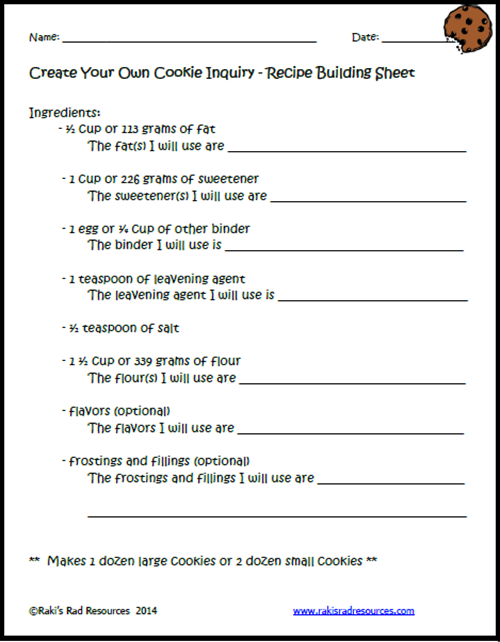
Baking is a huge part of our holiday traditions.  This year we started a new tradition.  My two older sons designed their own cookie recipes.  For the past few weeks, we have done a ton of baking, exploring different cookie and candy recipes.  During this “inquiry” my sons realized that most cookie recipes include the same ingredients and asked me if they could design their own cookies with these base ingredients.  So of course, me being me, I went and designed a “planning sheet” to help make the project a bit more manageable.  (Even with just 2 or 3 kids projects like that can drive me crazy if I approach them with out a plan.)  I’ve made this plan for creating your own cookie recipes available to others in my Teachers Pay Teachers store.

First, we talked about those things all cookies have – fats, sugars, flours, binders and flavors.  Then the kids planned out their recipes. 

   Create your own cookie recipe - science inquiry project from Raki's Rad Resources

 Create your own cookie recipe - science inquiry project from Raki's Rad Resources

Then, the kids went ahead and prepared and baked their cookies.

Create your own cookie recipe - science inquiry project from Raki's Rad Resources


Create your own cookie recipe - science inquiry project from Raki's Rad Resources

Create your own cookie recipe - science inquiry project from Raki's Rad Resources

Create your own cookie recipe - science inquiry project from Raki's Rad Resources

And of course their favorite part was taste testing the results!

Create your own cookie recipe - science inquiry project from Raki's Rad Resources.

This project helped us talk about chemical changes, heat and ingredients.  It was also fun and gave the kids a chance to be really creative in a new way.  It would be a great activity for homeschoolers, in a classroom or even with your kids over the holiday break.  In the spirit of the holidays, I am offering the Create Your Own Cookie Science Inquiry project up for FREE for the next week.  Download your copy between now and December 31, 2014.  Once the calendar changes to 2015, the price on this project will be $5.00.  Merry Christmas!

Heidi Raki of Raki's Rad Resources

Thursday, August 28, 2014

Top 10 Science Websites for the Elementary Classroom

For two years, I was the Technology Specialist at a school in Georgia. During that time, I amassed a large collection of websites that I use with my students. You can download my E-Book of Websites for the Elementary Classroom for free from Teachers Pay Teachers or Smashwords, or, you can check back here each week for the website suggestion.


Top 10 Science Websites for Elementary Students


Top 10 Science Websites for Kids - Great online resources to get kids engaged in learning science.  Suggestions made by Heidi Raki of Raki's Rad Resources

For the past two months, I have been busy re-working my Internet Scavenger Hunts.  This included checking each and every link to make sure that the links were working, current, and appropriate for the grade level of the Internet Scavenger Hunts, and fixing the ones that weren’t.  In the process, I discovered a bunch of new great sites, and “remembered” a bunch of old, bug good sites.  Each of my Internet Scavenger Hunts is designed to meet Science or Social Studies standards, so I decided to put together a list of the Top 10 Science websites.  (Next week, I will post a list of the Top 10 Social Studies websites.)  My internet scavenger hunts vary greatly in topic from Life Cycles to Rocks and Fossils to Light & Sound, so there should be a little bit on this list for everyone.

Nasa Education – If you are teaching astronomy or any type of engineering, Nasa is the place to go.  Their amazing education website has ready made lesson plans, articles geared specifically for kids, videos about astronauts and the space station and even a Kids Club area with games on different topics like building a jet and naming the planets.


1.)  Nasa Education – If you are teaching astronomy or any type of engineering, Nasa is the place to go.  Their amazing education website has ready made lesson plans, articles geared specifically for kids, videos about astronauts and the space station and even a Kids Club area with games on different topics like building a jet and naming the planets.


BBC Bitsize Science Games & Simulations – BBC has great educational games for every subject, but the sciences ones are really tops.  They have a variety of topics from Microorganisms to States of Matter to Friction.  For each topic, there is a chance for kids to read and to play and the play section offers very engaging, interactive activities.  I have yet to find a game on this site that I didn’t love.


2.)  BBC Bitsize Science Games & Simulations – BBC has great educational games for every subject, but the sciences ones are really tops.  They have a variety of topics from Microorganisms to States of Matter to Friction.  For each topic, there is a chance for kids to read and to play and the play section offers very engaging, interactive activities.  I have yet to find a game on this site that I didn’t love.


Top 10 Science Websites for Kids - Great online resources to get kids engaged in learning science.  Suggestions made by Heidi Raki of Raki's Rad Resources


3.)  Nature Works – This site is based around 16 different videos about different topics dealing with the natural world, including: Adaptation, Migration and Habitat.  In addition to the videos – which stream off of a connected PBS site – there are pages for students to read on the same topics and information about 208 different animals!  For teachers, there are lesson plans designed specifically around the various episodes, including key vocabulary and hands on activities.

Physics 4 Kids, Biology 4 Kids, Chemistry 4 Kids, Geography 4 Kids, Cosmos 4 Kids Although this is technically 5 different websites, they are all interconnected and have the same types of great, student friendly articles with information about key topics in science.  The only difference between the sites is the topics available.  When assigning research on any area of science, these are the first websites I turn to.


4.) Physics 4 Kids, Biology 4 Kids, Chemistry 4 Kids, Geography 4 Kids, Cosmos 4 Kids Although this is technically 5 different websites, they are all interconnected and have the same types of great, student friendly articles with information about key topics in science.  The only difference between the sites is the topics available.  When assigning research on any area of science, these are the first websites I turn to.

Science Kids – Based out of New Zealand, this science site has 30 possible science topics.  For each topic, there are games, videos, images, experiments and activities, fact sheets, quizzes and lesson plans.  This is really a one stop shop site for most science units.


5.) Science Kids – Based out of New Zealand, this science site has 30 possible science topics.  For each topic, there are games, videos, images, experiments and activities, fact sheets, quizzes and lesson plans.  This is really a one stop shop site for most science units.

Kids’ Science Experiments – In addition to tons of science experiments, each with materials needed and instructions, there are science fact sheets and a great science glossary to help build children’s science vocabulary.


6.) Kids’ Science Experiments – In addition to tons of science experiments, each with materials needed and instructions, there are science fact sheets and a great science glossary to help build children’s science vocabulary.

Kids’ Astronomy.com – Great graphics, fabulous information and more are available at this site, all about Astronomy and all geared for student research and learning.  In addition, there are games and songs, and even entire Astronomy Class with reading and assignments.  By the end of the class, students can print their own completion certification.


7.)  Kids’ Astronomy.com – Great graphics, fabulous information and more are available at this site, all about Astronomy and all geared for student research and learning.  In addition, there are games and songs, and even entire Astronomy Class with reading and assignments.  By the end of the class, students can print their own completion certification.

National Geographic – Where better to start a science study than at National Geographic?  Their kids site is amazing, full of games, videos and facts about different animals and habitats.  My kids’ favorite section is the Weird, but True! which contains amazing facts that sound like they could never be true, but of course they are.  On the site, kids have a chance to “heart” their favorite fun facts and there is always a “trending” number at the top so they can see which facts other kids like.  These facts are a great jumping off point to trigger student interests and begin genius projects.


8.)  National Geographic – Where better to start a science study than at National Geographic?  Their kids site is amazing, full of games, videos and facts about different animals and habitats.  My kids’ favorite section is the Weird, but True! which contains amazing facts that sound like they could never be true, but of course they are.  On the site, kids have a chance to “heart” their favorite fun facts and there is always a “trending” number at the top so they can see which facts other kids like.  These facts are a great jumping off point to trigger student interests and begin genius projects. 

Ducksters – Science Information – This site has great information and diagrams on a very wide range of science topics.  Topics range from Cell Division to Electricity to Black Holes.  The reading level is slightly higher than many kids’ sites but is still very doable for 4th grade and up.


9.)  Ducksters – Science Information – This site has great information and diagrams on a very wide range of science topics.  Topics range from Cell Division to Electricity to Black Holes.  The reading level is slightly higher than many kids’ sites but is still very doable for 4th grade and up.

Shephards Software – Science Games – This site has great educational games overall, but the science ones are fabulous.  There are tutorials, interactive games and quizzes on topics like Cells, Life Cycles and the Digestion System.


10.)  Shephards Software – Science Games – This site has great educational games overall, but the science ones are fabulous.  There are tutorials, interactive games and quizzes on topics like Cells, Life Cycles and the Digestion System.


For more resources to integrate technology into your classroom, check out my Technology Integration Kit.  You can also check out these blog posts:

Top 10 Reading Websites
Top 10 Writing Websites
Top 10 Math Websites
Top 10 Social Studies Websites
Websites to Teach Typing Skills
Websites to Create Videos

Heidi Raki of Raki's Rad Resources

Sunday, August 17, 2014

Get in Touch with History by Walking Around It

During the summer, most teachers I know spend at least some time planning for the next school year.  My favorite “planning” to do during the summer is field trip planning, because it means I get to tour cool places I’d like to take my students to – often with my own kids in tow.  Here are some of my favorite field trip locations, that can be found in most every community, as well as a list of content connections you can make for your students.  Often as teachers we only include field trips in our science and social studies, but there are lots of reading, writing and math connections that can be made in these locations as well.  I am going to share one type of field trip a week and ideas for making curriculum connections with each field trip.

field trips

Historical Sites: Battlefields, lighthouses, colonial homes, ancient ruins, anything of historical importance can be of great insight to students.  Seeing how things once were helps them to better understand how things once were.  My best historical site field trip had to be the Ancient Roman Ruins at Chellah, which you can read about this old blog post.

Reading: Historical fiction stories come to life when you are able to visit the places where these stories take place.  Newspaper articles – new and old – make for great reading in connection to historical sites, as do “first person accounts” of what went on in these places.  This is a great time to talk about the difference between primary and secondary sources, as well as in comparison with historical fiction based off of these events.

clip_image001Writing:  Once students have experienced the historical site, they can have a chance to write from the point of view of a person who lived or worked at this site.  Students may also write informational – newspaper articles – about the current site, OR about the site as it existed during it’s most important time period.  Taking time to write a descriptive essay that makes someone else feel as if they experienced the same field trip is also a great writing activity for historical field trips.

Math:  Using timelines is a great way to teach elapsed time.  Create a timeline of important events that happened at this location.  Have students create their own word problems based off of this timeline.  For example:  How long was it from when the castle was built until when King X moved in?

Science:  Students can explore the questions:  What materials were used to build this site?  How have they lasted as long as they have?  What types of preservation has been done? Were any archeological techniques used?

Social Studies:  Exploring the history of the area is huge, but students could also explore the time periods when this building was in its peak, the geographical and political elements that led to its creation, the elements that led to the downfall or closing of the site.  Creating a map or timeline of the site could also be beneficial.

To make field trips more educational, I often use graphic organizers and other activities to keep my students focused.  Read more about the specifics in this blog post: Field Trips Aren’t Just For Fun.  Be sure to stop by next week for another Field Trip Curriculum Connection.

What is your best field trip idea?

Heidi Raki of Raki's Rad Resources

Sunday, August 10, 2014

The Lawmakers Are In – Time for a Field Trip!

During the summer, most teachers I know spend at least some time planning for the next school year.  My favorite “planning” to do during the summer is field trip planning, because it means I get to tour cool places I’d like to take my students to – often with my own kids in tow.  Here are some of my favorite field trip locations, that can be found in most every community, as well as a list of content connections you can make for your students.  Often as teachers we only include field trips in our science and social studies, but there are lots of reading, writing and math connections that can be made in these locations as well.  I am going to share one type of field trip a week and ideas for making curriculum connections with each field trip.

 Make the most of your next field trip with these curriculum connections from Raki's Rad Resources

Government Buildings  Seeing how government works first hand can be extremely powerful and enlightening for children.  Most city halls and court houses will allow tours, and some might even arrange for children to speak with lawmakers.  Providing students with access to how and where laws are made gives them a sense of empowerment and may be the building of future political leaders.

Reading:  Dr. Seuss has a collection of stories that talk about government – without talking about government: Yertle the Turtle and If I Ran the Zoo are both great for beginning the discussion about government.  Most states these days of their own websites; let students explore the websites, reading for information about what goes on

Make the most of your next field trip with these curriculum connections from Raki's Rad Resources.Writing:  Create a list of questions you would ask if you were going to interview a lawmaker – if you get a chance to speak with one, be sure to ask some of the questions!  If you don’t get a chance to speak with one, do internet research to see if you can come up with the answers and create a “mock interview” with the information you find.  Write an informational essay about the history of the building you go to.  Make a list of information you would like to see added to the government building’s website.

Math:  Look for 2-dimensional and 3-dimensional shapes in the architecture of the building: arcs are semi-circles, domes are half a sphere, columns are tall cylinders.  How long has this building been around?  Create a timeline to explore the elapsed time history of the building.

Science:  While walking around the building, think about these questions:  What type of architecture or engineering went into the design of the building?  What materials were used?  Where did the materials come from?  What repairs need to be done, now or in the future?

Social Studies:  What type of government work goes on in the building?  Explore the connection between this government building, and other government buildings at different levels (ie. the county courthouse vs. the Supreme Courthouse).  If the chance is given, talk to a lawmaker about their job and the laws they have worked with.  Find out where the money comes from to fund this building and the people who work inside it.  Discover the history behind the building.

To make field trips more educational, I often use graphic organizers and other activities to keep my students focused.  Read more about the specifics in this blog post: Field Trips Aren’t Just For Fun.  Be sure to stop by next week for another Field Trip Curriculum Connection.

What is your best field trip idea?

Heidi Raki of Raki's Rad Resources

Monday, August 4, 2014

Beaches and Mountains – What Landforms Do You Live Near?

During the summer, most teachers I know spend at least some time planning for the next school year.  My favorite “planning” to do during the summer is field trip planning, because it means I get to tour cool places I’d like to take my students to – often with my own kids in tow.  Here are some of my favorite field trip locations, that can be found in most every community, as well as a list of content connections you can make for your students.  Often as teachers we only include field trips in our science and social studies, but there are lots of reading, writing and math connections that can be made in these locations as well.  I am going to share one type of field trip a week and ideas for making curriculum connections with each field trip.
  Get the most out of your next field trip with these curriculum connections from Raki's Rad Resources
Natural Landforms: beaches, mountains, lakes, rivers, etc.  Natural formations of the earth give us so much to talk about.  Being there and experiencing these places provides students with more than just a photo opportunity.  Landforms may differ depending on your location.  I have done beach field trips, mountain field trips and desert field trips – all helped my students expand their knowledge base and make curriculum connections like these.
Reading:  Non fiction reading about the creation, use or history of landforms in your area.  Fiction stories about a trip to the beach or climbing a mountain.  Read newspaper articles that talk about current events involving the landform – beach cleanups or wildlife protection acts.
Get the most out of your next field trip with these curriculum connections from Raki's Rad Resources.Writing:  Write the creation story of a landform, from the point of view of a rock sitting near by.  Create a pamphlet convincing people to come and visit this landform.  Write a descriptive essay that would make someone feel as though they were sitting right on or near this landform – be sure to take notes while you are there to help you remember how you felt.
Math:  Count, or estimate:  How many steps to the top of the mountain?  How many tide pools on the beach?  How many fish in the river? How many grains of sand in a bucket?
Science:  Science connections may vary depending on the type of landform, but for all different landforms, you can learn about how it was created, what animals or plants have adapted to live there, how the weather, or other natural forces like tides, affects the landform etc.
Social Studies:  Landforms tend to be a big part of local history.  Was this landform a help or a hindrance to historical populations?  Are there any historical events which happened here?  Are there any laws protecting this landform?  Does this landform attract tourist revenue?
To make field trips more educational, I often use graphic organizers and other activities to keep my students focused.  Read more about the specifics in this blog post: Field Trips Aren’t Just For Fun.  Be sure to stop by next week for another Field Trip Curriculum Connection.
What is your best field trip idea?
Heidi Raki of Raki's Rad Resources


Sunday, July 27, 2014

Stop and Look at the Flowers – Oh and Learn Along the Way

During the summer, most teachers I know spend at least some time planning for the next school year.  My favorite “planning” to do during the summer is field trip planning, because it means I get to tour cool places I’d like to take my students to – often with my own kids in tow.  Here are some of my favorite field trip locations, that can be found in most every community, as well as a list of content connections you can make for your students.  Often as teachers we only include field trips in our science and social studies, but there are lots of reading, writing and math connections that can be made in these locations as well.  I am going to share one type of field trip a week and ideas for making curriculum connections with each field trip.

Make the most out of your next field trip to the botanical gardents with these curriculum connections from Raki's Rad Resources.

Botanical Gardens:  Plants from all different habitats available in one place.  A chance to look at many parts of the life cycles.  Botanical Gardens provide so many different learning possibilities.

Reading:  There are great books out there about plants, including Diary of a Sunflower, the Great Kapok Tree and From Seed to Plant.  Reading the signs and placards at the botanical gardens is a highly overlooked skill – many kids walk right by without gaining that bit of extra information that they can get by looking at the posted signs.

Make the most out of your next field trip to the botanical gardents with these curriculum connections from Raki's Rad Resources.Writing:  Write the life story of one of the plants – from the point of view of the plant.  Look at the scientific names for the plants – see what root words you can find in these names.  Write a letter to the editor about why we should (or shouldn’t) give more money to the Botanical Gardens.

Math:  Create a tally chart to track which types of plants you see – trees, flowers, shrubs, cactus etc.  Measure the height of different plants. 

Science:  Explore the life cycle of a plant.  Note down ways plants are specially adapted to their natural habitat.  Keep track of which plants flower and which plants don’t.  Learn about how plants help out humans.  Choose one plant you see and research further information about it.  Group related plants together and explain how they are similar and how they are different.

Social Studies:  Explore how people have used plants for their benefit – for food, for medicine, for decoration etc.  Explore laws protecting certain types of plants.  Bring world maps and have students label where each type of plant comes from.

To make field trips more educational, I often use graphic organizers and other activities to keep my students focused.  Read more about the specifics in this blog post: Field Trips Aren’t Just For Fun.  Be sure to stop by next week for another Field Trip Curriculum Connection.

What is your best field trip idea?

Heidi Raki of Raki's Rad Resources

Sunday, July 20, 2014

Exploring Nature Field Trip

During the summer, most teachers I know spend at least some time planning for the next school year.  My favorite “planning” to do during the summer is field trip planning, because it means I get to tour cool places I’d like to take my students to – often with my own kids in tow.  Here are some of my favorite field trip locations, that can be found in most every community, as well as a list of content connections you can make for your students.  Often as teachers we only include field trips in our science and social studies, but there are lots of reading, writing and math connections that can be made in these locations as well.  I am going to share one type of field trip a week and ideas for making curriculum connections with each field trip.

field trips - make the most of them with these curriculum connections from Raki's Rad Resources

 Nature Preserve:  Seeing natural animals in their natural habitat – outside of cages – can be highly beneficial for students.  Knowing how animals are helped to stay in their natural habitat can also be completely beneficial.  Plus, there are so many benefits from simple nature hikes.  Find a blog post I wrote about nature hikes here.    

Reading:  Any number of books about animals can be read before and after going to a nature preserve.  Non fiction books about the types of animals you will see.  Fiction stories about animals, like Winnie the Pooh, the Berenstain Bears or Make Way for Ducklings – Talk about the difference between fictional animals and real animals. Read news articles and opinion pieces about nature preserves vs. zoos.

field trips - make the most of them with these curriculum connections from Raki's Rad Resources - trip to a nature preserveWriting:  Write informational essays about the natural habitat of one of the plants or animals that can be found in the nature preserve.  Persuasive writing – which is better nature preserves or zoos?  Write a fiction story from the point of view of one of the animals.

Math:  Measure how wide the trees are; learn about tree rings and calculate the age of a tree stump.  Create a graph of the animals living at the preserve, or of a statistic (like survival rate or release rate).

Science:   Learn about animal habitats, animal life cycles and animal adaptations.  Learn about plant habitats, plant life cycles and plant adaptations.  Discover how to protect the earth.  Explore the interconnectivity of plants, animals and humans.  Look at leaves and try to identify the different types of trees.  Look for “proof” of animal activity – footprints, feathers, droppings.

Social Studies:  Learn about how native people used nature to live.  Research people like Theodore Roosevelt and John Muir, who worked to set aside national parks to preserve nature, and complete a biography projects with the information.  Explore the laws and current trends that affect ecology.  Discuss what happens when gold or oil is found in a place that is protected by law.


To make field trips more educational, I often use graphic organizers and other activities to keep my students focused.  Read more about the specifics in this blog post: Field Trips Aren’t Just For Fun.  Be sure to stop by next week for another Field Trip Curriculum Connection.

What is your best field trip idea?

Heidi Raki of Raki's Rad Resources